

System to Revive Old or Dead Leads Through Better Follow-Up
A quiet lead isn’t always a lost lead. A system to revive old or dead leads uses buyer history, relevant follow-ups and clear prioritisation to reopen conversations when the timing is right. The aim is to give people a useful reason to respond, not send everyone the same generic email.
It’s frustrating to see past enquiries sit untouched while your team chases new ones. But a lead going quiet doesn’t always mean they’ve lost interest. Their priorities may have changed, the timing may have been wrong, or the conversation may simply have slipped off their radar.
This guide explains how dead lead revival works, how to write re-engagement emails that reflect a buyer’s context, and how to prioritise leads based on previous interactions. You’ll also learn what a professional setup involves and how to assess whether a campaign is bringing worthwhile conversations back. The goal is a practical follow-up process that gives promising leads another chance without adding manual work.
Key Takeaways
- Revival works best when sales follow-up is assigned clearly, with ownership based on each lead’s history and current fit.
- Re-engagement emails are more relevant when they refer to the buyer’s earlier needs and offer a clear next step.
- Prioritise dormant leads by their stage, past activity and likely timing, then nurture them with follow-ups that suit their context.
- Reconstruct the original buyer context from CRM records and past interactions so outreach feels informed, not generic.
- Track responses, re-engagements and revived opportunities to see where the campaign is working and what needs adjusting.
1. What Is Dead Lead Revival?
A system to revive old or dead leads reconnects with prospects who stopped responding or paused their buying process. It uses CRM history, well-timed follow-ups and clear sales ownership. A dormant lead might have requested a quote, attended a demonstration or downloaded a guide. The opportunity isn’t automatically lost.
For example, a prospect who received a proposal may have delayed the project, not rejected it. A useful revival message refers to that proposal and asks whether priorities have changed. B2B buyers spend 17% of their buying journey meeting potential suppliers, so a quiet period can sit within a longer decision process.
Age alone doesn’t determine whether a lead is worth reviving. The original enquiry, sales stage, contact details and previous response all matter. B2B contact data decays by 25-30% annually, so a professional campaign checks records before outreach. A business with 500+ leads aged 6-24 months may have enough dormant contacts to justify a structured programme.
The cost of a professionally set up system depends on factors such as CRM integration, campaign workflows and reporting needs. A setup that connects multiple systems and automates follow-up involves a different scope from a simple, single-segment campaign. The right approach depends on what your sales process needs.
A re-engagement campaign needs software that can use CRM records, segment leads, schedule follow-ups and track responses. It should also help identify invalid addresses, record opt-outs and prevent further messages to suppressed contacts. These controls support responsible campaign management and protect sender reputation.
Choose CRM and automation tools that fit your existing sales process. Check whether the system preserves lead history, assigns ownership and routes replies to the right salesperson. For an Australian business, make sure the setup supports your records and campaign workflow.
To reduce campaign risk, clean and segment the contact list before sending. Remove invalid addresses, suppress opt-outs and start with a relevant, focused audience. Then monitor replies, delivery problems and complaints, and adjust the campaign if those signals worsen.
Make sales ownership explicit. A revival workflow can assign each segment to a salesperson, create a follow-up task and record the next action in the CRM. For example, the salesperson who handled a proposal can receive a revived reply with the original notes attached.
That handover keeps warm responses from sitting in a shared inbox. The team can also route unfamiliar replies to a named owner. Clear assignment, context and tracking turn old records into manageable sales conversations.
How professionals write emails for re-engaging old leads
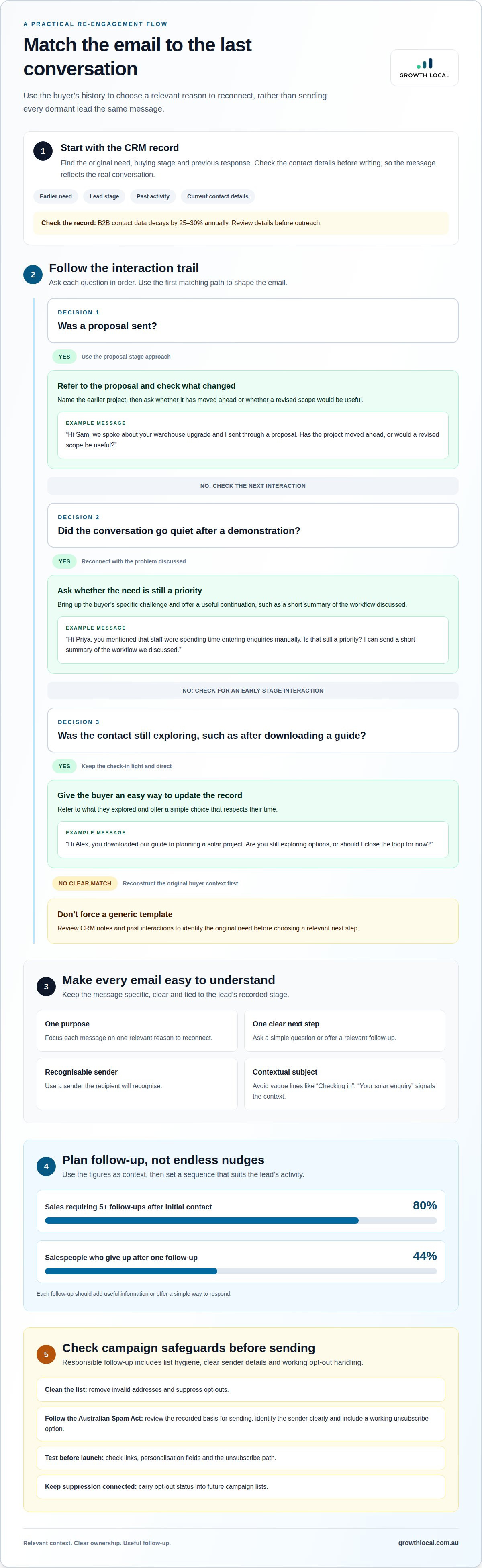
A useful re-engagement email makes the earlier conversation clear. Review the CRM record, identify the original need and choose one relevant next step. A message about an earlier quote should differ from one sent after a guide download. That distinction helps the email feel like a continuation, not a bulk blast.
For a proposal-stage lead, you might write: “Hi Sam, we spoke about your warehouse upgrade and I sent through a proposal. Has the project moved ahead, or would a revised scope be useful?” The message names the topic, invites an honest update and offers a simple response. It doesn’t assume the buyer is ready.
For a lead who went quiet after a demonstration, reconnect with the problem discussed: “Hi Priya, you mentioned that staff were spending time entering enquiries manually. Is that still a priority? I can send a short summary of the workflow we discussed.” This gives the recipient a clear reason to reply.
Early-stage contacts need a lighter touch. You could write: “Hi Alex, you downloaded our guide to planning a solar project. Are you still exploring options, or should I close the loop for now?” That direct choice respects the buyer’s time and helps the sales team update the CRM accurately.
Give each message one purpose, one clear call to action and a sender the recipient will recognise. Avoid vague subject lines such as “Checking in”. A subject like “Your solar enquiry” signals the context. Tailor the message to the lead’s recorded stage instead of putting every contact into the same script.
Follow-up needs a plan, not endless nudges. The campaign data says 80% of sales require 5+ follow-ups after initial contact, while 44% of salespeople give up after one follow-up. Professionals use those figures as context, then set a sequence suited to the lead’s activity. Each touch adds useful information or offers a simple way to respond.
For Australian Spam Act compliance, review the recorded basis for sending, identify the sender clearly and include a working unsubscribe option. Suppress contacts who opt out and keep that status connected to future campaign lists. These checks apply to marketing email and SMS workflows, not just the first message.
Before launch, the professional tests links, personalisation fields and the unsubscribe path. A broken first name or an old offer can undo otherwise relevant copy. If your follow-up relies on scattered templates and manual reminders, explore a managed email follow-up workflow to bring the process together.
How professionals prioritise and nurture old leads
A dormant lead list needs more than one follow-up queue. Rank contacts by buying stage, previous activity, recorded needs and likely timing. A proposal-stage prospect who asked about delivery dates needs different treatment from someone who downloaded a general guide. This helps the sales team focus on contacts with a relevant reason to reconnect.
Timing should reflect the last meaningful interaction. For proposal-stage leads marked closed-lost, the suggested revival wait is 90-120 days after close. For demo-stage leads that went quiet mid-process, use 60-90 days. Early-stage leads who downloaded content but never engaged may suit a 30-60 days wait.
Before an Australian campaign starts, review each record’s contact source, consent history, stated preferences and opt-out status. Suppress people who have opted out and keep that status visible across campaign lists. Reviewing privacy and consent helps prevent inappropriate recontact and keeps campaign records clear.
A managed campaign follows defined steps. First, segment records by stage and reason for dormancy. Then select a relevant message and assign a salesperson. Schedule follow-ups, log responses and stop messages when someone replies or opts out. Record each action in the CRM.
Follow-up frequency depends on the lead’s past engagement and the value of the next message. A proposal contact might receive a concise check-in, followed later by a useful update. Someone who only downloaded a guide may need a lower-pressure resource first. Professionals space messages to avoid repeating the same request without adding context.
Nurture should also respond to new signals. If a dormant lead clicks a nurture email or replies, the page recommends follow-up within 24 hours. A salesperson can then refer to the specific topic that prompted the activity. If there’s no response, the system keeps the record in its segment rather than repeatedly escalating contact.
Prioritisation should favour fit, not simply record age. High-performing sales teams are 1.5 times more likely to prioritise lead quality over quantity. In practice, a professional weighs the original need, previous engagement, current contactability and whether the business can still address the prospect’s problem. A stale record with no usable context may rank below a newer, responsive lead.
For a business with a long sales cycle, dormancy may be normal. Enterprise deals with sales cycles of 6-18 months can include extended quiet periods. The campaign should preserve the account history and return the lead to its original owner when interest resurfaces. That way, nurturing supports the sales process instead of creating a disconnected stream of messages.
Review segment performance and adjust timing or content. If a particular group produces replies, build on that signal in the next message. If contacts opt out or remain inactive, reduce further outreach and protect the quality of future follow-up.
How professionals reconstruct the original buyer context
A revival email falls flat when it ignores the earlier conversation. Rebuild that context before choosing a message or salesperson. Look for the original enquiry, the buyer’s stated need and the last meaningful interaction. A request for a service quote, for example, calls for different wording from a general information download.
Start with the CRM record. Check notes, enquiry details, recorded emails, call outcomes and previous tasks. If a prospect asked about project timing, that detail can guide a relevant check-in. If the notes only say “call back”, avoid presenting assumptions as facts.
Next, create a simple timeline. Put the first enquiry, meetings, proposal updates and final response in order to see where the conversation stopped. A lead who went quiet after receiving a proposal needs different context from someone who never booked a meeting.
Check the original source and campaign, too. Someone who responded to a specific service page may have a different interest from someone referred by an existing customer. Source information helps explain why the contact entered the pipeline, while campaign history shows which message they saw.
Reconcile contact records carefully. Compare the CRM profile with relevant email threads and sales notes, looking for duplicate records, changed job titles and conflicting company details. If two records show separate conversations with the same person, combine the history before assigning follow-up.
Consider a prospect who requested a quote, then paused after discussing timing. The record may show the requested service, expected decision process and reason for delay. Use those details to ask whether the timing has changed, rather than sending a generic “Are you still interested?” message.
Buyer context also includes who was involved. The CRM may list an initial contact, while later notes name a manager or finance approver. Identify each person’s role and keep the conversation linked to the right account. This prevents a message from treating one contact as the sole decision-maker.
Before outreach, give the assigned salesperson a concise context summary. Capture the original need, last recorded action, known obstacle and proposed next step. For example: “Requested a quote; timing was the concern; ask whether the project is active.” This gives the salesperson a useful starting point without overloading them.
Separate recorded facts from uncertain details. Use confirmed notes in the message and leave unclear points out. After a reply, update the CRM with current needs, timing and next actions. That refreshed record supports future follow-up and avoids rebuilding the same history later.
How professionals measure revival campaign results and benchmarks
A revival campaign needs more than an email open count. Professionals track responses, re-engagements and opportunities to see whether dormant contacts are moving towards sales. One benchmark puts the response rate for well-segmented campaigns at 5-15%. Treat it as a comparison point, not a promise for every audience.
Response rate and re-engagement rate measure different things. Response rate captures people who reply to campaign messages. Re-engagement rate tracks contacts who show renewed interest across the dead lead pool. The benchmark re-engagement rate is 2-5% of the total dead lead pool, so the denominator matters when comparing campaigns.
Next, measure how many re-engaged leads become opportunities. The benchmark revival-to-opportunity rate is 30-50%. A professional checks how the business defines an opportunity, then applies that same definition across each segment. Otherwise, a change in sales-stage labels can make results look stronger or weaker than they are.
Speed matters after renewed interest. Interested leads typically respond within 3-7 days, according to the benchmark. Professionals track the time between a lead’s response and the sales team’s next action. This highlights delays that can stall a revived conversation, even when campaign messaging earns a reply.
Track outcomes by source segment, message and previous sales stage. For example, compare proposal-stage leads with contacts who only downloaded a guide. If one group generates replies but few opportunities, the campaign may be reaching people without a strong current fit. Segment-level reporting helps pinpoint the gap.
SiriusDecisions found that 25% of leads marked dead can be revived within 12 months with proper lead nurturing. Professionals can use this finding to set a longer measurement window, especially for sales cycles that don’t move quickly. They should report both early engagement and later opportunity creation, rather than judging solely on immediate replies.
Cost per revived lead is another useful measure. The benchmark is 30-50% of new lead acquisition cost. Compare like with like, including the campaign’s relevant operating costs and the same definition of a qualified lead. This helps assess whether reactivation is contributing efficiently, without mistaking cheap responses for valuable sales outcomes.
Before launch, agree on metric definitions and reporting periods. The CRM should record campaign source, reply status, opportunity stage and any resulting sale. A consistent dashboard shows where follow-up works, which segments need adjustment and whether revived leads progress beyond initial interest.
Growth Local: Lead Generation System Setup
Growth Local can help when old enquiries sit in your CRM without clear ownership or follow-up. Its Lead Generation System Setup and CRM Setup support a more organised process for recording lead history, assigning next actions and tracking responses. Marketing System Setup can connect campaign activity with follow-up, so revived enquiries don’t disappear into disconnected records.
This is a practical next step if your team relies on scattered notes, manual reminders or inconsistent lead records. A clearer setup makes it easier to see who needs follow-up and what happened next, while your sales team focuses on relevant conversations.
Contact Growth Local to discuss your lead follow-up needs.
Build lead revival into your sales process
A system to revive old or dead leads works best as part of your wider sales operation, not as a one-off database clean-up. Give it a clear role alongside new enquiries, so revived conversations have a path forward and don’t vanish when attention shifts elsewhere.
Start by deciding what your team needs the process to do. You might want to clarify follow-up ownership, give salespeople better context or connect campaign activity with your CRM. A professional setup can turn those priorities into a consistent workflow that fits how your business handles enquiries.
Start with the bottleneck causing the most friction. A focused conversation about your current records, follow-up process and sales goals can shape a practical approach without adding another disconnected task to your team’s workload.
With a clear process in place, dormant opportunities can become a more considered part of your growth plans.
Frequently Asked Questions
What Is Dead Lead Revival?
Dead lead revival means reopening contact with a prospect whose earlier sales conversation has stalled. The useful distinction is why it stalled: a project may have been postponed, a budget may have changed, or the prospect may have chosen another option. Use the sales record to decide whether renewed contact has a relevant purpose, rather than treating every inactive record as equally promising.
What is a lead reactivation system?
A lead reactivation system combines CRM records, campaign rules and follow-up tasks to reconnect with inactive prospects. For example, a system to revive old or dead leads can flag a record after a sales stage changes, then prompt an assigned salesperson to review its history. The value is a consistent process: every contact has a reason for outreach, an owner and a recorded outcome.
How does a lead revival system work?
A professional starts by selecting a group of inactive records with a shared reason for follow-up, such as paused projects. The system then links each contact to relevant history and a suitable message. A reply can create a salesperson task and update the record, while an opt-out stops further campaign messages. For example, a renewed enquiry can return to an active sales pipeline instead of remaining in an old campaign list.
What email and SMS templates can a professional use to re-engage old leads?
Adapt each template to the original conversation. Email example: “Subject: Still planning your website redesign? Hi Sarah, we spoke about your digital marketing needs. Has your plan changed, or would an updated overview help?” SMS example: “Hi Sarah, it’s Growth Local. You asked about SEO services earlier. Is that still relevant? Reply STOP to opt out.” Send marketing messages only when the contact record supports outreach, and make the opt-out process clear.
How can a professional measure lead reactivation campaign results and ROI?
A professional connects campaign records to sales outcomes, then compares revenue attributed to revived leads against campaign costs. One basic ROI calculation is: (attributed revenue minus campaign costs) divided by campaign costs. They should define attribution consistently, such as counting a sale only when the CRM links it to the revival campaign. Comparing results across audience groups can reveal which past lead types produce valuable sales, not just replies.
Best CRM and automation tools for reviving old leads in Australia
Choose CRM and automation tools that fit your sales process, preserve lead history, assign ownership, route replies to the right salesperson, schedule follow-ups and track responses.


