
Solar Sales Pipeline Automation: The 2026 Guide to Closing More Deals
In 2026, a solar lead is worth far too much to let it die in an unread email or a messy spreadsheet. If you're still relying on manual follow-ups, you aren't just working hard; you're actively handing your competitors the keys to the kingdom. Implementing solar sales pipeline automation is no longer a luxury for the big players. It's the only way to keep pace with an Australian market where a record 1GW of new capacity is being added every single quarter.
We know the drill. You're likely flat out managing installers and chasing STC rebates while your phone won't stop ringing. It's incredibly frustrating to watch a $10,000 job vanish because a competitor got their quote out ten minutes faster while you were stuck doing manual data entry. You deserve a business that works as hard as you do, without the constant fear of leads falling through the cracks and costing you thousands in lost revenue.
This guide will show you how to build a "set and forget" system that captures, nurtures, and closes leads without needing extra staff. You'll discover how to automate your entire process from the first enquiry to the final installation. We're going to look at streamlining your workflow, cutting down response times, and boosting your conversion rates so you can focus on scaling your operations.
Key Takeaways
- Understand why "Speed to Lead" is the make-or-break factor for your win rate and how responding within five minutes secures the job before your competitors wake up.
- Discover how an AI Receptionist captures every enquiry around the clock, so you never lose a $10,000 lead while you're busy on a roof or between sites.
- Learn how to use solar sales pipeline automation to build a "set and forget" system that nurtures prospects from their initial enquiry right through to installation.
- Get a clear, step-by-step framework for auditing your current lead sources and mapping a seamless sales journey that cuts out hours of tedious manual admin.
- Compare the massive ROI of automated triggers against manual follow-ups to see how you can boost your conversion rates without the need for extra staff.
Why Your Solar Sales Pipeline is Leaking Profit
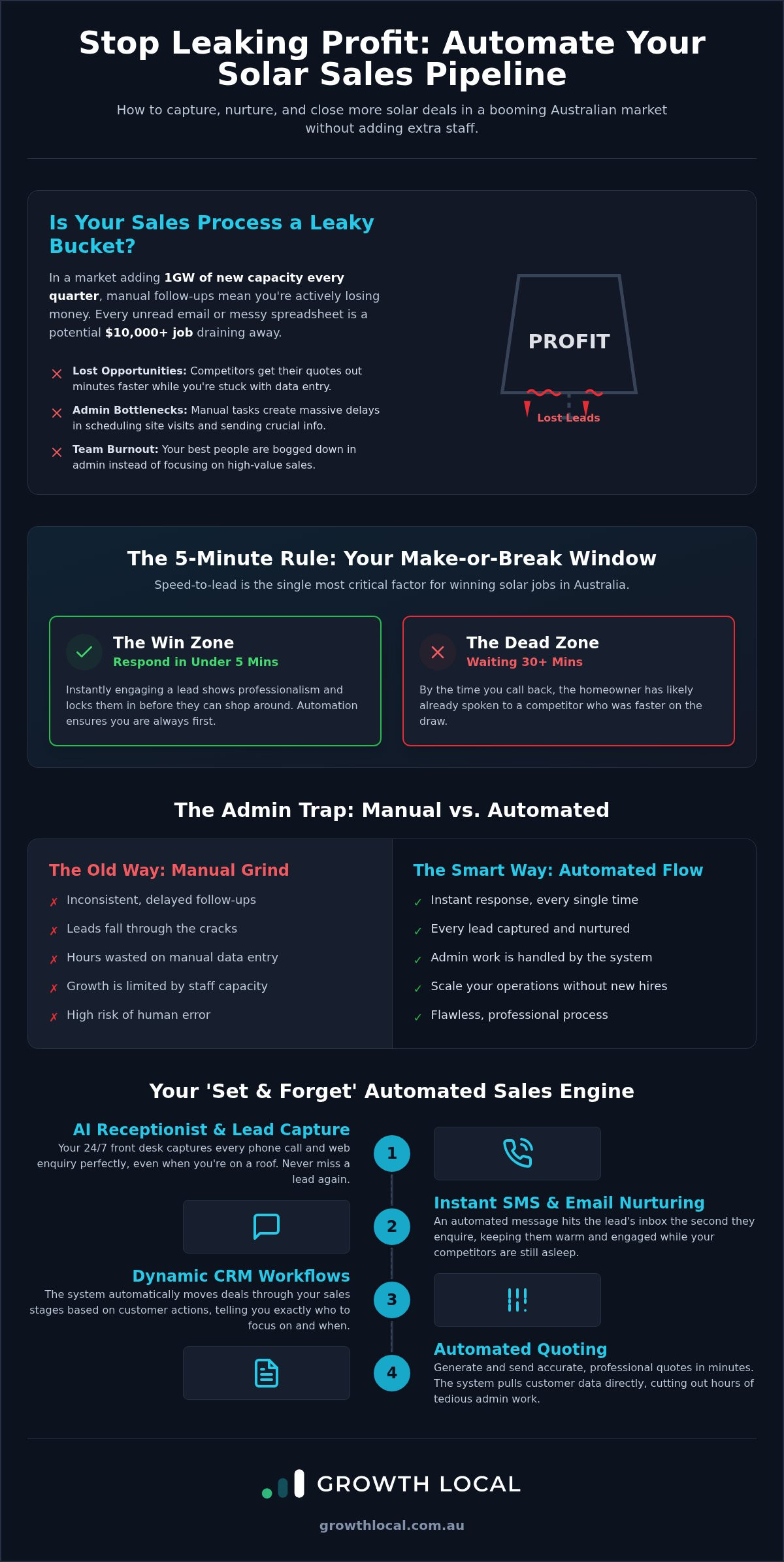
Most Australian solar businesses are operating with a "leaky bucket" regarding their enquiries. You might be spending thousands on lead generation, but if those prospects aren't handled with surgical precision, your profit is literally draining away. Think of solar sales pipeline automation as the digital engine of your business. It is the system that moves a prospect from "just looking" to a "signed contract" without requiring you to manually push every single button along the way.
This systematic approach is often referred to as sales process engineering, and it is the backbone of any scalable solar operation in 2026. Without it, you are relying on luck and memory; these are two things that don't scale. When you automate the pipeline, you ensure that every lead is captured, qualified, and nurtured by a tireless system that never forgets to follow up or gets distracted by a phone call on another line.
The 5-Minute Rule in Australian Solar
The pace of the Australian market has shifted. With record installations reaching 1GW of new capacity per quarter, consumers are more educated and more impatient than ever. If a homeowner submits an enquiry and you wait 30 minutes to call back, they have likely already spoken to a competitor who was faster on the draw. Speed-to-lead is the most critical metric for solar conversion.
Delayed follow-ups don't just lose you the race; they signal a lack of professionalism. In the mind of the customer, if you're slow to answer a sales enquiry, you'll probably be even slower when it's time to get on the roof or handle an after-sales issue. Automation ensures that an SMS or email hits their inbox the second they click "submit," keeping them engaged while you're still grabbing your car keys.
The Admin Trap: Why Tradies Get Stuck
Being "flat out" is often worn as a badge of honour, but it's usually a sign of a broken process. If you or your team are still re-keying data from a website form into a CRM, you are stuck in an admin trap that kills growth. This manual work creates massive bottlenecks, especially for scheduling site visits or sending out quotes.
The hidden cost of manual follow-ups is staggering. It leads to lost time, missed calls, and eventually, a burnt-out sales team that can't keep up with the volume. Instead of focusing on closing high-value commercial installs or complex residential jobs, your best people are bogged down in the "heavy lifting" of data entry. Moving to a solar sales pipeline automation model replaces the mental load of "remembering to call back" with a reliable system that handles the grunt work for you.
Core Components of Modern Solar Sales Pipeline Automation
Building a high-performance sales engine requires more than just a place to store phone numbers. It requires a series of interconnected tools that work together to eliminate friction. According to the Solar Market Insight Report, the sheer volume of residential and commercial installations is creating a massive administrative burden for businesses that haven't yet modernised. To stay ahead, you need a system that handles lead capture, nurturing, and quoting without you needing to lift a finger.
A robust solar sales pipeline automation framework consists of four main pillars. First, you need automated lead capture that never sleeps. Second, instant SMS nurturing to keep the conversation warm. Third, dynamic CRM workflows that move deals through stages based on customer actions. Finally, automated quoting that pulls technical data directly into your sales documents. When these pieces click together, your business stops being a chaotic scramble and starts feeling like a well-oiled machine.
AI Receptionists: The Front Door of Your Business
If you're on a roof or halfway through a site inspection, you can't answer the phone. Every missed call is a missed opportunity, potentially costing you a five-figure contract. An AI Receptionist acts as your 24/7 front desk; it answers calls, answers basic questions, and captures lead details with perfect accuracy. This isn't a "dumb" chatbot that frustrates people with generic replies. It's an intelligent phone system that understands context and intent.
The real magic happens when this data flows directly into your Solar CRM setup. Instead of scribbling notes on a scrap of paper in the ute, the lead is already created, tagged, and ready for follow-up before you've even climbed down the ladder. This level of integration ensures no lead ever falls through the cracks again.
Automated SMS and Email Nurture Sequences
In Australia, SMS is king. While email open rates continue to slide, a text message gets read almost instantly. Automation allows you to send a "What to expect" guide or a quick "Thanks for reaching out" message the second an enquiry hits your system. This immediate engagement builds massive trust with the homeowner because it shows you're organised and responsive.
The trick is personalising these sequences so they don't feel like a bot wrote them. You can customise your triggers to use friendly, down-to-earth language that sounds like a real Aussie mate checking in. By the time you actually jump on a call, the prospect already feels like they know you. If you're curious about how this looks in practice, you can book a walkthrough of our automation systems to see the tech behind the scenes.
Beyond simple messages, your pipeline should integrate directly with tools like OpenSolar or Pylon. When a deal moves to the "Quote Requested" stage, your system can automatically trigger the creation of a technical design. This removes the bottleneck of manual data entry and ensures your quotes are accurate, professional, and delivered faster than anyone else in your area.
Manual vs. Automated: The ROI of Streamlining Your Process
Most solar companies in Australia think they have a sales problem when they actually have a time problem. When you compare manual follow-up to automated triggers, the difference in efficiency is staggering. A manual process involves calling, chasing, and re-keying data, which is slow, inconsistent, and prone to human error. Conversely, solar sales pipeline automation ensures that every lead is handled with the same level of rigour, every single time, without you needing to be at your desk.
One of the biggest profit killers in the solar industry is the "no-show" for site inspections. You've paid for the lead, spent time on the phone, and driven across town, only to find the homeowner isn't there. Automated reminders via SMS and email significantly reduce these gaps in your calendar. By keeping the prospect engaged and reminding them of the value of the consultation, you protect your most valuable asset: your time. This streamlined approach directly impacts your lead-to-sale conversion rates by ensuring you only spend time on qualified, high-intent prospects.
The Real Cost of a Missed Lead
In 2026, the average cost of a 6.6kW residential solar system ranges from $5,000 to $8,500, while larger 10kW systems can fetch up to $10,500. When you consider these margins, losing even one lead a month to a faster competitor is a massive blow to your bottom line. Automation pays for itself the moment it captures just one extra job that would have otherwise fallen through the cracks. Automation is an investment in your business infrastructure, not just a monthly expense. It transforms your pipeline from a series of "maybe" conversations into a reliable revenue generator.
Scaling Without the Headaches
If your team is currently struggling to manage 20 leads a month, trying to hit 100 will likely break your business. Scaling usually means hiring more office staff, which increases your overheads and management burden. With solar sales pipeline automation, you can handle five times the lead volume with the same headcount. This removes the "hero dependency" on a single sales person who knows the whole process by heart. Instead, the system holds the knowledge, allowing you to scale your solar business with automation while keeping your operations lean and your team focused on closing deals rather than pushing paper.
How to Build Your Automated Solar Pipeline: A Step-by-Step Framework
Building a high-performance system isn't about buying the most expensive software; it's about designing a process that actually fits your workflow. You can't just plug in a CRM and hope for the best. To make solar sales pipeline automation work, you need a logical framework that takes the pressure off your team while keeping the customer experience top-notch. It starts with a clear audit of where your leads are coming from, whether that's Facebook ads, your website, or local referrals.
Once you know your sources, you can follow this five-step framework to get your engine running:
- Step 1: Audit your lead sources. Identify every entry point so you can connect them to your automation engine.
- Step 2: Map your "Ideal Sales Journey." Document every touchpoint from the first click to the final sign-off.
- Step 3: Customise your CRM. Set up your stages in a platform like GoHighLevel or Pipedrive to match your real-world process.
- Step 4: Implement triggers. Set up the AI lead capture and automated follow-ups we discussed earlier.
- Step 5: Monitor your data. Look at your conversion rates and refine the system based on where people are dropping off.
Mapping the Solar Customer Journey
In the solar industry, the gap between an enquiry and an install can be weeks or even months. You need to define clear stages in your pipeline: New Lead, Qualified, Site Visit Booked, Quote Sent, Follow-up, and Closed. Most profit leaks happen at the "Follow-up" stage because sales teams get flat out and forget to chase the quote. Using a CRM setup for solar installers allows you to visualise these drop-off points. When you see a pile-up of leads in the "Quote Sent" stage, you know exactly where to trigger an automated nudge to get the deal moving again.
Setting Up Your First Automations
Don't try to automate everything at once. Start with the "Holy Trinity" of solar automation: the Auto-Reply, the Calendar Link, and the Review Request. The Auto-Reply handles that critical "speed-to-lead" factor. The Calendar Link allows qualified leads to book their own site visits, removing the back-and-forth phone tag. Finally, the Review Request triggers automatically after the install is marked as complete, building your reputation for the next batch of leads.
When writing your automated messages, keep the copy human. Use friendly, down-to-earth language so it feels like a quick note from a mate rather than a corporate broadcast. A common mistake is over-automating to the point where you lose the personal touch. Automation should handle the heavy lifting of admin, but it should always clear the path for a real conversation when it's time to close the deal.
Transform Your Solar Sales with Growth Local
Trying to build your own solar sales pipeline automation system while running a busy install crew is a recipe for a half-finished mess. You are likely flat out managing your team, chasing site inspections, and keeping customers happy. You don't have forty hours to sit in front of a computer trying to figure out API integrations or workflow triggers. A custom setup from Growth Local beats the DIY route every time because we build the digital infrastructure while you focus on the physical installs.
Our approach is built on practical utility rather than flashy gimmicks. We act as your strategic partner, handling the technical heavy lifting so your sales process runs like a well-oiled machine. By combining a professional Solar CRM setup with an intelligent AI Receptionist, we create a system that captures every lead and moves them toward a signed contract without you needing to lift a finger. This isn't just about software; it's about giving you the freedom to lead your business instead of being a slave to your inbox.
Our Result-Oriented Process
We don't just hand you a login and wish you luck. Our process starts by designing a customised lead generation engine that maps perfectly to your specific sales journey. We deploy the system, test every trigger, and ensure your team knows exactly how to use it. Once the system is live, we provide ongoing support to make sure your automation keeps humming as you scale. If you're ready to see how this technical mastery can transform your bottom line, you can contact us at Growth Local to get started.
No-BS Results for Australian Tradies
We aren't interested in vanity metrics like "impressions" or "reach." We care about physical business results: more jobs won, faster install times, and higher profit margins. Working with a partner who understands the Australian solar landscape means you get a system built for local conditions, not some generic template from overseas. We focus on the outcomes that actually matter to a service-based business owner. To see which of our solutions fits your current stage of growth, check out our pricing and packages today.
Take Control of Your Solar Growth
You've seen how a "leaky bucket" pipeline and slow response times can drain your profits. By implementing solar sales pipeline automation, you turn your business into a high-performance engine that works around the clock. This shift allows you to capture every lead and move them toward a signed contract without the constant stress of manual data entry or missed opportunities.
Stop losing $10k in missed calls with an AI Receptionist and leverage a custom CRM setup designed specifically for the Australian solar landscape. Our no-nonsense automation delivers real results by handling the administrative heavy lifting so you can focus on scaling your installs. It's about working smarter, not harder, to secure your spot in an increasingly competitive market.
The tech is ready to do the grunt work for you. It's time to step back from the admin trap and start leading your business toward the growth you deserve.
Frequently Asked Questions
What is solar sales pipeline automation?
Solar sales pipeline automation is the digital framework that manages your prospects from the moment they click an ad until the panels are on their roof. Instead of you manually chasing leads or re-keying data, the system uses pre-set triggers to send SMS follow-ups, update your CRM, and schedule site visits. It ensures that every single lead is nurtured with perfect consistency, which is vital for winning more jobs in the fast-paced Australian market.
Will automation make my solar business feel too impersonal?
Absolutely not. When you customise your automated messages with friendly, down-to-earth language, it feels like a quick check-in from a mate rather than a corporate broadcast. The system handles the repetitive admin tasks, like confirming site visits or sending "what to expect" guides, which actually gives you more time for genuine, one-on-one conversations with your customers. Automation supports your personal touch by ensuring you never forget a follow-up call.
How much time can I actually save with an automated CRM?
Most solar business owners who implement solar sales pipeline automation report saving between 10 and 15 hours of admin work every single week. You stop wasting time on manual data entry from Facebook lead forms and quit the endless "phone tag" game with prospects. By automating the grunt work, you and your sales team can handle a much higher volume of enquiries without needing to hire extra office staff to manage the paperwork.
Do I need to be a tech expert to use these systems?
You don't need to be a tech whizz to see the benefits of these systems. While the backend of a professional solar sales pipeline automation setup can be complex, the frontend is designed to be simple and intuitive for you and your team. Strategic partners like Growth Local handle the heavy lifting of the technical configuration, so you can just focus on leading your installers and closing high-value commercial and residential jobs.
Can I integrate my existing quoting software with an automated pipeline?
Yes, most modern automation systems are designed to work seamlessly with industry-standard quoting tools like OpenSolar or Pylon. We can set up workflows where a deal moving to the "Quote Requested" stage automatically triggers the creation of a technical design in your chosen software. This removes the manual bottleneck and ensures your quotes are accurate, professional, and delivered to the homeowner's inbox faster than any of your local competitors can manage.
How does an AI receptionist help a solar business?
An AI Receptionist acts as your 24/7 front desk, ensuring you never miss a $10,000 lead just because you were flat out on a roof or between sites. It answers calls, answers basic questions, and captures prospect details with perfect accuracy. This data flows directly into your CRM, allowing for an instant automated SMS follow-up. It provides a level of responsiveness that a human receptionist simply can't match at a fraction of the cost.
What is the best CRM for solar installers in Australia?
While there isn't a single "one size fits all" answer, platforms like GoHighLevel and Pipedrive are excellent choices when customised for the Australian solar industry. The best CRM is the one that is professionally set up to mirror your specific sales journey, from lead capture to STC processing. Growth Local specialises in building these custom environments, ensuring the software works for your business instead of you having to change your process to fit the software.
How long does it take to set up a fully automated sales pipeline?
A professional setup typically takes between two to four weeks to fully design, deploy, and test. This timeframe ensures that every trigger is firing correctly and that your AI lead capture is perfectly integrated with your CRM. While a "DIY" approach can drag on for months, a strategic partner can get your engine running quickly so you can start seeing the ROI of a streamlined, automated sales process almost immediately.


