
CRM Setup for Solar Installers: The 2026 Implementation Checklist
How many $15,000 solar installs did you accidentally ignore this week because a lead got buried in a dusty spreadsheet or a voicemail went unchecked? If you're like most Aussie installers, you're likely working harder than ever but still feel like you're leaking opportunities through the cracks of a manual system. Managing a growing business on sticky notes and Excel is a recipe for burnout and missed revenue. Getting your CRM setup for solar installers right isn't about chasing the latest tech fad; it's about building the digital infrastructure your business needs to scale without the usual chaos.
You already know that speed is everything in this game, yet manual data entry and slow quote turnarounds are constantly holding you back. This guide provides a pragmatic, 2026-ready implementation checklist designed to help you organise your pipeline and stop the "leaky bucket" problem for good. We will show you how to automate follow-ups so they sound like a real person, capture every high-intent call, and finally see which marketing channels are actually putting money in the bank. It's time to trade the spreadsheets for a system that works as hard as your install teams do.
Key Takeaways
- Stop losing thousands of dollars to messy spreadsheets by building a digital engine that tracks every lead from the first click to the final install.
- Follow a proven 7-step CRM setup for solar installers to create custom sales pipelines that actually mirror your team’s real-world workflow.
- Automate your lead capture and follow-up sequences so your business keeps moving even when you're busy on a roof or between jobs.
- See how AI receptionists act as a 24/7 safety net, ensuring high-intent prospects never get sent to voicemail during peak periods.
- Learn why professional implementation saves months of tech-related frustration and helps you scale your solar business faster than a DIY approach.
Why Your Solar Business is Leaking Leads (and How a CRM Fixes It)
The Aussie solar market isn't just competitive; it's a race. Every time you tell yourself you'll call that lead back after lunch, you're essentially handing a few thousand dollars to the bloke down the road. High-intent prospects don't wait around for a callback that might never come. If they've filled out a form, they're looking for a solution right now. A professional Customer Relationship Management (CRM) system isn't just a digital filing cabinet. It's the engine that ensures you're proactive rather than reactive. The "Speed to Lead" rule is brutal: if you don't respond within five minutes, your chances of qualifying that prospect drop significantly. Without a proper CRM setup for solar installers, you're fire-fighting every day instead of building a scalable business.
The Spreadsheet Ceiling: Why Manual Tracking Fails
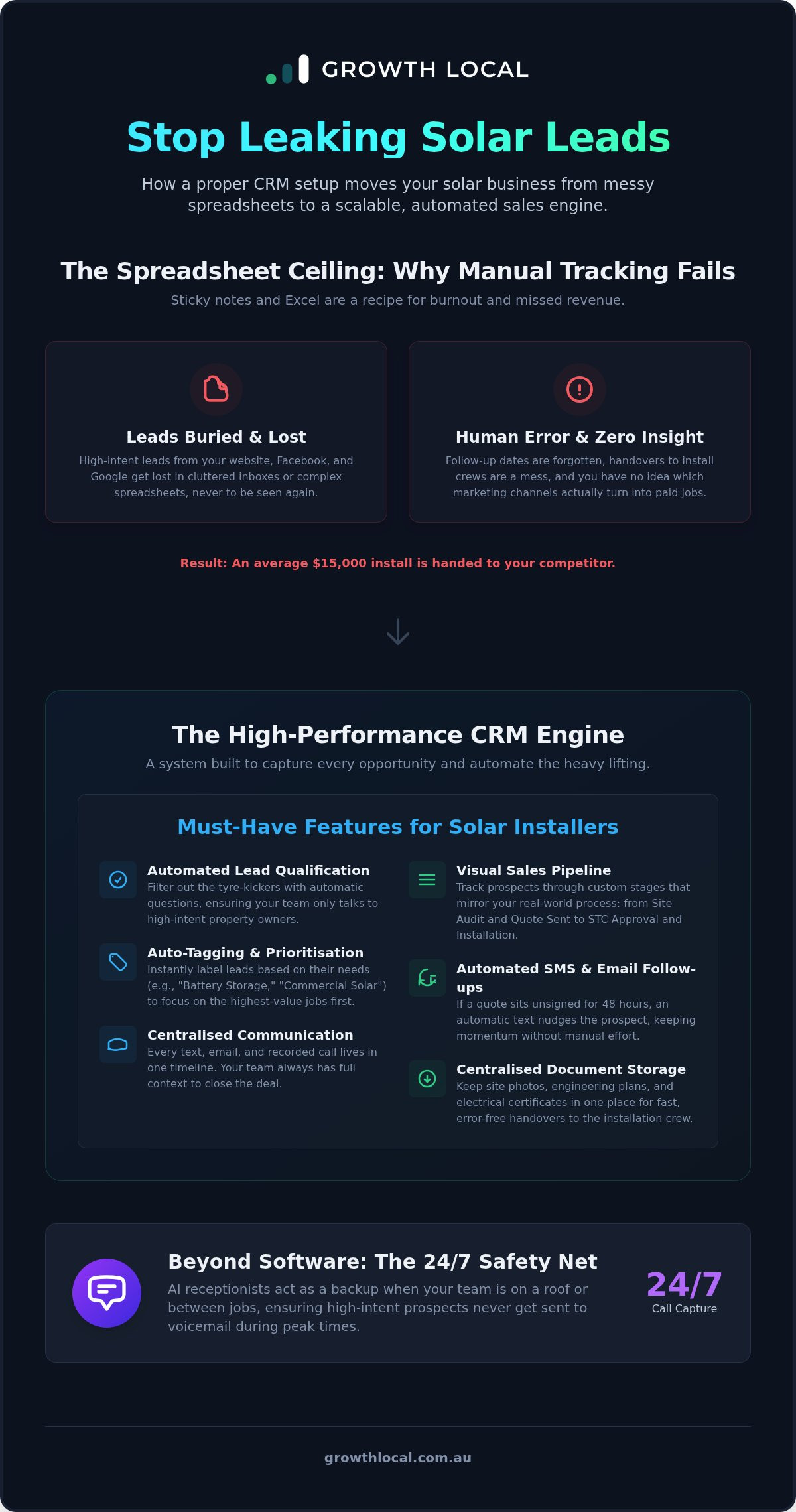
Excel is great for math, but it's a disaster for sales. When you're managing leads in a spreadsheet, human error is a guarantee, not a possibility. Leads get buried in cluttered inboxes, follow-up dates are forgotten, and you have zero visibility on which Facebook ads or Google searches actually turned into paid installs. Handovers become a nightmare too. When a sales rep closes a deal, the installation crew needs clear data, not a messy email chain. Spreadsheets don't talk to other systems; they just create silos that slow you down and frustrate your team. If you want to grow, you need to break through this ceiling with a centralised system.
The ROI of a Proper Solar CRM Setup
Think about the numbers for a second. If a streamlined system helps you capture just two extra installs per month, that’s a massive boost to your annual bottom line. A tailored CRM setup for solar installers automates the heavy lifting. It sends the initial "thanks, we've got your message" text immediately and nudges your sales team to pick up the phone. This automation means the business can keep growing even when you're busy managing a complex site or taking a rare weekend off. You're moving from a job that depends entirely on your memory to a system-driven asset that produces predictable revenue. If you're ready to stop the leaks, it's time to contact us to discuss a more professional approach.
Must-Have Features for a High-Performance Solar CRM
The generic "one-size-fits-all" approach is exactly why so many solar businesses fail to see a return on their software investment. To get the best results from a CRM setup for solar installers, the system must be customised to handle the high-volume, high-pressure nature of the Aussie market. You don't need a digital filing cabinet; you need a proactive sales engine that captures every lead from Facebook, Google, and your website without you lifting a finger. This automation ensures that no prospect is left waiting while you're busy on a roof or managing a crew.
Lead Management and Qualification
Your sales team shouldn't be chasing every single person who clicks an ad. Use automated qualification questions to filter out the tyre-kickers who are just "browsing" or don't actually own their property. By using auto-tagging, your system can instantly label leads based on their intent, such as "Battery Storage" or "Commercial Solar". This ensures your best reps are always prioritising the highest-value opportunities. Centralising all communication is another non-negotiable. When every text, email, and recorded call lives in one timeline, your team has the full context they need to close the deal without digging through old inboxes.
Pipeline Visualisation: Lead to Install
A high-performance pipeline mirrors your actual boots-on-the-ground process. It should track prospects through specific stages like Site Audit, Quote Sent, STC Approval, and Installation. If a quote sits unsigned for 48 hours, the CRM should automatically send a friendly SMS follow-up to keep the momentum going. Integrated quoting tools that allow for on-the-spot digital signatures can drastically reduce your sales cycle. You can also use the system to store essential documents like site photos, engineering plans, and electrical certificates in one accessible spot. This makes the handover from sales to the install crew fast and error-free. If you're ready to move past messy manual tracking, you can book a strategy session to see how these workflows fit your business.
Effective CRM setup for solar installers also includes SMS and email automation that keeps prospects warm during the "thinking" phase. Most homeowners won't drop $10k to $20k on the first phone call. They need education and reassurance. Automated workflows can send case studies or explain the benefits of specific inverter brands over a few weeks, keeping your brand top-of-mind until they're ready to pull the trigger. This systematic approach turns a cold database into a predictable source of revenue.
The Solar CRM Setup Checklist: 7 Steps to Success
Setting up a new system shouldn't feel like you're trying to decode a manual for a faulty inverter. It's simply about taking your current sales mess and organising it into a repeatable, scalable process. Most installers jump straight into the software and wonder why it feels like an expensive address book. To get your CRM setup for solar installers right, you need to focus on the business logic before you start clicking buttons. You're building a digital engine, and that requires a solid blueprint.
Step 1-3: Foundation and Data
Success starts with knowing exactly who you're talking to. Define your ideal customer profile (ICP) so you can set up proper lead tagging from day one. Are you chasing residential 6.6kW installs or commercial rooftop projects? Your CRM should label these automatically so your sales team knows the priority. Before you even think about importing your old data, give it a proper scrub. Moving messy, duplicate-filled spreadsheets into a clean CRM is like walking onto a new job site with muddy boots. Finally, map out your "Perfect Sales Journey" on a piece of paper. If you can't visualise the path from the first click to the final STC approval, you won't be able to automate it effectively.
Step 4-7: Automation and Launch
Once your data is clean and your stages are mapped, it's time to build your first "Instant Lead Response" automation. This is the SMS and email that fires off the second a prospect hits "submit" on your website. It's the difference between winning the job and being the third person they talk to. You also need to integrate your marketing channels, like Facebook and Google Ads, to create a "single source of truth." This allows you to see exactly which ad spend is resulting in panels on roofs. After the install is complete, set up an automated review request. Getting that 5-star Google review should be a hands-off process that triggers the moment the system is commissioned.
The final, and most important, step is team training. A CRM is only as good as the data your reps put into it. If they aren't logging calls or moving deals through the pipeline, your reporting will be useless. For more on how this fits into your wider marketing strategy, check out our Lead Generation System Setup guide. By following this checklist, you're not just installing software; you're building the infrastructure that allows your business to grow without you having to micromanage every single lead.
Beyond the Software: The Power of AI Receptionists
Even the best CRM setup for solar installers is useless if the leads don't actually make it into the system. For a busy installer, the biggest bottleneck isn't usually closing the deal; it's being available to answer the phone when a high-intent prospect calls. You're often on a roof, hauling panels, or navigating traffic between site visits. An AI receptionist acts as your digital front office, ensuring that every enquiry is handled with professional precision, regardless of the time or your location. It's the difference between a business that's always "open" and one that constantly misses out on new installs because the owner was too busy to pick up.
Never Miss a "Ready-to-Buy" Lead Again
Industry data shows that roughly 60% of callers won't bother leaving a message if they hit a standard voicemail; they'll simply hang up and call the next installer on their list. A "dumb" answering machine is a lead-killer. An intelligent AI receptionist, however, is a proactive lead capture engine. It can handle common solar questions about battery storage or current rebates on the fly. If the caller is a genuine prospect, the system can trigger an immediate SMS follow-up. This keeps them engaged and stops them from browsing your competitors while you're finishing a job. You're capturing the lead at their peak moment of interest, not three hours later when they've already booked a site visit with someone else.
Seamless CRM Integration
The real magic happens when your AI receptionist is fully baked into your CRM setup for solar installers. This isn't a separate, disconnected tool. The AI captures the prospect's details and pushes them directly into your sales pipeline as a qualified lead. It can even check your availability and book a site audit directly into your calendar while you're still on-site at another job. This removes the administrative "heavy lifting" that usually clogs up your evening. Instead of spending two hours returning voicemails after a long day, you wake up to a calendar already filled with confirmed appointments. It turns your phone from a constant distraction into a systematic growth tool that runs in the background.
Ready to Scale? Choosing Your Implementation Partner
The decision between DIY and a professional CRM setup for solar installers usually comes down to how much you value your time. You could spend your weekends watching YouTube tutorials and trying to stitch together complex integrations, but most installers find that "saving money" this way actually costs them thousands in lost leads and technical glitches. A professional implementation isn't just about data entry; it's about building a digital infrastructure that works from day one, allowing you to focus on the roof rather than the screen.
What to Look for in a CRM Expert
Don't hire a generic tech agency that doesn't know the difference between a string inverter and a micro-inverter. You need a partner who understands the specific sales cycle of the Australian solar industry, including the nuances of STC claims and site audit requirements. Look for experts who prioritise automation and AI over manual processes. They should provide a clear roadmap for your digital infrastructure and offer transparent pricing so you aren't hit with unexpected costs halfway through the project. It's about finding a strategic partner who understands that your goal is more panels on more roofs, not just a pretty dashboard.
The Growth Local Difference
At Growth Local, we don't do fluff or "futuristic novelties" that don't actually move the needle. We specialise in Solar CRM Setup that actually drives revenue. Our team handles the technical grunt work, including the API connections, automated workflows, and AI receptionist logic, so you can stay focused on your installation schedule. We take a "no-BS" approach to automation; if a feature doesn't help you win more work or save time, we don't build it. This ensures your system remains lean, efficient, and easy for your sales reps to use every day.
Your CRM setup for solar installers needs to be a living system. As your team grows and the market changes, your workflows should evolve too. We don't just "set and forget" your software; we build a foundation that scales with you. Ready to trade the messy spreadsheets for a high-performance engine? View our pricing to see which level fits your current volume, or contact us today to discuss your specific goals. It's time to stop fighting your software and start letting it do the heavy lifting for you.
Start Dominating the Solar Sales Race
The days of running a solar business from a cluttered spreadsheet are over. To truly scale in the 2026 market, you need a system that captures every enquiry, automates the heavy lifting of follow-ups, and provides a clear view of your revenue. Getting a professional CRM setup for solar installers ensures you stop leaking high-value leads and start winning more work with less manual effort.
By integrating an AI receptionist and customising your sales stages, you build a business that runs like a well-oiled machine even when you're busy on-site. Growth Local provides a no-BS Aussie implementation that focuses on practical results, not tech gimmicks. We are specialised solar CRM experts who understand the local market and the pressure of managing a growing install team.
It's time to stop fire-fighting and start building the digital infrastructure your business deserves. We are ready to help you take that next step toward a more organised and profitable future.
Frequently Asked Questions
How much does it cost to set up a CRM for a solar business?
CRM costs vary based on the number of users and the complexity of your automation. You'll typically pay a monthly software subscription fee plus a one-off implementation fee for the initial setup. While DIY might seem cheaper, the hidden cost of lost leads usually makes professional implementation more cost-effective in the long run. We focus on building a digital infrastructure that returns its investment through captured revenue and improved team efficiency.
Can I integrate my solar design software with my CRM?
Yes, most modern CRM systems can talk to popular solar design tools via direct integrations or third-party connectors. This allows you to push site measurements and panel layouts directly into the customer's record. It eliminates double-handling of data and ensures your sales team has all the technical details they need to close the deal. Streamlining this handover is a core part of a professional CRM setup for solar installers.
How long does a professional CRM implementation take?
A standard implementation typically takes between four to eight weeks from the initial audit to the final team training session. This timeframe allows us to map your sales process, build out automated workflows, and clean your existing data. Rushing the process often leads to broken automations and team frustration. We ensure the system is fully tested and your staff are confident before we go live to ensure immediate results.
What is the best CRM for solar installers in Australia?
The best CRM is the one that actually fits your specific workflow rather than a generic off-the-shelf product. Many Aussie installers use platforms like GoHighLevel or HubSpot because they are highly customiseable. The key isn't just the brand of software; it's how it's configured to handle local needs like STC tracking and lead sources. We specialise in tailoring these platforms specifically for the local solar market to ensure they drive growth.
Do I need an AI receptionist if I already have an office manager?
An AI receptionist isn't a replacement for your office manager; it's a tool that frees them from the manual work of answering basic enquiries. While your manager handles complex scheduling and compliance, the AI handles high-volume lead capture 24/7. This ensures that even during peak periods or after hours, every prospect gets an immediate response. It allows your human staff to focus on high-value tasks that actually grow the business.
Can a CRM help with STC processing and compliance?
A well-configured CRM is a game-changer for managing STC paperwork and electrical safety certificates. You can create specific pipeline stages that trigger document requests or internal reminders when compliance tasks are due. By storing all site photos and engineering docs in one centralised record, you eliminate the stress of hunting through emails during an audit. This systematic approach ensures you get paid faster and stay compliant with Australian solar regulations.
Will my sales team actually use the new system?
Adoption depends entirely on how much the system helps your team win. If a CRM makes their job harder, they'll ignore it. If it automates their follow-ups and provides them with hot leads, they'll live in it. We focus on creating a user-friendly interface that reduces manual data entry and repetitive tasks. Proper training and a system that clearly shows their commission pipeline are the best ways to ensure high engagement.
Can I migrate my data from old spreadsheets into a new CRM?
You can definitely migrate your data, but it requires a careful audit first. Importing messy or duplicate data will only break your new system. We help you clean and format your existing spreadsheets before mapping them into the new CRM fields. This ensures your history is preserved without the clutter. A clean migration is a vital step in any professional CRM setup for solar installers to ensure your new engine runs smoothly.


