
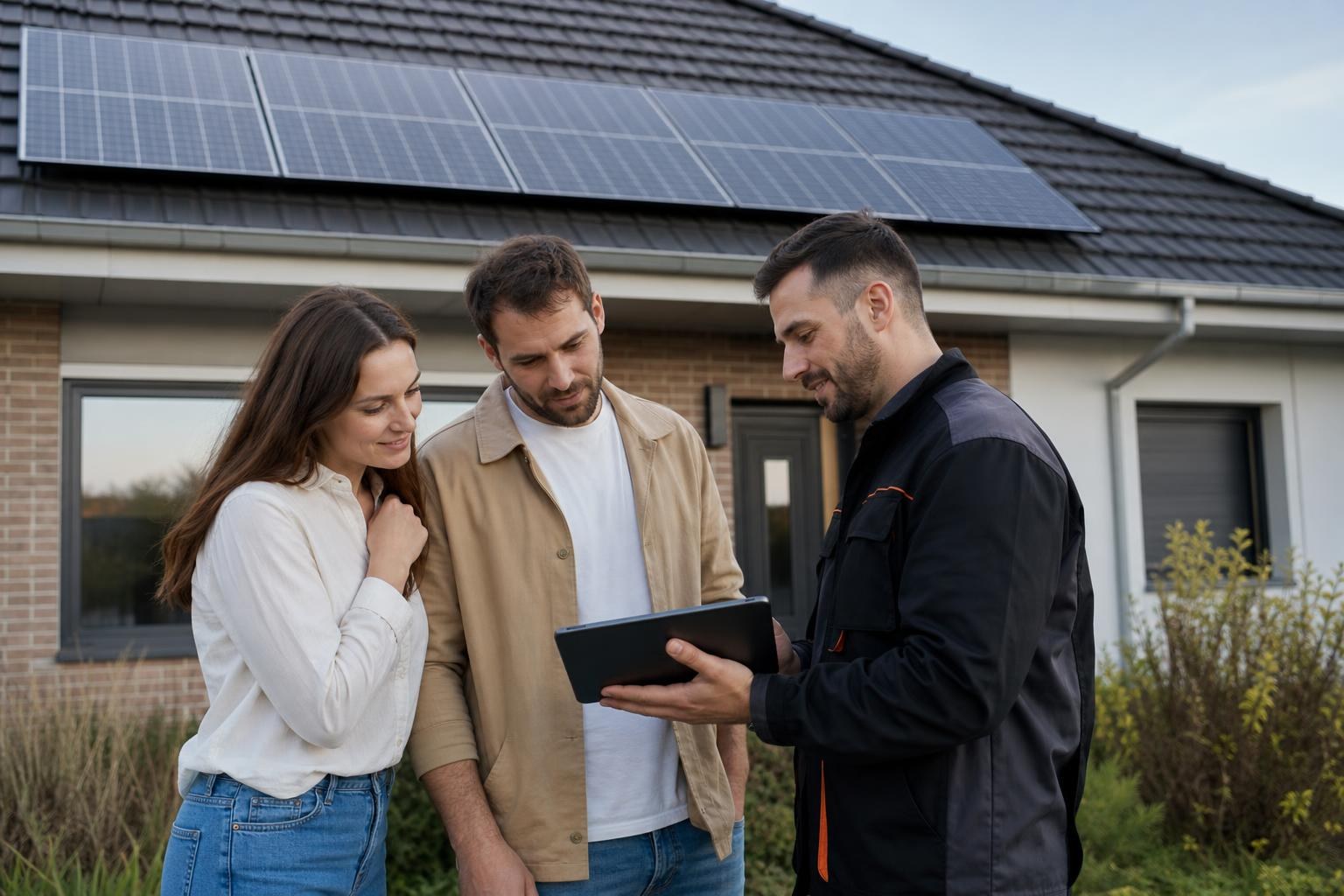
Solar Lead Generation Automation: Convert More Solar Enquiries in 2026
The solar industry across Australia has shifted dramatically over the past two years. Homeowners are more informed, more impatient, and more likely to request quotes from three or four installers simultaneously before choosing the one who responds fastest. For solar businesses still relying on spreadsheets, manual callbacks, and disconnected tools, this speed gap is costing real money. The companies winning the most jobs right now aren't necessarily the cheapest or the most experienced: they're the ones with automated systems that capture, qualify, and follow up on every enquiry within minutes, not hours. Solar lead generation automation isn't a luxury reserved for large national installers anymore. It's becoming the baseline expectation for any solar company that wants to stay competitive and convert more solar enquiries through 2026 and beyond. If your current process involves someone checking a shared inbox twice a day and manually entering leads into a spreadsheet, you're already behind. This piece breaks down exactly what's working right now, what technologies matter, and how to build a system that turns more enquiries into booked site surveys without hiring additional staff.
Table of Contents
The 2026 Solar Market: Why Manual Lead Management is Obsolete
Rising Customer Expectations for Instant Response Times
The Impact of Rising Acquisition Costs on Profit Margins
Core Automation Technologies for High-Volume Solar Enquiries
AI-Driven Lead Scoring and Qualification Frameworks
Integrating CRM Workflows with Real-Time Data Validation
Optimising the Conversion Funnel with Intelligent Nurturing
Automated Multi-Channel Follow-Up via SMS and Email
Dynamic Self-Scheduling Tools for Site Surveys
Leveraging Predictive Analytics to Maximise Return on Ad Spend
Identifying High-Intent Geographical Clusters
Future-Proofing Your Solar Lead Strategy for the Next Decade
Adopting Privacy-First Data Collection Practices
The 2026 Solar Market: Why Manual Lead Management is Obsolete
The Australian solar market in 2026 looks nothing like it did even three years ago. With over 3.7 million rooftop installations nationwide and battery storage becoming mainstream, the pool of easy-to-close customers has shrunk. The homeowners requesting quotes today are savvier, often armed with pricing data from comparison sites and social media groups. They expect a professional, fast experience from the moment they fill out a form or make a phone call.
Manual lead management simply cannot keep pace with this reality. A solar business receiving 40 to 60 enquiries per week through Google Ads, Meta campaigns, and organic search cannot afford to have those leads sitting untouched for hours. The maths is brutal: if your average close rate on leads contacted within five minutes is 35%, but drops to 8% after 30 minutes, every delay is directly eating into your revenue. Automation isn't about replacing your sales team. It's about making sure they spend their time talking to qualified, interested prospects instead of chasing cold leads who've already signed with a competitor.
Rising Customer Expectations for Instant Response Times
A 2025 study by the Australian Energy Council found that 72% of homeowners requesting solar quotes expected a response within 15 minutes. By 2026, that expectation has only tightened. Consumers are conditioned by same-day delivery, instant chat support, and real-time booking confirmations in every other area of their lives. Solar is no exception.
The problem for most solar businesses is that their best salespeople are often on roofs or in consultations during peak enquiry hours. Without automation, those midday enquiries from Google Ads sit in a queue until someone gets back to the office. By then, the homeowner has already booked a site survey with a faster competitor. An automated response system that immediately acknowledges the enquiry, asks qualifying questions, and offers a booking link can bridge this gap entirely. It doesn't replace the human conversation: it ensures the human conversation actually happens.
The Impact of Rising Acquisition Costs on Profit Margins
Customer acquisition costs for solar leads in Australia have climbed steadily since 2023. Google Ads cost-per-click for terms like "solar panels Melbourne" or "solar installation Brisbane" now regularly exceed $18 to $25, up from $10 to $14 just three years ago. Meta advertising costs have followed a similar trajectory. For a solar company spending $5,000 to $10,000 per month on advertising, the difference between converting 15% and 25% of those leads isn't marginal: it's the difference between profitability and burning cash.
This is where automation pays for itself most clearly. If you're already spending the money to generate leads, letting even 20% of them go cold due to slow follow-up is equivalent to throwing $1,000 to $2,000 per month into a skip bin. Automated qualification and instant follow-up don't just improve conversion rates: they fundamentally change the return on every advertising dollar you spend.
Core Automation Technologies for High-Volume Solar Enquiries
Building an effective automation system for solar enquiries doesn't require a computer science degree or a six-figure software budget. The core technologies are well-established and increasingly accessible to small and mid-sized installers. What matters is how they connect and work together as a single system rather than a collection of disconnected tools.
The foundation is a CRM that actually does something useful beyond storing contact details. From there, you layer on lead scoring, automated communications, data validation, and booking tools. Each component handles a specific part of the conversion process, and the goal is to move a lead from "just enquired" to "site survey booked" with minimal manual intervention. The human touch comes at the right moment: during the consultation itself: rather than being wasted on data entry and follow-up calls.
AI-Driven Lead Scoring and Qualification Frameworks
Not every solar enquiry is worth the same amount of your time. A homeowner with a north-facing roof, a quarterly electricity bill over $600, and no shading issues is a fundamentally different prospect than a renter who's "just curious." AI-driven lead scoring assigns a numerical value to each enquiry based on factors that predict conversion likelihood.
Effective scoring models for solar businesses typically weigh several factors:
Property ownership status (owner-occupier vs. renter vs. landlord)
Roof orientation and condition, often gathered through qualifying questions
Current energy spend, which indicates both motivation and system size potential
Timeline urgency: "looking to install this month" scores higher than "researching for next year"
Geographic location, since some areas have higher approval rates and fewer installation complications
These scores allow your sales team to prioritise their callbacks. A lead scoring 85 out of 100 gets an immediate personal call. A lead scoring 30 gets an automated nurture sequence with educational content. This isn't about ignoring lower-scoring leads: it's about allocating your team's limited time where it generates the most revenue.
Integrating CRM Workflows with Real-Time Data Validation
A CRM is only as good as the data inside it. Real-time data validation catches fake phone numbers, incorrect postcodes, and duplicate entries before they clog your pipeline. When a lead submits a form, validation checks can confirm the phone number format is correct, verify the postcode matches a serviceable area, and flag obvious spam submissions.
This matters more than most solar businesses realise. Industry data suggests that 15% to 25% of online form submissions contain errors or are outright spam. Your sales team calling invalid numbers wastes time and creates frustration. A properly integrated CRM workflow validates the data at the point of entry, enriches it with additional information where possible, and routes the lead into the correct automation sequence based on their profile. Growth Local builds these integrated CRM systems specifically for trades and local service businesses, replacing the usual mess of disconnected tools with one connected platform where lead capture, validation, and follow-up all happen automatically.
Optimising the Conversion Funnel with Intelligent Nurturing
The solar purchase journey is rarely instant. Most homeowners take between two and six weeks from initial enquiry to signed contract. During that window, your business needs to stay top of mind without being annoying. Intelligent nurturing sequences accomplish this by delivering the right message at the right time through the right channel.
The mistake many solar companies make is treating all leads the same way. Someone who downloaded a guide on battery storage has different questions than someone who requested an urgent quote after receiving a massive electricity bill. Segmented nurturing sequences address each scenario with relevant content, timely follow-ups, and clear next steps. The automation handles the repetitive work while your team focuses on the conversations that actually close deals.
Automated Multi-Channel Follow-Up via SMS and Email
Email alone isn't enough in 2026. Open rates for solar-related emails hover around 18% to 22%, which means roughly four out of five leads aren't seeing your follow-up. SMS, by contrast, has open rates above 95% and response rates significantly higher than email. The most effective follow-up programmes combine both channels in a coordinated sequence.
A proven sequence for solar enquiries looks something like this:
Immediate SMS acknowledgement within 60 seconds of enquiry, thanking them and confirming next steps
Email within five minutes with a personalised quote estimate or educational resource
SMS at the 24-hour mark if no response, offering a specific callback time
Email on day three with a case study from a nearby installation
SMS on day five with a gentle reminder and a direct booking link
This multi-touch approach catches leads at different times and through different channels. Some people respond to texts immediately but ignore emails. Others prefer to read a detailed email in the evening. Covering both channels dramatically increases your contact rate without requiring your team to manually send a single message.
Dynamic Self-Scheduling Tools for Site Surveys
Every additional step between "interested" and "booked" is a point where you lose prospects. Traditional scheduling involves a phone call, checking availability, calling back if the first time doesn't work, and eventually confirming. Dynamic self-scheduling tools eliminate this friction entirely.
When a qualified lead receives a booking link, they see your team's real-time availability and can select a time that works for them. The system automatically assigns the right installer or assessor based on geographic zone, sends confirmation messages, and adds calendar reminders. No phone tag, no back-and-forth emails. Companies using self-scheduling tools report a 30% to 40% increase in booked site surveys compared to manual scheduling processes. The lead stays warm because they've committed to a specific time, and your team arrives prepared with the lead's information already in the system. Growth Local has seen this pattern consistently across the 3,500+ leads generated and captured through its integrated systems: removing friction from the booking process is one of the highest-impact changes a solar business can make.
Leveraging Predictive Analytics to Maximise Return on Ad Spend
Predictive analytics takes your historical data and uses it to make smarter decisions about where to spend your advertising budget. Instead of spreading your Google Ads budget evenly across all suburbs, predictive models identify which areas, demographics, and even times of day produce leads that actually convert into installations.
For solar businesses, this is particularly powerful because conversion patterns are highly geographic. A suburb with predominantly older homes, higher electricity costs, and strong solar irradiance will convert at a fundamentally different rate than a newer estate with smaller roofs and lower energy bills. Predictive analytics surfaces these patterns from your own data, allowing you to shift budget toward the areas and audiences that generate the most revenue per dollar spent. Over a 12-month period, this kind of optimisation can reduce cost-per-acquisition by 25% to 40% while maintaining or increasing total installation volume.
Identifying High-Intent Geographical Clusters
Geographic clustering analysis examines your past installations and identifies postcodes and suburbs where conversion rates are highest. This goes beyond simple "we get lots of leads from this area" analysis. It considers the full journey: which areas produce leads that book surveys, which surveys convert to quotes, and which quotes close into signed contracts.
The results are often surprising. A suburb generating fewer total leads might have a close rate three times higher than a high-volume area, making it far more profitable per advertising dollar. Once you identify these clusters, you can create hyper-targeted ad campaigns with messaging specific to that area, reference local installations as social proof, and allocate more budget to the geography that actually drives revenue. This data-driven approach replaces gut-feel advertising decisions with evidence-based allocation. Solar businesses running campaigns across multiple regions often find that 60% to 70% of their profitable installations come from just 30% of their service areas: a pattern that only becomes visible through proper geographic analysis.
Future-Proofing Your Solar Lead Strategy for the Next Decade
The solar industry will continue evolving rapidly through the late 2020s and into the 2030s. Battery storage, vehicle-to-grid technology, and virtual power plants are creating new product categories and new customer segments. Your lead generation and conversion systems need to be flexible enough to adapt as these markets mature.
Building on a rigid, custom-coded platform that requires a developer for every change is a recipe for falling behind. The businesses that will thrive are those building on flexible, API-connected systems that can incorporate new data sources, communication channels, and product offerings without starting from scratch. Think of your automation system as infrastructure, not a one-time project.
Adopting Privacy-First Data Collection Practices
Australia's privacy landscape has tightened considerably since the Privacy Act reforms began rolling out. Consent requirements for marketing communications are stricter, and consumers are increasingly aware of how their data is used. Solar businesses collecting enquiry data need to be deliberate about what they collect, how they store it, and how they use it.
Privacy-first data collection means being transparent about what happens after someone fills out a form. Clearly state that they'll receive SMS and email follow-ups, give them easy opt-out options, and ensure your CRM handles data retention in line with current regulations. This isn't just legal compliance: it builds trust. Homeowners are more likely to engage with a company that respects their preferences than one that bombards them with unsolicited messages. Practical steps include implementing double opt-in for email sequences, providing one-tap SMS unsubscribe options, and regularly purging inactive contacts from your database.
Scaling Operations Through API-First Ecosystems
An API-first ecosystem means every tool in your stack can talk to every other tool without manual data transfer. Your advertising platforms feed leads directly into your CRM. Your CRM triggers SMS and email sequences automatically. Your booking tool updates your calendar and notifies the assigned installer. Your review management system sends a feedback request after installation.
This interconnected approach is what separates solar businesses doing 10 installations per month from those doing 50. At lower volumes, you can get away with manual processes and disconnected tools. At higher volumes, the cracks become chasms. Leads get lost between systems, follow-ups get missed, and your team spends more time on admin than on selling. An integrated, API-connected system scales with your business because the automation handles the increased volume without requiring proportional increases in staff. Growth Local has helped trades businesses save over $300K in combined software costs by replacing fragmented tool stacks with a single connected system: an approach that works particularly well for solar companies managing high lead volumes across multiple channels.
Building a Solar Business That Grows Without the Grind
The solar companies thriving in 2026 share a common trait: they've stopped treating lead management as an afterthought and started treating it as a core business system. Automating your enquiry capture, qualification, follow-up, and booking processes isn't about removing the human element from solar sales. It's about making sure the human element happens at the right moment, with the right prospect, armed with the right information.
The gap between solar businesses that automate and those that don't will only widen from here. Every month you operate with manual processes, you're leaving installations on the table and paying more per acquisition than you need to. The technology exists, it's proven, and it's accessible to businesses of every size.
If you want to see how this would work for your solar business specifically, book your free Growth Call with Growth Local. They'll map out a plan tailored to your business: no pitch, no pressure, just a clear picture of what's possible when your lead generation and conversion systems actually work together.


