

Lead nurturing strategies that build valuable client relationships
A strong client relationship isn’t built by sending more emails. Effective lead nurturing strategies for high-value clients keep your business relevant while prospects weigh their options, using timely, useful communication to build trust and move decisions forward.
Steady follow-up matters, but persistence alone won’t win the right work. Each message should address what a prospect cares about at their current stage of the decision-making process.
This guide explains what lead nurturing involves and how to put it into practice. You’ll learn how to map the customer journey, tailor content, use lead magnets and coordinate account-based marketing, so you can focus effort on prospects who fit your business.
Key Takeaways
- Map the steps prospects take before choosing a service, then match your follow-up to their questions and preferred channels.
- Use behaviour-triggered messages and progressive profiling to make each interaction more relevant as you learn about a prospect’s needs.
- Tailor content to the buyer’s stage, from helpful explanations early on to practical decision-making information later.
- For high-value accounts, coordinate relevant, personal communication around the needs of each organisation and its decision-makers.
- Build a follow-up sequence that provides value consistently, responds to prospect activity and leaves room for a genuine conversation.
1. Customer journey mapping and multichannel nurturing
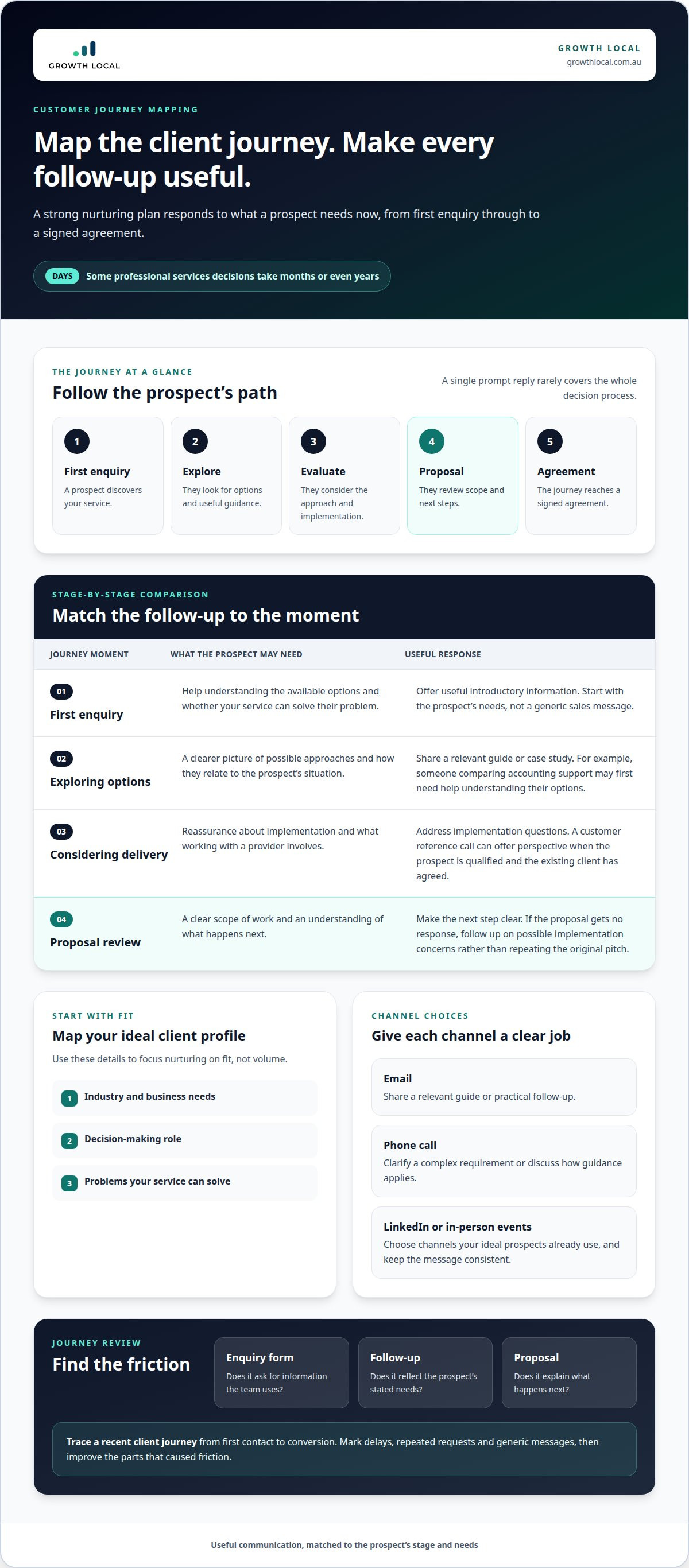
Map the journey from first enquiry to signed agreement, then identify what prospects need at each stage. A professional services decision may take days, months or even years, so one prompt reply rarely covers the whole process. Someone comparing accounting support, for example, may first need help understanding their options, then reassurance about implementation, followed by a clear scope of work. Each interaction should answer the question they have now.
Start with your ideal customer profile, not a broad list of possible leads. Record the client’s industry, business needs, decision-making role and the problems your service can solve. Compare these details with your strongest existing client relationships. A high-value prospect might be a growing business struggling to manage enquiries manually; a poor-fit lead may need a service you don’t provide. These criteria keep lead nurturing strategies for high-value clients focused on fit, not volume.
Plot the key journey stages and the events that move someone between them. A prospect might discover your service through a Google search, read a case study, attend an industry event and request a proposal. At each point, record their likely question, useful information to offer and the next action to make clear. If a proposal gets no response, address possible implementation concerns in your follow-up rather than repeating the original pitch.
Review the customer experience at every stage, including the handover from marketing to sales. Check whether the enquiry form asks for information the team uses, follow-ups reflect the prospect’s stated needs, and the proposal explains what happens next. Trace a recent client journey from first contact to conversion. Mark delays, repeated requests and generic messages, then improve the parts of the process that caused friction.
Choose a few channels your ideal prospects already use, such as email, phone calls, LinkedIn or in-person events. Give each channel a clear purpose: email can share a relevant guide, while a call can clarify a complex requirement. Keep the message consistent while adapting its format and detail. Someone who downloads a planning checklist could receive a practical follow-up email, followed by a call if they ask how to apply it to their business. This keeps lead nurturing strategies for high-value clients useful across channels.
Customer reference calls can help a qualified prospect understand what working with a provider involves. Ask an existing client’s permission first and agree on a suitable contact. Match the reference to the prospect’s situation, such as a similar business challenge or project type. Explain the purpose to both parties and protect confidential details. The call should offer perspective, not pressure the prospect to decide.
2. What is lead nurturing?
Lead nurturing is planned communication that helps prospects move from initial interest towards an informed buying decision. Rather than sending every new contact the same sales message, share useful information and follow up in ways that reflect each prospect’s needs. Someone who requests a service guide, for example, may need practical advice before they’re ready to discuss a proposal.
Behaviour-triggered communication makes that follow-up relevant. A form submission, webinar registration or visit to a service page can start a workflow matched to the action. MarketingSherpa found that 39% of marketers considered automatically sending emails based on triggers the most effective tactic for improving email engagement. The trigger should connect to the prospect’s expressed interest, not simply create another message.
Progressive profiling builds a clearer picture over time instead of asking for every detail on the first form. Begin with useful basics, such as a name, work email and the type of help someone needs. If they later download a planning guide or request a consultation, ask one relevant follow-up question, such as their main operational challenge. Each answer adds context and helps tailor the next interaction.
Lead scoring helps a team prioritise prospects using firmographics, budget and behaviour. Firmographics describe an organisation, including its industry, size and location. Budget indicates whether the likely investment aligns with your service, while behaviour signals interest through actions such as requesting a quote. A small business that fits your target profile and asks about implementation may rank above a contact who only reads a general article. Base scoring on genuine fit, and review the criteria when sales outcomes show they are misjudging prospects.
For Australian email or SMS nurturing, follow the Spam Act requirements for consent, sender identification and an unsubscribe option. Where the Privacy Act applies, handle personal information in line with its privacy obligations and collect only what you need for a clear purpose. Record consent and communication preferences in your CRM so workflows respect each contact’s choices.
Over-contacting high-value prospects can make your business feel intrusive, damage trust and prompt people to disengage. Set frequency limits, suppress messages after an unsubscribe or direct request, and pause automated workflows when a person is already in a sales conversation. If a prospect remains inactive for 72 hours, use a different value-add communication to re-engage them rather than repeating the same pitch.
When manual follow-up makes these steps hard to manage, a lead generation system setup can help organise relevant workflows and prospect information.
3. Buyer journey stages and tailored content
Prospects need different information as they move through the buying funnel. In the awareness stage, they’re identifying a problem, such as missed enquiries or slow follow-up. A practical guide can explain common causes without pushing a service. During consideration, they compare approaches, so a process breakdown or case example can help. At the decision stage, a clear scope, implementation steps and answers to likely objections support a confident next move.
Tailor each piece to a specific audience and question. A business owner researching lead management might value a checklist, while a manager assessing automation may need a workflow diagram. The content should use the prospect’s language and focus on their stated challenge. One report says 71% of consumers expect personalisation and can be influenced by relevant content through suitable channels and at the right moments.
Build a simple content plan around the buying stages. First, list the questions prospects ask during sales conversations. Match each question to a useful asset, such as a comparison guide, short explainer or implementation checklist. Then plan a relevant follow-up. Someone who reads a guide about handling enquiries could receive a practical email explaining how to map their current process before considering changes.
Lead magnets earn attention by offering a useful resource in exchange for contact details. Make the promise specific: a downloadable audit worksheet should help someone identify gaps, not disguise a sales pitch. Make the next step clear, too. After a checklist download, an email could invite the reader to explore a related topic; a proposal request should prompt direct, relevant follow-up.
Content marketing works best as a connected campaign, not a pile of disconnected posts. Use one core insight across channels: turn a detailed article into a short email, a social post and a discussion point for an industry event. Keep each version suited to its channel and audience. One report found 56% of marketers considered targeted content the most important element of a lead nurturing programme, reinforcing the value of relevance over sheer output.
Review performance by stage, not just total views. Track whether an asset leads to meaningful actions, such as a reply, event registration or request for more detail. If readers open an email but don’t take the next step, revise the offer or call to action. If a guide attracts the wrong audience, sharpen its topic and distribution. These checks keep marketing focused on qualified interest.
For Australian businesses, CRM and marketing automation tools can bring contact records, campaigns and follow-up workflows together.
5. Account-based marketing for high-value accounts
Sales and marketing teams can coordinate high-value lead nurturing by agreeing on target accounts, shared goals and a single record of each interaction. Marketing plans relevant campaigns, while sales shares insight from conversations. If a prospect raises concerns about implementation, for example, both teams can address that issue in the next email, meeting or resource.
Define what makes an account valuable by assessing revenue potential, profitability, fit with your services and alignment with growth goals. Then identify organisations that match those criteria instead of targeting every large business. Even an account with strong potential needs thoughtful engagement to build a relationship and show that you understand its needs.
Map the people involved in each target account. A business owner may focus on outcomes, while an operations manager needs to understand the workflow and a finance lead wants clarity on costs. Create a simple account plan that records each person’s priorities, concerns and role in the decision. Tailor messages to those priorities while keeping the core offer consistent across the organisation.
Account-based marketing works best when efforts are coordinated, not split into separate campaigns aimed at the same company. Marketing might share a sector-specific guide, while sales follows up with a conversation about the account’s stated challenge. If several contacts from one organisation engage with the guide, notify the account owner and agree on a useful next step before sending more material.
Automate routine actions, such as recording a content download or notifying sales about a quote request, but keep personal conversations human. A workflow can remind the account owner to follow up after a meeting; the message should still reflect what the prospect discussed. Automation supports consistency, but it shouldn’t turn a complex business relationship into a string of generic emails.
Give each account a clear engagement plan and a purpose for every interaction. A useful sequence might include a tailored introduction, an educational resource, a relevant event invitation and a follow-up conversation. Space these actions according to the account’s response and buying process. If a contact asks to pause communication, stop the sequence and update the shared record.
Review account progress jointly at regular sales and marketing meetings. Check which contacts are engaging, what questions remain unanswered and whether the account still fits the target profile. Businesses have reported 27% faster profit growth when sales and marketing teams work collaboratively. Treat that figure as a reason to coordinate efforts, not as a guaranteed outcome for every account.
Measure account-level progress, not isolated clicks. Track meaningful signals such as replies, meetings, stakeholder involvement and movement towards a proposal. If an account shows interest but stalls, sales can share the barrier with marketing, which can provide a relevant case example or explanation. This feedback loop connects campaigns to real relationships and decisions.
5. What is an effective lead nurturing sequence and contact frequency?
A useful sequence gives each prospect a reason to engage, then adjusts based on their response. A lead may need about 5 to 20 touchpoints before converting, so one follow-up rarely covers the full decision journey. Plan a sequence with a clear purpose for each contact, such as answering a question, sharing a relevant resource or arranging a conversation.
Start with the prospect’s last action. After an enquiry, send a personal acknowledgement and explain what happens next. If they request a quote, follow up with information that clarifies scope or implementation. If they download a guide, share a related resource instead of repeating the download link. Each interaction should add value and connect logically to the previous one.
There’s no single contact interval that suits every lead. One sales professional, Leslie Venetz, said she sent prospects something valuable every 3-6 weeks. Use that as a guide for longer consideration periods, then adjust for the prospect’s activity and preferences. A direct question or proposal request calls for a prompt personal response, while a quiet prospect may need more space between messages.
Build event-based follow-up into the sequence. For a webinar, send a useful follow-up email within 24 hours to attendees and people who registered but didn’t attend. Give attendees a further relevant message a week after the event, such as a practical application of the session’s key idea. Tailor the non-attendee message differently, perhaps by sharing the recording or a concise summary.
Don’t let a sequence stop after its first week. One audit found leads had no follow-up after day 7, despite interest continuing on days 8-45 and rising again after day 90. Create later check-ins with a fresh reason to reconnect, such as a new guide or an answer to a common objection. Avoid sending a routine “just checking in” message with no useful next step.
Set frequency rules in your CRM so several campaigns don’t contact the same person at once. Pause automated messages when sales is having an active conversation, and stop promptly if someone opts out. In competitive service sectors, a 24-hour follow-up delay can decrease conversion rates by 60%. Track replies, meetings and opt-outs to spot when timing or message frequency needs adjusting.
Review the sequence against actual prospect behaviour. If a contact replies after the second email, move them into a personal conversation rather than continuing the automated series. If they remain quiet, space out further messages and change the value you offer. This keeps follow-up deliberate, relevant and respectful throughout the decision process.
Growth Local: Lead Generation System Setup
Growth Local helps businesses build a more organised path from first enquiry to meaningful follow-up through Lead Generation System Setup. It’s a practical next step when good prospects are slipping through the cracks, enquiry details are scattered, or nurturing depends on manual reminders.
CRM Setup can bring prospect information and follow-up activity into one system, while Marketing System Setup connects campaigns with the customer journey. Growth Local’s AI Receptionist can support enquiry handling as part of a broader lead generation process. The right setup depends on your workflow, audience and growth priorities, with the focus on resolving the bottleneck holding your nurturing efforts back.
Contact Growth Local to discuss your lead generation system.
Make your next lead interaction count
Turn your nurturing approach into a working process your team can maintain. Choose a point where valuable prospects often stall, then make that moment easier to manage. A clear handover, timely follow-up or more useful first response can improve the experience without adding unnecessary admin.
Growth Local can connect this process through Lead Generation System Setup, CRM Setup and Marketing System Setup. These services help businesses organise incoming enquiries, keep prospect information together and coordinate follow-up. Start with the bottleneck affecting your lead nurturing strategies for high-value clients.
Build a system that gives your team more room to focus on real conversations and lasting client relationships.
A clear process behind each interaction helps your team move forward with greater focus and confidence.
Frequently Asked Questions
What is lead nurturing?
Lead nurturing helps a potential customer make an informed decision through useful, timely communication. A commercial cleaning prospect, for example, might first need a clear explanation of service options, then answers about onboarding before requesting a quote. Make each interaction relevant to the prospect’s situation instead of sending sales messages that don’t address their questions.
What is lead nurturing for high-value clients?
Lead nurturing for high-value clients focuses on building trust with prospects whose needs and business fit make a relationship worthwhile. It may involve tailored communication, thoughtful follow-up and coordination around several decision-makers. A supplier, for example, could give an operations manager process details and a business owner a clear view of expected outcomes. Keep communication useful rather than excessive.
Which lead nurturing strategies work best for high-value B2B clients?
Combine relevant expertise with personal contact from the people responsible for the relationship. A useful approach might include a practical industry briefing, a tailored business review and a conversation that answers the prospect’s current concerns. For complex purchases, ensure sales and marketing share account information and agree on the next step. This avoids conflicting messages and asking prospects to repeat themselves.
How do you segment and qualify high-value leads?
Assess each lead against your ideal account criteria, then use fit and buying signals to prioritise follow-up. Relevant details include the organisation’s industry, service needs, decision-making role, budget alignment and recent enquiry activity. A company requesting implementation details may merit a direct conversation, while a poor-fit enquiry can receive general educational information. Revisit your segments when sales outcomes show the criteria need adjusting.
How do you measure lead nurturing ROI, conversion rates, and pipeline impact?
Track how nurtured leads progress from initial engagement to qualified opportunity, proposal and sale. Calculate conversion rates by dividing the number who reach a stage by the number who enter it, then compare results across campaigns or audience segments. To assess ROI, compare revenue attributed to nurtured opportunities with campaign costs. Also monitor pipeline value, time to progress and stalled opportunities to identify where follow-up needs improvement.


