

Lead generation: How it works, what it costs and lead quality
A well-designed campaign can do more than collect contact details: it can guide the right prospects from first interest to a sales conversation. If you’re asking what a lead generation system is and how it works, it’s a connected process of attracting prospects, capturing their details, following up and tracking results so your team can act on each opportunity.
It’s easy to focus on lead numbers, but a busy inbox doesn’t necessarily mean better sales opportunities. For B2B teams, the aim is to reach the right businesses, understand what they need and follow up in a way that moves the conversation forward.
This guide explains what lead generation means, how B2B teams use it and how to assess lead quality. You’ll also learn what affects campaign costs and how to plan a campaign around your audience, offer and sales process.
The process runs from attracting prospects to capturing their details, nurturing interest and measuring what happens next. Understanding each stage helps you find gaps, reduce wasted effort and build a system that supports business growth.
Key Takeaways
- Lead generation attracts potential customers, captures their details and builds a path towards a sales conversation.
- For B2B, define what counts as a useful lead and focus campaigns on businesses that fit your ideal customer profile.
- Nurture leads with relevant follow-ups so interested prospects can move towards a buying decision at the right time.
- Measure more than lead volume: compare campaign costs with lead quality and the rate at which leads become customers.
- A connected system for campaigns, contact details and follow-up can help reduce manual work and keep prospects from slipping through the cracks.
What is lead generation?
Lead generation attracts potential customers, captures their contact details and moves them towards a sale. The process takes a person from first interest through follow-up and qualification to conversion, when there’s a good fit.
Attraction starts with a target audience and a reason to engage. A B2B business might publish an advice article for operations managers, promote it through search or LinkedIn, then invite readers to download a planning guide. The call to action turns attention into an opportunity to capture details through a form or subscription.
Keep the first form focused on essential details, such as a name, work email and the service they’re interested in. Asking for too much upfront can put people off. Follow-up conversations can clarify their needs, role and timing, helping your team decide whether they’re a qualified lead.
For an Australian campaign, explain why you’re collecting contact details, record each person’s marketing preferences and provide a straightforward way to stop promotional messages. Clear consent practices help people understand what they’re signing up for before their details enter a campaign.
Marketing-qualified leads and nurturing
A marketing-qualified lead (MQL) has shown interest but may not be ready to buy. Lead nurturing provides relevant information to help them assess their options. For example, someone who downloads a guide might receive a related checklist, followed by an invitation to discuss their requirements. Useful follow-up builds interest before a stronger opportunity moves to sales.
Nurturing works best when messages reflect each prospect’s actions and needs. Someone who viewed a service page may need practical details, while a newsletter subscriber may still be exploring. Sending both the same sales pitch can miss the mark. Relevant, useful emails give each prospect a reason to keep engaging.
Lead generation systems and tools
A lead generation system connects the channels and tools you use to attract, capture, organise and follow up with prospects. It might combine a website form, email marketing software, analytics and a customer relationship management (CRM) platform, giving marketing and sales a shared place to track interactions. Centralised records show which strategies attract leads and what follow-up has taken place.
Automation can send a welcome email after a form submission, assign a lead to a sales queue or flag someone who requests a product demonstration. The CRM stores contact details and interaction history, reducing the chance that an interested prospect is overlooked. Clear handovers and useful records help these tools work together.
Common mistakes include targeting too broadly, collecting unnecessary details and treating every submission as sales-ready. Someone downloading an introductory guide, for example, may need more information before a sales call. Skipping qualification or sending irrelevant follow-ups can cause prospects to disengage and waste sales time on poor-fit opportunities. Review your target audience, form and follow-up messages together to see where interest drops off.
Lead-generation metrics, including cost per lead and lead quality
Lead-generation metrics show whether campaigns attract the right prospects and move them towards sales. Track cost per lead alongside qualification and conversion rates, not on its own.
Marketing-qualified and sales-qualified leads
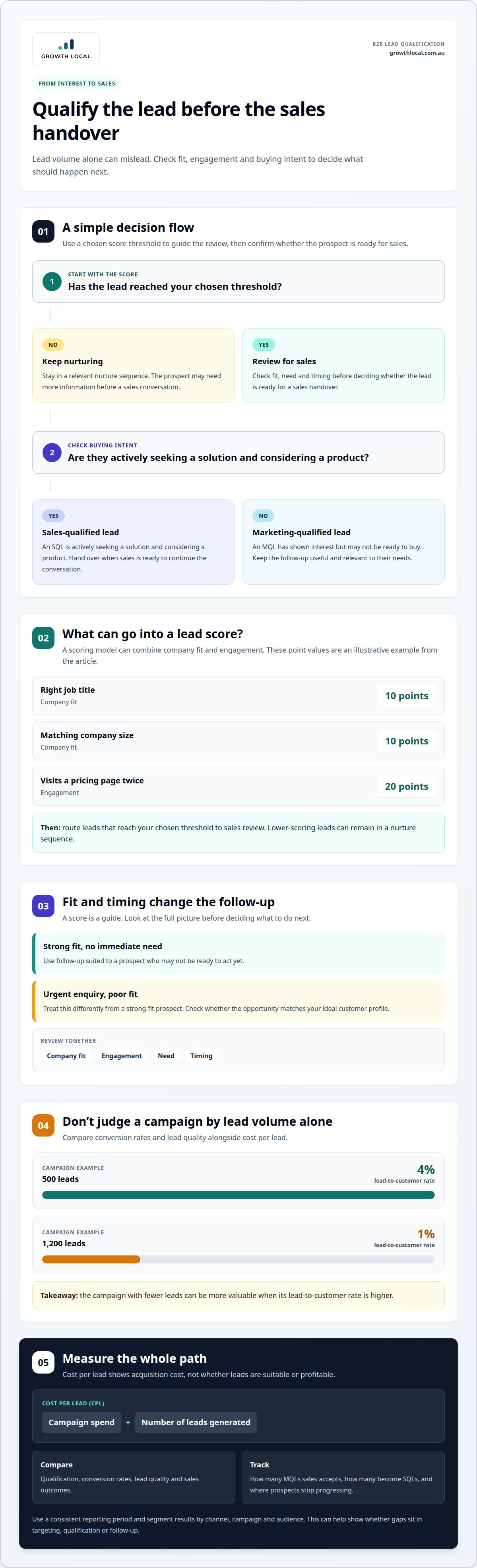
A marketing-qualified lead (MQL) has shown interest but may need nurturing, while a sales-qualified lead (SQL) is actively seeking a solution and considering a product. This distinction helps marketing hand prospects to sales when they’re ready, rather than passing along everyone who shares contact details.
A guide download can indicate early interest, while a request to discuss a solution suggests stronger buying intent. Follow-up may confirm an MQL’s needs and fit, making them ready to become an SQL. Agreeing on these definitions helps marketing and sales assess prospects consistently and focus on those more likely to convert.
Qualification dimensions and timing
Lead qualification assesses how well a prospect fits your ideal customer profile, what they need and when they may act. A strong-fit prospect with no immediate need calls for different follow-up than an urgent enquiry from a poor-fit business.
A scoring model can combine company fit and engagement. For example, an illustrative model might assign 10 points for the right job title, 10 for matching company size and 20 for visiting a pricing page twice. A prospect who reaches a chosen threshold can be routed to sales; a lower-scoring lead can stay in a nurture sequence.
Cost per lead (CPL) is campaign spend divided by the number of leads generated. It shows acquisition cost, not whether those leads are suitable or profitable. Compare CPL with the share of leads that qualify, progress to sales and become customers.
Use a consistent reporting period and segment results by channel, campaign and audience. Inbound search leads may behave differently from paid social leads, so combining them can hide which source produces stronger opportunities. Track handovers too: how many MQLs sales accepts, how many become SQLs and where prospects stop progressing. These stages can show whether the issue lies in targeting, qualification or follow-up.
Lead volume alone can point teams in the wrong direction. A channel producing 500 leads with a 4% lead-to-customer rate can be more valuable than one producing 1,200 leads at a 1% rate. Review conversion rates alongside CPL, lead quality and sales outcomes before shifting campaign effort. A simple CRM report can bring these measures together and show which leads need attention.
If lead stages or reporting are hard to connect, explore a lead-generation system setup as a way to structure tracking and routing around your sales process.
Definition and role of lead generation in B2B
In B2B, lead generation attracts potential customers, captures their interest and builds a sales pipeline. It gives a business a way to start conversations with organisations that may need its products or services. For example, an accounting software provider might target finance managers at growing companies, rather than promoting one message to every business.
The goal is to create a useful path from first contact to a potential sale. A lead might come from a search result, a LinkedIn post or an industry event. A relevant landing page can explain the offer and invite visitors to share their contact details. Analytics can then show whether the page supports the campaign’s conversion goal.
Lead types help teams interpret a prospect’s actions. A marketing-qualified lead (MQL) has shown interest but may need more information. A sales-qualified lead (SQL) is actively seeking a solution and considering a product. A product-qualified lead (PQL) is familiar with a product, often through a free trial or basic version. Existing customers interested in upgrades or additional services can be service-qualified leads.
These distinctions shape the next conversation. Someone who downloads an introductory guide may benefit from educational emails, while a prospect requesting a product discussion may be ready for sales follow-up. Record each person’s source, business role and engagement, then use that information to decide what happens next.
Timing matters in B2B because interest and purchasing cycles don’t always line up. About 5% of B2B buyers are in the market in a given quarter, while the other 95% may buy in the future. That makes lead generation more than a search for immediate enquiries. Useful content and relevant follow-up can keep a business in consideration until a prospect is ready.
Content is one way to attract and educate potential customers before they speak with sales. The Content Marketing Institute’s 2020 B2B Benchmarks Report found that 70% of B2B brands used content marketing to generate leads. A practical article, case study or webinar can address a specific business problem and give readers a reason to take the next step.
Channel choice should reflect how the target audience researches and communicates. LinkedIn can support B2B social activity, while email can deliver useful information directly to interested contacts. Outbound approaches, such as paid ads or trade shows, can also introduce an offer to prospects who haven’t found the business through search.
For a B2B team, the key is connecting each channel to a clear next action. Define the lead, select a relevant audience, offer a useful reason to engage, then track which prospects progress. That structure helps marketing and sales focus on genuine opportunities, not just a growing contact list.
Four-stage lead generation process
A lead generation process moves prospects through four connected stages: attract, capture, qualify and follow up. A LinkedIn post, landing page and sales conversation can each serve a different purpose along the way.
- Attract the right prospects. Start with a specific audience and a problem your offer addresses. A B2B firm, for example, could publish an article answering a common operations question, then share it through social media or search. Paid ads, webinars and industry events can also introduce prospects to the business. The channel matters less than the match between the message and the people you want to reach.
- Capture interest. Give visitors a clear next step on the landing page, such as downloading a useful guide or requesting a product demonstration. The page should explain what they’ll receive and make the action easy to complete. A short form captures the details needed for follow-up. For instance, a guide download might ask for a name and work email, rather than a long list of background information.
- Qualify the lead. Add each new contact to the CRM with its source and stated interest. Then assess whether the person and their organisation fit the target customer, and whether their actions suggest a genuine need. Someone who downloads an introductory guide may need further information; a prospect requesting a product discussion may be ready for sales. Clear qualification criteria help route each person to the right next step.
- Follow up and learn. Send a relevant response based on the action taken, then record what happens next. A guide download could trigger a related email, while a direct enquiry could go to the sales queue. Contacts collected at events should be added to the CRM and followed up within 24 hours. Reviewing responses and conversions by channel helps show which messages and offers deserve more attention.
Handovers connect the stages. If a landing page attracts visitors but captures few details, review the offer and form. If contacts arrive but rarely progress, examine qualification and follow-up. Tracking each transition helps locate the bottleneck, so you can improve the part that needs attention instead of adding activity everywhere.
What is a lead generation system?
Understanding what a lead generation system is and how it works starts with seeing how its parts connect. It links campaigns, contact capture, customer records and follow-up, giving every prospect a clear path through the sales process. Without those connections, a form submission can sit in an inbox while sales works from incomplete information.
Think of the system as an operating process, not a single piece of software. A website form captures an enquiry, analytics records its source and a CRM stores the contact and activity. Email automation can deliver a relevant response, while a sales queue flags prospects who meet agreed criteria. Each tool has a role, and the handovers between tools matter just as much.
For example, a B2B campaign could promote a planning guide through search and social media. A visitor submits a form, the CRM records the campaign source, and an automated email delivers the guide. If that person later requests a product discussion, the system can update their record and route the request to sales. The sequence makes it easier to see how interest developed and what action followed.
A useful system also links marketing activity to sales outcomes. Campaign reports can show which landing page or channel brought in a contact, while CRM records track whether that contact became a qualified opportunity or customer. Comparing outcomes helps you identify channels that attract relevant prospects, rather than relying on lead totals alone.
Automation handles repeatable tasks, but it can’t replace judgement in every interaction. A rule can assign a lead by source or stated interest, and a follow-up sequence can send relevant information. A person still needs to review unusual enquiries, confirm fit and answer questions outside the standard process. Clear ownership helps prevent leads from getting stuck in the automation.
Design the system around your sales process. Define what each form collects, which behaviours trigger follow-up and when sales takes ownership. A direct consultation request, for instance, may need a different route from a newsletter subscription. These distinctions keep messages relevant and prevent the team from treating every contact as equally ready to buy.
Reliable records matter too. Duplicate contacts, missing campaign sources and inconsistent lead stages can distort reports. Use consistent field names and qualification definitions, and record each handover in the CRM. Then review whether the system captures useful data and supports your team’s actual workflow. A well-fitted setup can reduce manual copying and make gaps easier to spot.
The system should adapt as campaigns change. A new landing page, audience or offer may require updated tracking, routing or email content. Review the path from campaign to customer to see where prospects drop away, then make targeted improvements instead of adding software without a clear purpose.
Growth Local: Lead Generation System Setup
Growth Local can help when lead flow feels disconnected, manual or difficult to measure. Its Lead Generation System Setup brings campaign activity and lead handling into a more organised process. CRM Setup helps manage prospect information, while Marketing System Setup connects marketing activity. Businesses looking to streamline enquiry handling can also use Growth Local’s AI Receptionist.
Consider this support when leads arrive through different channels, follow-up is inconsistent or your team can’t easily see the status of opportunities. Start with the bottleneck: lead capture, contact management or the wider marketing workflow.
Contact Growth Local to discuss your lead generation needs.
Make your next lead-generation move count
Understanding what a lead generation system is and how it works gives you a starting point. Next, identify the main decision your business needs to make. Is the biggest constraint reaching the right audience, turning interest into enquiries or giving sales a clear next action? Choose one bottleneck to address first. This keeps your next campaign focused and gives your team a practical way to assess progress.
Before changing tools or adding channels, agree on what a useful result looks like for your business. You might want clearer ownership of enquiries, better visibility from first interaction to sale or a smoother handover between marketing and sales. Let that goal guide your next change instead of adding complexity without purpose. A focused plan gives your team room to learn and refine the process as customer needs change.
Your next step doesn’t need to solve everything at once. Start with the part of the process that will make the biggest difference to your team, then build from there.
Frequently Asked Questions
How do you measure the success of your lead gen strategy?
Measure success against the campaign’s original business goal, such as generating enquiries for a particular service or starting conversations with a new audience. Track what happens after the first response, including whether prospects book a meeting, request a proposal or become customers. A campaign with fewer enquiries may still be working well if those prospects progress to valuable sales conversations.
What are the main components of a lead generation system?
A working system needs a defined audience, a relevant offer, a way to capture interest and a process for managing what happens next. It also needs clear ownership: a person or automated workflow must handle each enquiry. For example, a business can assign website enquiries to a sales queue and use a CRM status to show whether each contact has been actioned.
How do businesses qualify and score leads?
Businesses qualify leads by assessing fit and intent, then use a scoring model to apply the criteria consistently. A model might give more weight to a relevant role or direct product enquiry, and less to contacts outside the target market. Review the model against sales outcomes and adjust it if high-scoring leads repeatedly fail to progress or promising prospects are overlooked.
How do businesses measure lead generation performance and ROI?
Measure performance by linking campaign activity to sales outcomes in your CRM. To calculate ROI, compare campaign revenue with its costs, then divide the difference by those costs. Use a consistent attribution approach so reports treat a sale influenced by several interactions consistently. Where practical, consider profit as well as revenue for a clearer view of commercial return.


