

How to score service business leads and set MQL thresholds
A high lead score doesn’t automatically mean a lead is ready for sales. Lead scoring for service businesses works best when points reflect both fit and buying intent, with scores commonly set on a 1-to-100 scale. The MQL threshold is the point where a lead is considered sales-ready and passed to sales, so it should reflect the patterns that actually lead to conversions.
It makes sense to want a clear way to prioritise enquiries without overlooking promising prospects or spending time on poor-fit leads. This guide explains how to score different lead types, identify the behaviours and attributes linked to conversions, and set a practical MQL threshold. You’ll also learn how to use signals such as consultation requests, referrals and content engagement to build a scoring model, then refine it based on which leads become customers.
Key Takeaways
- Give points to fit and intent signals, and subtract points when behaviour suggests a lead is less likely to convert.
- Look for patterns in the actions and attributes shared by customers who became good-fit clients.
- Score prospects, past customers and referral partners differently so each group gets a relevant follow-up.
- Set your MQL threshold around the signals that consistently lead to sales, then refine it as conversion patterns change.
- Use your CRM to organise scores and make follow-up more consistent across your team.
What is the lead scoring process?
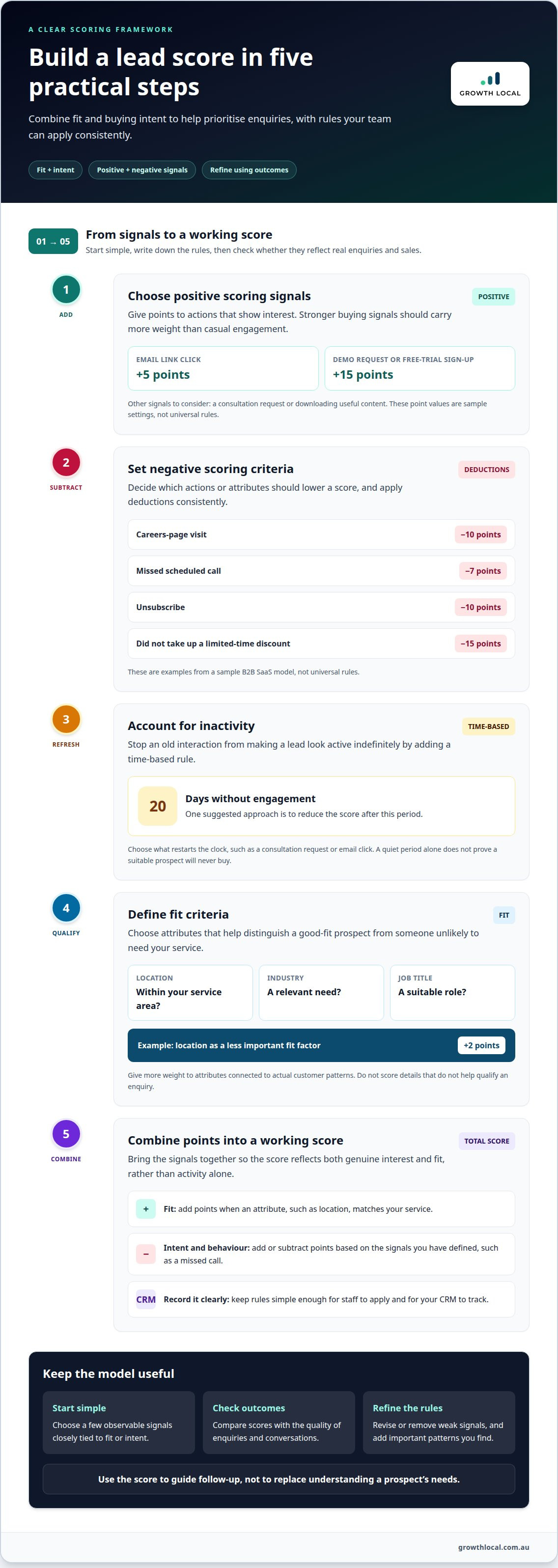
Lead scoring assigns points to prospect attributes and actions, then combines them to estimate fit and buying intent. Use the steps below to define positive and negative criteria that reflect how people choose your service.
-
Choose positive scoring signals
Start by identifying actions that show genuine interest, such as requesting a consultation, clicking an email link or downloading useful content. A sample model gives an email click 5 points, while a demo request or free-trial sign-up could earn 15 points. Check which actions appear before real enquiries and sales. Award more points to stronger buying signals than casual engagement.
-
Set negative scoring criteria
Decide which actions or attributes should reduce a lead’s score, and apply deductions consistently. For example, a sample B2B SaaS model subtracts 10 points for a careers-page visit, while missing a scheduled call could subtract 7 points. An unsubscribe could subtract 10 points, and not taking up a limited-time discount could subtract 15. Treat these as starting examples, not universal rules.
-
Account for inactivity
Add a time-based rule so an old interaction doesn’t keep a lead looking active indefinitely. One suggested approach is to reduce a score after 20 days without engagement. Decide which activity restarts that clock, such as a consultation request or email click, and apply the same rule across marketing teams. Avoid treating a quiet period as proof that a suitable prospect will never buy.
-
Define fit criteria
Choose attributes that help distinguish a good-fit prospect from someone unlikely to need your service. Criteria could include geographical location, industry and job title. For example, a model could assign 2 points to location as a less important fit factor. Give more weight to attributes connected to actual customer patterns, and avoid awarding points for details that don’t help qualify an enquiry.
-
Combine points into a working score
List each positive and negative signal, then assign points to a lead’s actions and attributes. For example, a prospect’s location may add points if it fits your service area, while a missed call may subtract them if it signals difficulty reaching the prospect. Keep the rules clear enough for staff to apply consistently and for your CRM to record. Check that scores reflect genuine fit and interest, rather than simply rewarding high activity.
Small and medium businesses can start audience scoring with a few signals. Choose ones that are easy to observe and closely tied to fit or intent, rather than trying to capture every possible detail. Keep the initial rules simple, record why each signal matters, and define positive and negative criteria consistently.
Once the model is in use, compare scores with the quality of enquiries and conversations your team handles. If a signal adds little insight, revise or remove it; if an important pattern is missing, consider adding it. Treat the score as a guide for prioritising follow-up, not a substitute for understanding a prospect’s needs. Clear rules make changes easier to explain and apply consistently.
Lead-scoring patterns and conversion behaviour
Compare the attributes and actions of converted leads with those who didn’t proceed, then use the patterns to refine your criteria. In Australia, handle personal information responsibly and ensure marketing messages respect consent and unsubscribe preferences. Use only relevant data when assessing a lead.
- Collect demographic and firmographic data. Record details that help show whether a prospect fits your service, such as job title, industry and organisation size. For example, a decision-maker in an industry with strong demand may be a closer fit than someone with no need for the service. Connect each field to a real qualification decision instead of gathering details just because a form can collect them.
- Track behavioural signals alongside fit. Website visits, content downloads, email engagement and webinar attendance can indicate interest. A sample scoring model assigns 15 points for downloading a case study, while webinar attendance could receive 10 points. These examples aren’t universal settings. Compare each action with subsequent enquiries and conversions to see which behaviours signal intent for your business.
- Separate explicit details from implicit behaviour. A job title or industry is information a prospect provides directly. An email click or repeat visit is implicit behavioural data: it shows what they do, rather than what they say. Scoring helps marketing teams combine both views. A suitable role can indicate fit, while repeated engagement with a service page can suggest active interest.
- Look for patterns across converted leads. Group past enquiries by outcome, then compare their demographic, firmographic and behavioural attributes. Check whether leads who converted often shared a job title, downloaded a particular resource or attended an event. A company with more than 500 employees could receive 7 points in a sample model, but that signal matters only if it aligns with your own conversion behaviour.
- Automate scoring only after defining the rules. Write down which attributes and actions earn points, and make sure each criterion reflects evidence rather than assumption. For example, opening an email without clicking through could receive 3 points, while clicking a link could receive 5. Use consistent rules in your CRM, then assess whether higher-scoring groups actually progress to consultation or purchase.
For B2B services, assess the organisation as well as individual contacts. Several people may research, recommend and approve a purchase, so one contact’s activity won’t always represent the whole account. Track the combined engagement of relevant contacts to recognise a buying pattern without treating every visit as equal intent.
Scoring prospects, customers, lapsed buyers, and referral partners
Build separate scoring rules for each audience, because a new prospect and a past customer show intent differently. A score from 1 to 100 can help organise the evidence and guide sales and marketing efforts.
-
Gather sales feedback and customer data
Ask the sales team which prospect details and actions tend to precede a successful sale. Compare their feedback with customer records, including service type, industry, team size and referral source. Look for examples where a high score led to a qualified lead, and where a low score still converted. Base the criteria on evidence, not assumptions about which leads seem promising.
-
Build customer profiles
Group customer data into profiles that describe shared needs, fit and buying behaviour. Start with your best existing customers and identify patterns, such as industry demand or the size of the teams they serve. Even a modest contact list can reveal engaged contacts and people who need nurturing. Don’t treat every customer as equally useful evidence for every service.
-
Define the ideal customer profile
Turn the strongest patterns into an ideal customer profile that describes the organisations most likely to benefit from your service. Include relevant attributes such as industry and team size, then use them to score prospects consistently. For example, one model adds 10 points for an organisation with a team of 50 or more, and 5 points for a team of 10-49. Use these as starting examples, not fixed rules.
- Score prospects for fit and intent. Give new prospects points for attributes that match the ideal profile, then consider their actions separately. An organisation in an industry with higher demand could receive 8 points in a sample model. A consultation request or referral activity can add evidence of intent, while a job title can help show whether the contact is involved in a purchasing decision. Keep the score tied to your service’s actual customer patterns.
- Use different rules for customers, lapsed buyers and referral partners. An existing customer may show interest through a new consultation request, while a lapsed buyer may need renewed engagement before sales follow-up. Score referral partners for relevant introductions and ongoing referral activity, rather than prospect behaviours such as content downloads. Give each group a distinct follow-up route, then compare results with sales team feedback before changing your rules.
Lead score thresholds and MQL qualification
A lead score threshold marks when a prospect is ready for sales follow-up and becomes a marketing-qualified lead (MQL). Connect each score band to a clear next step, such as a sales call, tailored emails or continued nurturing.
Lead scores should guide both sales follow-up and marketing automation. For example, a score of 80 can trigger the same action across marketing automation, sales and service teams, while lower scores can enter nurturing.
-
Set score weights and thresholds
Choose a scoring model that reflects which actions and fit attributes matter most to conversion. A sample temperature scale classifies scores from 0 to 24 as cold and 25 to 49 as cool. Use 50 to 79 as a warm nurture band, then 80 to 100 as hot. These are working examples, not universal cut-offs for every service.
- Choose the MQL cut-off from lead quality. Compare past scores with the outcomes sales recorded, including whether leads booked a consultation or became customers. One recommendation is to qualify only the top 20-30% of leads, but the right share depends on how many genuinely sales-ready prospects your team can handle. If high scores rarely convert, adjust the criteria or weights before lowering the threshold.
-
Connect qualification to follow-up
Assign a practical next step to each score band. For example, direct leads scoring above 80 to a sales rep for a follow-up call, while marketing automation can send personalised emails to leads scoring 50 to 79. Keep the action consistent across teams, and make sure a strong signal, such as a demo request, can qualify a lead immediately when it reliably predicts a sale.
- Test the model against real outcomes. Review whether each band produces the expected behaviour: cold leads may need more education, while hot leads should warrant prompt sales attention. Track score, follow-up and conversion together in your CRM. If a lead scoring 78 converts, for instance, check which actions helped predict that outcome before changing the threshold for every lead.
- Keep the handover clear. Decide what happens when a lead crosses the MQL threshold, who owns the next action and what information sales needs. A score of 80 can trigger a shared action across marketing automation, sales and service teams. For leads below the threshold, nurture them with relevant emails and review their score as new actions arrive.
When your score bands, CRM and follow-up actions need to work together, see how a lead scoring workflow can be structured.
Lead scoring for service businesses
For Australian service businesses, score fit and intent using signals such as consultation requests, referrals and content engagement. Common mistakes include relying on clicks alone, applying one model to every service, and leaving outdated criteria unchanged.
-
Choose service-business scoring criteria
Start with actions and attributes that connect directly to your service and sales process. A consultation request can signal stronger intent than a general content download, while event attendance or referral activity may reveal interest or loyalty. Use BANT, meaning budget, authority, need and timeline, as a starting point for choosing criteria. Weight each signal according to its relevance to an actual service enquiry.
- Set a clear scoring goal. Decide what the scoring system needs to help your team do, such as prioritise consultation requests or identify prospects needing more information. A sample goal tracks three data points within 60 days. For a service business, those points might include the lead’s source, a consultation request and a later conversion. Keep the goal connected to decisions your marketing and sales teams can act on.
-
Identify scoring mistakes and risks
Check that your model doesn’t confuse frequent activity with strong buying intent. A contact who opens emails may still be a poor fit, while a suitable prospect might convert after one consultation request. Don’t automatically apply the same weights to every service or audience. Check whether high-scoring contacts progress, and adjust criteria that reward activity without matching customer outcomes.
- Route each score to a useful next step. Leads scoring between 50 and 79 can receive personalised email nurturing, while high-priority leads can go to a CRM for follow-up or longer-term nurturing. Use low scores to guide relevant education rather than discarding a contact outright. The next action should match both the lead’s intent and the service they’re considering.
- Keep the model current. Review your audience scoring model every quarter, especially if high-scoring contacts aren’t converting as expected. Compare lead sources, scores and outcomes, then adjust the criteria to reflect changes in market conditions and business goals. A referral that consistently leads to a sale may deserve priority, even when that contact hasn’t reached your usual conversion threshold.
A 100-point total can give your team a consistent scale, but the weights should reflect your own service and customer patterns. Set distinct routes for new prospects, past customers and referral partners, then use actual outcomes to improve the model. This keeps assigning points connected to decisions, not just activity.
Growth Local: Lead Generation System Setup
Growth Local helps put your lead scoring approach into practice with Lead Generation System Setup, CRM Setup and Marketing System Setup. These services can help when enquiries are coming in but your team needs a clearer way to organise leads, apply qualification criteria and manage follow-up. A structured setup can connect your scoring rules with the systems your team uses to manage leads.
An AI Receptionist can also support enquiry handling as part of your wider lead generation process. The right setup depends on how your business captures and manages enquiries, and which steps you want to streamline.
Turn better lead decisions into steady progress
Make lead quality part of how you plan growth, not just how you sort enquiries. As your services and customer mix evolve, the profile of a valuable opportunity can shift too. Keep your lead scoring for service businesses aligned with those changes so the decisions it supports stay useful to the team doing the work.
Choose one improvement that will make lead handling easier to act on, such as clarifying who owns the next step or making score outcomes visible across the team. Practical operational changes can make scoring a dependable part of daily business without adding unnecessary admin.
Growth Local can help you build a lead generation and CRM system around your lead process and business goals.
Take the next step at a pace that works for your business. Clearer decisions start with a practical plan.
Frequently Asked Questions
What is lead scoring for service businesses?
Lead scoring for service businesses ranks potential customers by how well they fit your offering and how ready they seem to act. A plumbing business, for example, might prioritise a request for an urgent repair over a general website enquiry. The score helps organise follow-up, but it isn’t a guarantee that someone will become a customer.
How do you assign points to service business leads?
Assign points according to how useful each detail or action is for identifying a viable enquiry. For a gardening service, a prospect’s location might show whether the job is suitable, while a quote request signals active interest. Record the reason for each score so staff can apply it consistently. Remove or revise points that reward activity without helping your team decide what to do next.
How can service businesses use fit and intent in lead scoring?
Use fit to assess whether a prospect matches the service you provide, and intent to gauge whether they’re considering taking action. For example, a commercial cleaning business could treat a suitable premises type as a fit signal and a site assessment request as an intent signal. Weigh both together: strong interest from someone outside your service scope may not be a useful sales opportunity.
How do you set up lead scoring step by step for a service business?
Start by agreeing on what counts as a qualified enquiry, then map the information your team already records to that definition. Choose a manageable set of fit and activity signals, document their point values, and enter the rules into your CRM. Test the setup with real enquiries before relying on it for handovers. Make sure staff can see why a lead received its score and what action follows.
How do you measure whether a lead scoring model improves conversion rates?
Compare conversion rates for leads above and below your qualification threshold, using the same outcome, such as a booked job or signed proposal. Track how many qualified leads reach that outcome and how often sales follow-up goes nowhere. Review results by lead source and service type, because a model may work well for one channel but poorly for another. Use what you learn to refine the scoring rules.


