

How to prioritise sales leads by intent and buyer stage
A CRM is more than a contact list. To understand how to prioritise sales leads effectively, rank each prospect by fit with your ideal customer profile, buying intent and sales stage. A strong-fit lead showing clear interest and nearing a decision usually deserves attention before a poor-fit contact with little engagement.
It’s easy to focus on new enquiries or the latest activity. But one signal can mislead: a click doesn’t always mean a lead is ready to buy, and a quiet prospect may still be a good fit. Consider the full picture before deciding what your sales team should tackle next.
This guide explains how to weigh buyer intent, journey stage, CRM activity and technographic signals alongside funnel position. You’ll learn how to turn those clues into a practical ranking system, so your team can focus on leads ready for a useful conversation and nurture the rest at the right time.
Key Takeaways
- Build a lead score around customer fit and meaningful buying signals, then use it to sort prospects into clear priority groups.
- Read intent alongside buyer stage: a pricing-page visit or repeat engagement can signal interest, but context helps show whether the lead is ready to talk.
- Use CRM reminders and tailored nurture sequences to keep follow-ups timely and relevant as prospects move through their decision process.
- Combine technographic clues with engagement and company fit to spot prospects whose needs align with your offer.
- Give sales attention to leads nearest a decision, while keeping earlier-stage prospects moving with suitable follow-up.
1. What is lead prioritisation?
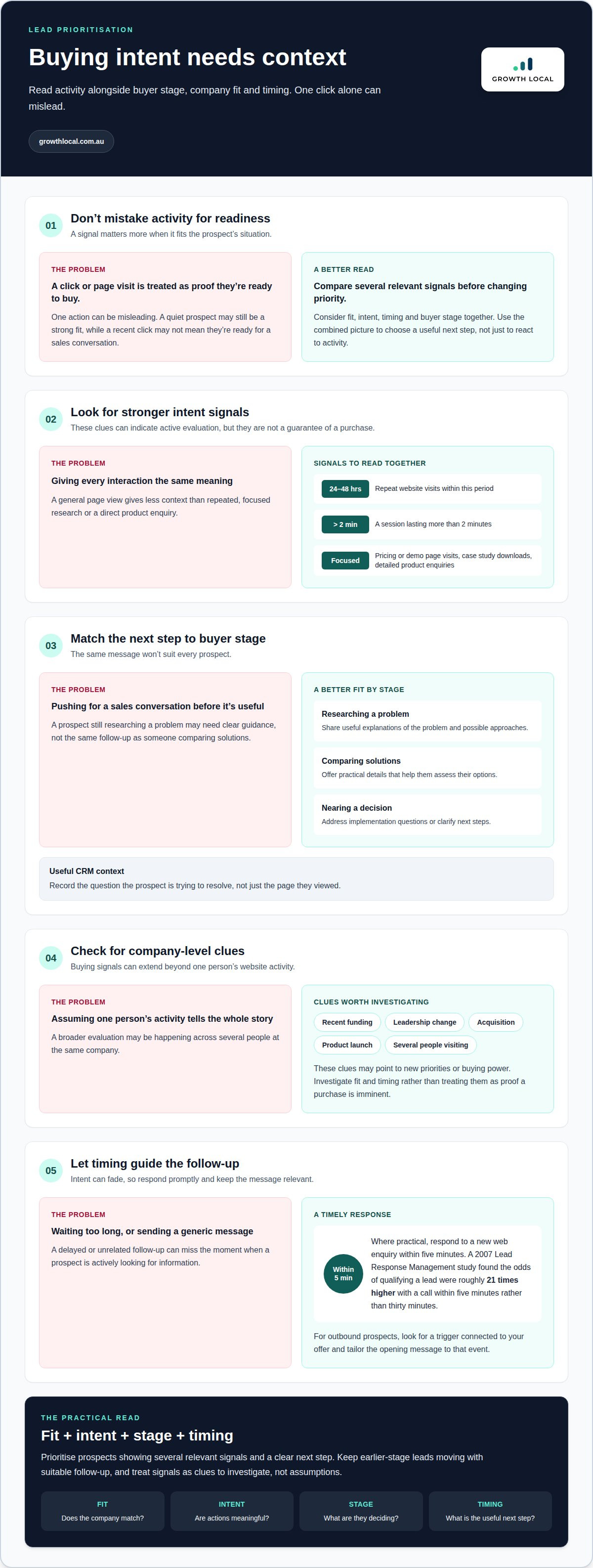
Lead prioritisation helps a sales team decide which prospects need attention first. Lead scoring supports that decision by ranking prospects according to fit, behaviour and interactions with the business. A strong-fit prospect who requests a demo may belong in a higher-priority category than someone who has only viewed a general page.
Lead scoring, lead qualification and sales prioritisation do different jobs. Scoring assigns value to a prospect’s characteristics and actions; qualification checks whether their needs and buying situation are a match; prioritisation uses both to decide what the sales team should do next. Together, they turn a list of names into clear actions.
Start with an ideal customer profile (ICP), then weigh fit, intent and timing. For example, assess a business by industry, company size, revenue and location, then look for buying signals such as a case study download or webinar attendance. A scoring model can weigh ICP fit, buying intent, timing, persona fit and signal recency, with the balance adjusted to suit the business. Treat the model as a starting point and adjust it to reflect which signals lead to useful sales conversations.
Demographic and purchase-behaviour data can sharpen a score. A business in your target industry may earn fit points, while a prospect requesting product information shows stronger intent. Set categories such as hot, warm and cold based on previous qualification experience. A score should guide a decision, not replace a conversation about the prospect’s actual needs.
In CRM systems such as Salesforce or HubSpot, scoring can be automated by assigning values to profile fields and recorded actions, then applying rules that update scores and lead statuses. Use status fields to make the next step clear, such as calling, following up or nurturing. Review scores and prioritisation rules regularly against conversion outcomes; a lead with a score of 90 last month may need a lower score if engagement has stopped.
Keep the process manageable with a daily routine: review and sort new leads for 20-30 minutes each morning, then schedule two focused follow-up blocks per day, each lasting 45-60 minutes. A CRM can centralise contact details and the history of emails, calls and meetings, helping the team act faster without losing context.
For the best chance of conversion, respond to a new web enquiry within five minutes where practical. The 2007 Lead Response Management study found the odds of qualifying a lead were roughly 21 times higher with a call within five minutes rather than thirty minutes.
Common mistakes include giving too much weight to one click, leaving stale scores unchanged and favouring familiar industries without evidence. Reduce bias with consistent criteria, review score outcomes across lead categories and update the rules when results reveal a mismatch. This keeps prioritisation grounded in fit and behaviour, not assumptions.
2. Buying intent and buyer journey stage
A prospect’s activity means more when you understand what they’re trying to decide. Someone researching a problem needs useful guidance, while someone comparing solutions may be ready to discuss requirements. Match each lead’s engagement to their buyer stage, then prioritise the next step accordingly. This helps your sales team create valuable opportunities without treating every click as a buying signal.
Look for actions that show active evaluation. Repeat visits to your website within 24-48 hours, a session lasting more than 2 minutes, or a visit to a pricing or demo page can indicate stronger intent. A case study download or a detailed product enquiry adds context. One action alone can mislead, so compare several signals and their timing before raising a lead’s priority.
Buyer stage also shapes the right follow-up. Early-stage prospects may need clear explanations of the problem and possible approaches. Those comparing options may want practical details, while prospects nearing a decision may need answers about implementation or next steps. Record the question they’re trying to resolve, not just the page they viewed. This gives your team useful context for a relevant conversation.
Company-level buying signals can reveal opportunities beyond one person’s activity. Recent funding, a leadership change, an acquisition or a product launch may indicate new priorities or buying power. Visits by several people from the same company can also suggest a broader evaluation. Treat these clues as reasons to investigate fit and timing, not proof that a purchase is imminent.
Timing matters because intent can fade. Prioritise inbound enquiries promptly, especially when someone requests information or visits a pricing or demo page. For outbound prospects, look for a trigger directly connected to your offer, then tailor the opening message to that event. Compare conversion rates across triggers and buyer stages to learn which signals lead to real conversations, rather than just activity.
For Australian sales teams, compare buying patterns across regions and industries using your own enquiry and conversion history. Keep regional context in CRM records, and use personal information appropriately, respecting people’s stated communication preferences and applicable privacy obligations. This keeps prioritisation grounded in observed behaviour rather than assumptions about a location.
Review intent signals as a combined picture: company changes, individual engagement, buyer stage and timing. A prospect showing several relevant signals deserves a more useful next action than a contact who has only browsed. If your team needs a clearer way to map those signals into sales conversations, book a demo to discuss the approach.
3. Automating nurture sequences and CRM reminders
Automation keeps follow-up moving when a prospect isn’t ready to decide. A CRM can trigger a relevant email, set a call reminder and update the lead’s pipeline status after a recorded action. The aim isn’t to send more messages. It’s to make the next step clear and timely for each prospect.
Build nurture sequences around the point where a conversation paused. After an initial meeting, send a recap of the prospect’s priorities and agreed next steps. If someone requests more information, send material that answers their request, then set a follow-up reminder. These triggers connect marketing activity to sales action instead of leaving an enquiry untouched.
Use CRM reminders for specific commitments, such as a scheduled check-in, a call after a proposal or a deadline the prospect has mentioned. Assign each task an owner and a reason, so the sales team knows what to do and why. A reminder that says “follow up” lacks context. “Call to discuss the proposal questions raised in the last meeting” gives the next action a purpose.
A commonly used B2B benchmark is three to five contact attempts over two to three weeks before closing a lead. Treat this as a planning guide, not a rigid sequence. Vary the approach where it makes sense: a useful email, a call, then a follow-up that refers to the prospect’s stated need. If the prospect replies, update the CRM and stop any automated messages that no longer fit.
Make messages responsive to signals. A prospect who opens an email or clicks a link may merit relevant follow-up, but that action alone doesn’t prove readiness to buy. Check previous conversations, requests and sales status in the CRM before sending. If the lead has asked to pause, record that preference and ensure the sequence respects it.
Review each sequence against pipeline movement, replies and conversion outcomes. If prospects repeatedly ask the same question, improve the message or add a helpful resource at that point. If a sequence creates activity without useful conversations, change its trigger or content. The goal is a practical strategy that supports decision-making, not an automatic stream of emails.
Start with a common scenario, such as a lead requesting more information. Map the trigger, message, reminder, owner and exit condition in your CRM. Test the sequence with a small group, check that each task appears as intended, then refine it using sales feedback. This keeps automation useful, measurable and connected to the work of moving opportunities through the pipeline.
4. Buyer intent and technographic signals
Intent data shows what a prospect is actively researching; technographic data shows the technology a business uses. Combine both with ideal customer profile criteria to judge whether a lead deserves priority. For example, a company may match your target industry but use a system your solution doesn’t support. That may indicate a poor fit, even if the company has visited your site.
Start by listing the technologies relevant to your offer. These might include a CRM, booking platform or existing marketing system. Then separate required integrations from useful indicators. A prospect already using a compatible platform may be easier to serve, while a business with a clear gap may have a strong reason to consider a change. Neither signal proves buying intent on its own.
Sales intelligence tools can enrich lead records with firmographics, technographics, direct dial numbers and buying signals. Use consistent fields to capture the source and date of each signal, then compare it with the prospect’s recent engagement. A technology match plus a relevant enquiry is stronger evidence than an old record showing a software product alone. Tracking context helps the sales team decide whether to act, research further or nurture.
Intent signals can come from website visits, form submissions, content use and email clicks. Technographic clues add another layer: a prospect’s current tools may reveal a workflow problem, an integration need or a reason to explore alternatives. Record the observed signal and its likely business relevance separately. This keeps assumptions from becoming facts in the lead record.
Use more than one source where practical, but don’t treat every data point as equally reliable. Forrester’s Q1 2023 global survey found that over 70% of intent-data users used multiple providers, while almost half used three or more sources. A team can apply the same principle by checking intent against CRM engagement and company information, rather than ranking a lead from one isolated signal.
Tie scoring criteria to the decision your team needs to make. A compatible technology stack may increase fit; repeated research into a relevant topic may increase intent; a recent, specific enquiry may justify faster follow-up. Conversely, an outdated technology record or activity unrelated to your offer should carry little weight. Review how these signals relate to qualified opportunities, then adjust their influence based on actual sales outcomes.
Finally, make the next action clear. If technology fit is strong and the prospect is actively researching a relevant solution, assign a sales conversation. If fit looks promising but intent is limited, gather useful context or add the lead to relevant nurture. This approach helps turn data into better priorities without confusing a long technology list with a ready buyer.
5. Prioritising leads by sales-funnel position
A lead’s funnel position shows how close they are to a purchase decision. Sales teams should prioritise prospects nearing a decision, then match follow-up to their current stage. A prospect requesting a proposal needs a different conversation from someone still learning about the problem. Understanding how to prioritise sales leads effectively means turning funnel position into a clear plan for allocating sales effort.
At the top of the funnel, prospects may be exploring a challenge or learning what solutions exist. Share relevant information and record the topics they respond to. Don’t treat an early enquiry as sales-ready just because it arrived first. Keep the lead visible in the pipeline, with a next step suited to their research stage.
Middle-funnel prospects are comparing approaches or considering whether a solution fits their needs. Check the CRM for specific questions, meeting notes and requested information. For example, a prospect asking how a service fits an existing workflow may need a practical discussion, not another introductory email. Progress the lead when their actions show active evaluation.
Bottom-funnel leads are closer to a purchase decision. They may be reviewing a proposal, discussing requirements or asking about implementation. Give these prospects prompt, focused attention and make the next action explicit. If a decision-maker is waiting for an answer, assign an owner and track the follow-up so the opportunity doesn’t stall.
Use stage-entry criteria to stop leads advancing on guesswork. A lead might enter the evaluation stage after a discovery conversation confirms a relevant need. A proposal-stage record should include the proposal and agreed follow-up action. If a prospect’s behaviour changes or a key requirement is missing, move the lead back to the appropriate stage rather than leaving an inflated forecast in the pipeline.
Funnel position and lead scoring work best together. A high score can flag a strong-fit prospect, but stage and recent actions show what the sales team should do next. Review stalled opportunities separately from active ones: a lead that hasn’t responded after a proposal needs a different action from one asking to schedule a decision meeting. Track stage movement, reasons for delay and closed outcomes to improve your prioritisation strategy.
For a practical starting point, define the evidence required at each stage, assign one clear next action, then review pipeline movement with the sales team. Teams learning how to prioritise sales leads effectively can connect daily actions to potential revenue while keeping early-stage prospects in view. Use a demo to explore funnel-based lead prioritisation.
Growth Local: Lead Generation System Setup
Growth Local’s Lead Generation System Setup can help when enquiries arrive through disconnected channels or sales follow-up is hard to manage. Its marketing and CRM systems bring lead capture and CRM processes together, helping you organise prospects, record their status and keep next steps visible. Growth Local also offers CRM Setup and Marketing System Setup to support a clearer hand-off between marketing activity and sales conversations.
This is a practical next step if your team has defined its lead priorities but lacks a consistent way to manage them. Growth Local sets up the systems around your process, making leads easier to track and act on.
Contact Growth Local to discuss your lead generation setup.
Make lead prioritisation part of your sales rhythm
A useful next step is to turn your prioritisation approach into a repeatable team practice. Choose a clear starting point, record why each lead receives its priority, and note the action taken. This gives your sales team a shared basis for decisions instead of relying on individual judgement alone.
Then compare those decisions with what happens next. Look for patterns in which leads progress, which stall and which signals proved misleading. Use those observations to refine your criteria and keep the process aligned with how buyers move through your pipeline. A practical system should help your team use its time deliberately, not add another layer of admin.
Learning how to prioritise sales leads effectively is an ongoing process, not a one-off scoring exercise. Keep the rules clear, make ownership visible and improve the approach as your business gathers useful sales data. Small, considered adjustments can help your team make better use of each opportunity.
Build a process your team can use confidently, then keep refining it as your business grows.
Frequently Asked Questions
What is lead prioritisation?
Lead prioritisation is the process of deciding which potential customers deserve attention first. It helps a business allocate sales time according to factors such as fit, urgency and likely opportunity value. For example, a prospect with an active project and a clear need may warrant a direct conversation, while someone gathering general information may be better suited to ongoing education. The aim is to choose a sensible next action for each lead.
Why should you prioritise leads?
Prioritising leads helps salespeople spend less time on contacts unlikely to progress and more time on conversations with a clear business purpose. It also reduces the risk of overlooking a promising enquiry in a crowded inbox. For example, reserve direct calls for prospects with an active requirement, while sharing relevant information with people still exploring. That gives each prospect suitable attention and makes daily sales work more deliberate.
What is lead prioritisation and why is it important for sales teams?
For a sales team, lead prioritisation is a shared way to decide who owns each opportunity and what action comes next. Without agreed criteria, two team members might pursue the same contact while another enquiry receives no response. A clear process assigns ownership, records why a lead has its priority and sets a follow-up task. That makes handovers easier and gives managers a clearer view of where sales effort is going.
Which lead scoring criteria best predict conversion, such as fit, intent and engagement?
The most useful criteria connect to your actual customers and sales outcomes. Assess whether a prospect matches your target customer profile, has a need your offer addresses and has taken relevant actions. For instance, an enquiry describing a specific operational problem may carry more weight than a general newsletter subscription. Compare qualified and unqualified leads to identify which characteristics and behaviours consistently precede meaningful sales conversations.
How do you build a lead scoring model using demographic, firmographic and behavioural data?
Build your model by selecting fields that distinguish suitable prospects from poor-fit contacts. Demographic details describe an individual, such as their role; firmographic details describe their organisation, such as its industry or size; behavioural data records actions, such as requesting a consultation. Assign points based on each criterion’s importance, then test the scores against past lead outcomes. Remove fields that add complexity without helping the team make better decisions.
How should sales teams prioritise leads using frameworks such as BANT, MEDDIC or ICP fit?
Use these frameworks to structure qualification, not replace judgement. BANT prompts discussion of Budget, Authority, Need and Timing. MEDDIC examines Metrics, Economic buyer, Decision criteria, Decision process, Identify pain and Champion. An ideal customer profile (ICP) checks whether the organisation resembles customers your business is equipped to serve. Choose a framework that fits your sales process, then record evidence rather than treating unanswered questions as negative signals.
How should sales teams balance high-value leads against urgent or highly engaged leads?
Balance value with readiness by separating a lead’s potential from the action needed now. A large potential account may deserve careful planning, while a smaller prospect with an immediate requirement may need a prompt response. Keep both visible, but set different next steps: schedule strategic account work for the former and handle time-sensitive enquiries quickly. Reassess priorities as new information arrives, so assumed deal value doesn’t permanently outrank clear buyer activity.


