
How to capture website leads after hours and route follow-up
An enquiry that arrives after closing still needs a clear next step. Knowing how to capture leads after hours starts with a short website form or chat that collects useful details, acknowledges the enquiry automatically and sends it to the right owner. A team member can follow up early the next business day.
An overnight enquiry can easily get buried in an inbox or sit untouched until someone checks it. A simple process records the lead, confirms receipt to the prospect and shows the right person what to do next.
This guide covers practical steps: collecting useful details without making forms a chore, routing enquiries by service or lead type, and setting clear expectations in the acknowledgement. You’ll also learn how to organise next-business-day follow-up, so your team can respond promptly without implying live help is available when nobody is on duty.
Key Takeaways
- Keep enquiry forms short and make it easy for website visitors to share the details needed for follow-up.
- Route each new lead by enquiry type, service or sales owner so it reaches the right person.
- Use an immediate acknowledgement to confirm the enquiry arrived and set a clear expectation for a reply.
- Prepare a next-business-day follow-up queue so overnight leads don’t get lost in busy inboxes.
- Match the response to the enquiry: offer self-service booking where it fits, and schedule a personal conversation when it doesn’t.
1. How do you capture leads from website enquiries after hours?
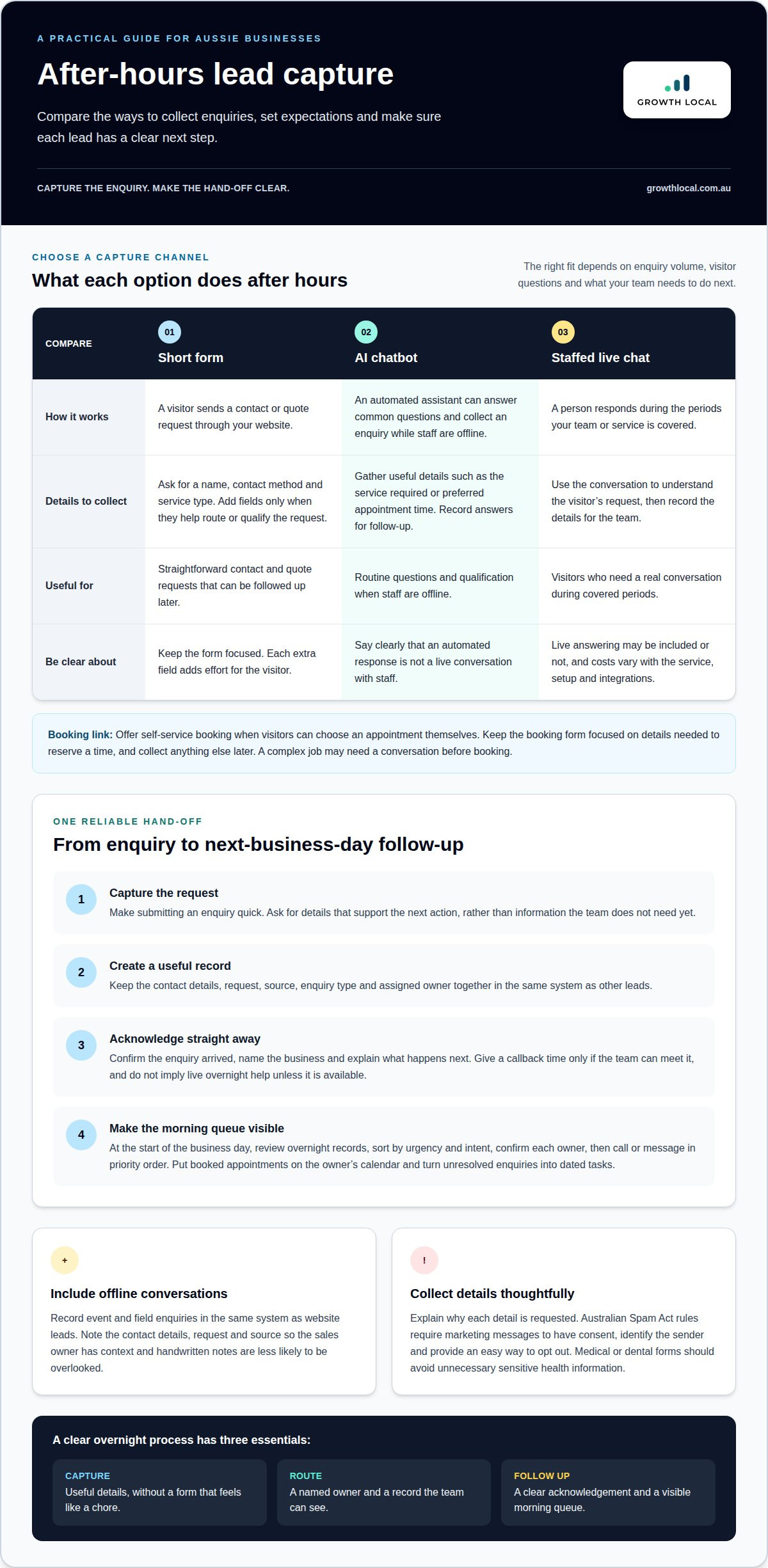
A short contact or quote form gives visitors a clear way to enquire after hours. Place it on relevant pages and request only details needed for follow-up, such as a name, contact method and service type. Each extra field adds effort, so ask for more only when it helps route or qualify the request. A practical way to capture leads after hours is to make submitting an enquiry quick and straightforward.
Live chat and AI chatbots can collect enquiries while staff are offline. An automated assistant can answer common questions, gather visitor details, qualify a request and send it to the business. Ask for useful routing details, such as the service required or preferred appointment time. Make clear that an automated response isn’t a live conversation with staff, and record the answers for follow-up.
Australian businesses can use staffed live chat during covered periods or an AI chatbot to collect details after hours. Costs vary depending on the software, setup, integrations and whether live answering is included. The right tool depends on enquiry volume, the questions visitors ask and what the business needs to do next.
Capture enquiries from events and field conversations, too. Record the person’s contact details, request and source in the same system as website leads. This gives the sales owner useful context and helps prevent event contacts or handwritten notes from being overlooked. For example, a staff member can log that someone requested a quote at an event and assign the enquiry for follow-up.
Ask only for information that supports the next action. A straightforward quote request may need a contact method and brief description. A complex job might need a conversation before booking. Offer a booking link when visitors can choose an appointment themselves. Keep the booking form focused on details needed to reserve a time, and collect anything else later.
Consent and privacy matter when collecting details or sending follow-up messages. Australian Spam Act rules require marketing messages to have consent, identify the sender and provide an easy way to opt out. Medical or dental forms should avoid collecting unnecessary sensitive health information. Explain why each detail is requested, and separate a request for a response from permission to receive ongoing marketing.
If you’re deciding how to capture leads after hours, connect each channel to a clear follow-up workflow. Check that each form or chat submission creates a record with its source, enquiry type and assigned owner. This gives the team useful context and helps prevent visitors from having to repeat themselves. It also makes missed hand-offs easier to spot and fix.
2. Routing leads to the right sales owner
A captured enquiry needs an owner, not just a place in the CRM. Set routing rules around service type, location, lead intent or the team responsible for that work. For example, a solar enquiry can go to the solar sales queue, while a general service request goes to the relevant local team. Record the rule and lead source on each CRM entry.
Set up the hand-off to happen as soon as an enquiry arrives. A useful CRM record includes the contact’s details, request, source, priority and next action. Use required fields and clear ownership so nobody assumes someone else will respond. If several staff share a queue, assign one person first, then set a fallback owner when that person is unavailable.
Lead intent can guide priority. Someone requesting a quote or asking to start work soon may need a faster call than someone browsing general information. For example, repeated visits to a pricing page within a week can trigger a high-priority record and a sales notification. Keep that signal with the enquiry, so the morning owner understands why it needs attention.
After hours, use separate rules for calls and web enquiries. A caller seeking urgent help may need a clear call option or an on-call process the business can actually support. A quote enquiry can receive an automatic acknowledgement, then enter the morning call queue. Don’t route every missed call to the same staff member if the request belongs to another team.
Live answering services, chatbots and automated forms do different jobs. A live answering service lets a person speak to someone, while a chatbot or form collects information and records the request for later follow-up. Chat and forms suit routine qualification; a caller with a complex request may need a conversation. Choose routing based on urgency and the appropriate next step.
Make the morning routine visible in the CRM. At the start of the business day, review overnight records, sort by urgency and intent, confirm each owner, then call or message in priority order. Put booked appointments on the owner’s calendar and turn unresolved enquiries into dated tasks. This keeps overnight leads from disappearing beneath newer activity.
Keep routing rules easy to maintain. When a staff member changes roles or a service area shifts, update the CRM assignment and test a sample enquiry. A notification should reach the assigned owner, while the record stays available to the team if nobody responds promptly. To see how an automated lead-routing workflow can connect these steps, review the process in action.
3. After-hours acknowledgement and next-business-day follow-up
Send an acknowledgement as soon as a website form arrives, even outside business hours. The message should confirm the enquiry was received, name the business and explain what happens next. For example: “Thanks for your enquiry. Our office opens at 8:00 a.m. A team member will call by 9:00 a.m.” Only give a callback time the team can meet. Don’t imply someone is available live overnight unless that’s genuinely how the business operates.
Keep the first message useful and brief. Confirm the request, repeat the contact method provided and set a clear next step. If a visitor asks for a quote, the acknowledgement can say the team will review the details and follow up during business hours. Avoid sending extra messages overnight. One clear confirmation gives the person a record and avoids confusion about whether a human has replied.
Set a morning routine before leads arrive. At the start of each business day, open the overnight enquiry queue, check contact details and sort requests by urgency. Assign each lead to an owner, then make the first call or send a personal message. If a customer wants work completed that week, an appointment link can let them choose an available time sooner.
Give the next-business-day promise a practical deadline. One recommended approach is to acknowledge immediately and have a team member reply by 10 AM the next business day. A business that opens at 8:00 a.m. might set an earlier callback expectation, such as 9:00 a.m., if its morning workflow supports it. Put the promised time in the autoresponder and CRM task so both the customer and owner have the same expectation.
Missed calls need their own acknowledgement path. A missed-call text-back can send a message promptly, confirming the call and asking what help the person needs. Include the business name and explain when a team member will return the call. If the caller leaves voicemail, attach it to the lead record and assign a callback task for the next business morning.
Keep automated answers within their limits. An autoresponder can confirm receipt and share practical details, but it shouldn’t present itself as a live person or promise immediate service. Route urgent requests according to the business’s actual operating process. For routine enquiries, use the morning call to answer questions, clarify the job and agree on the next action.
Close the loop in the CRM after each attempt. Record whether the customer answered, requested a different time or needs more information. If there’s no response, schedule a sensible follow-up rather than sending repeated messages in quick succession. This gives the next owner a clear history and makes the next action visible, even when the original team member is away.
4. Why after-hours website leads matter
Your website stays open after the team clocks off. Someone comparing services in the evening can submit an enquiry, call or leave without making contact. If the next step is hard to find, that opportunity may disappear before business hours begin.
That makes conversion optimisation practical, not cosmetic. Review pages that attract enquiries and remove friction from the next action. Put a clear contact option near the service information, explain what happens after submission, and make sure the form works smoothly on a phone. A visitor ready to ask for a quote shouldn’t have to hunt through menus.
Mobile matters because potential customers may be browsing between tasks, not sitting at a desk. Keep the phone number easy to tap and consider a call or text action that stays visible as visitors scroll. Test the full journey on a mobile screen: open a service page, find the contact option, submit the form and confirm that the acknowledgement appears.
AI website chat can turn an unanswered visit into a useful conversation. An automated assistant can answer common questions, collect contact details and qualify an enquiry when staff aren’t online. For example, it can ask which service someone needs, then record the request for a human to follow up. Keep automated answers within the information the business can stand behind.
Measure the full journey, not just form submissions. Track visits, enquiries, qualified leads, booked appointments and resulting sales by source and time of day. Calculate the conversion rate by dividing enquiries by visits, then compare later stages to see where leads drop away. To assess ROI, compare the value generated by after-hours leads with the related capture and follow-up costs.
Use a consistent baseline before judging changes. One suggested approach is to review leads from the previous 30 to 90 days, then compare similar periods after adjusting the website or follow-up process. Unbounce’s 2024 Conversion Benchmark Report gives a 6.6% median landing-page conversion rate. Treat that as broad context, not a target for every Australian business, because page purpose and audience affect results.
Source tracking helps explain what creates results. Label each record with its page, campaign and arrival time, then compare after-hours enquiries with daytime ones. If mobile visitors start conversations but don’t submit forms, simplify the form or make chat easier to find. If an update makes no difference, test one part of the journey at a time and measure again.
5. Why after-hours leads are lost
An enquiry can be captured and still go nowhere. A prospect may submit a form, but a vague confirmation leaves them unsure whether it worked. If the page promises a callback without saying when, they may keep searching and contact another business. Make the next step specific: confirm receipt, set a realistic response expectation and explain what information the team will review.
Timing is only part of the problem. A lead can go unnoticed because it arrives through a channel nobody checks, such as a website chat inbox separate from the CRM. Map each channel to a record and an owner. Then test the route with a sample enquiry, from submission through notification, to see exactly where a hand-off fails.
Visitors also abandon enquiries when the next action feels like hard work. For example, a mobile form asking for a long job history may put off someone who only wants a quote. Remove fields that don’t help with the first response, keep the contact option easy to find and explain why each requested detail matters. A shorter path gives a ready prospect less reason to leave.
A mismatch between the page and follow-up can undermine trust, too. Someone who clicks an ad for a specific service expects the form and confirmation to reflect that service. If the response asks them to repeat details they already submitted, the business looks disorganised. Keep the campaign, landing page and CRM record connected, then pass the original request to the person following up.
Unclear ownership creates another gap. If two sales staff assume the other person has the lead, nobody follows up. Assign one owner, show the next task in the CRM and add a backup route for absences. Review unassigned records during the morning queue check. This simple process exposes a breakdown before the prospect has to send another message.
Finally, don’t judge lead capture by form volume alone. Compare the source, service requested, contact outcome and booked work. If a channel brings visitors but few qualified enquiries, inspect its page and message before increasing promotion. If qualified leads go cold after submission, focus on the hand-off and response timing. The pattern points to the fix.
Growth Local: Lead Generation System Setup
Growth Local can help when website enquiries arrive but capture, routing and follow-up happen in disconnected systems. Its Lead Generation System Setup connects the steps that turn an enquiry into an assigned sales task. CRM Setup can organise lead records and ownership, while Marketing System Setup can align enquiry sources with follow-up. An AI Receptionist can automate the initial handling of incoming enquiries when your team is unavailable.
This is a practical next step if leads are missed, duplicated or left without a clear owner. Growth Local can shape the setup around your enquiry channels and the hand-offs your team needs, without promising live human support after hours.
Contact Growth Local to discuss your lead follow-up process.
Make after-hours follow-up part of the system
A plan for how to capture leads after hours works best when it fits how your team operates. Decide who owns overnight enquiries, what the first business-day action should be and how the team records the outcome. Then review real enquiries regularly. Look for stalled hand-offs, questions visitors keep asking or steps that make prospects abandon the process.
Use those patterns to make targeted improvements rather than rebuilding everything at once. If enquiries arrive but don’t become conversations, adjust the follow-up process. If visitors leave before submitting details, simplify the page or clarify the next action. Make each change to address a specific sticking point, then track the results over time.
A dependable process doesn’t need to be complicated. It needs to capture the enquiry, make ownership clear and give your team a practical next step. With those foundations in place, you can improve the experience as your business grows.
Frequently Asked Questions
How do you capture leads from website enquiries after hours?
Give visitors a clear way to make contact, then connect each submission to a follow-up process. For example, a property maintenance business could ask what type of repair is needed and whether the request is urgent. The enquiry record should retain the page or channel it came from, so the person following up understands the context and doesn’t have to start the conversation from scratch.
What is lead capture?
Lead capture is the process of collecting and recording details from someone interested in a business’s services. A website form, chat conversation, phone call or event sign-up can all create a lead. What matters is what happens next: the record gives the team enough context to respond, assess the request and decide on a suitable next action, rather than leaving a name in an isolated inbox.
Can AI give a quote after hours?
AI can provide an indicative quote when the business has supplied clear pricing rules and the visitor’s request fits them. It can ask about factors such as the service needed and job scope, then explain the next step. For unusual work, missing details or a complex quote, collect the request and arrange a conversation with a person instead of presenting an unreliable figure as final.
How does missed-call text back work?
A missed-call text-back automatically sends a message after an unanswered call. It can identify the business, acknowledge the call and invite the person to describe what they need. For example, a customer who calls while a tradesperson is on a job can reply with the type of work required. The response should create or update a lead record, so the team can return the call with context.
Is an AI chatbot on your website worth it?
An AI chatbot can be useful if visitors ask repeat questions or submit enquiries outside staffed hours. It can collect details and organise requests for later follow-up, but it needs accurate business information and a clear hand-off when it can’t answer. A business receiving few chat enquiries may get more value from improving its contact form first. Judge the chatbot by qualified enquiries and completed next steps, not chat volume alone.
What are the best ways for Australian businesses to capture leads after hours?
Match the method to the enquiry. A short form suits quote requests, chat can collect context through a conversation, and a booking tool helps when customers can choose an appointment themselves. For urgent or complex work, provide a clear route that reflects the business’s actual operating process. Whichever channel you use, connect it to a record with the enquiry source and a clear follow-up owner.
How can an Australian business set up an after-hours website lead form?
Choose a form builder connected to the business’s lead record system, then create fields for contact details, service requested and a short description. Add a confirmation message explaining when the team will respond. Test the form on a mobile phone and check that a real submission reaches the correct queue. Keep marketing consent separate from the request for a response, and make the form’s purpose clear.
How can businesses use SMS or WhatsApp to follow up with after-hours enquiries in Australia?
Use the channel the person provided or agreed to use, and keep the first message relevant to their enquiry. Identify the business, confirm the request and explain the next step. If a message is marketing, Australian Spam Act rules require consent, sender identification and an easy way to opt out. Record the contact preference and message history so another team member can continue the conversation appropriately.


