

How to Calculate CRM ROI for a Service Business
A CRM bill is easy to see. Its payoff can be harder to pin down when faster follow-ups, fewer missed enquiries and more booked jobs may have several causes. This guide explains how to calculate CRM ROI for service business workflows using outcomes your team can track, rather than generic figures that overlook how service businesses operate.
You’ll learn how to count the full cost of a CRM, including software, setup, training and staff time, then compare it with measurable gains in productivity and gross profit. You’ll also learn how to assess the CRM’s contribution without claiming more than the evidence supports.
We’ll work through a repeatable calculation using your own business figures, look at the lead stages and workflows that make CRM data more useful, and cover what to do when the return is weak or difficult to attribute. The aim is to understand what the CRM is delivering and identify where to improve.
Key Takeaways
- Measure financial outcomes, not just logins or activity, by connecting CRM use to results that matter to your service business.
- Count the full investment, including subscriptions, setup, integrations, training and staff time spent implementing or running the system.
- Calculate CRM ROI for your service workflows using a baseline, attributable benefits and total costs.
- Compare results before and after implementation, while accounting for changes in demand, pricing, staffing and other campaigns.
- Turn the findings into a clear next step: retain, refine, expand or reassess a workflow. Name one bottleneck, assign an owner and set a review date.
Why CRM ROI matters for a service business
A CRM can show more enquiries logged, follow-ups completed and quotes moved to the next stage. Those are useful signals, but they don’t prove the system is paying for itself. The key question is whether changes supported by the CRM create measurable business value after you account for the full investment.
CRM ROI is the financial value reasonably attributable to using a CRM, compared with the full cost of implementing and operating it. Revenue growth alone isn’t ROI. More sales may look impressive, but revenue doesn’t show how much extra gross profit the business kept, what the CRM contributed or what it cost to achieve the result.
That distinction matters in service work, where a lead can pass through several steps: an enquiry arrives, a quote is sent, work is booked and the customer may return. A well-organised CRM can make those steps easier to track. For a general foundation on managing customer relationships, see this Customer Relationship Management (CRM) overview.
What counts as a return from a service-business CRM?
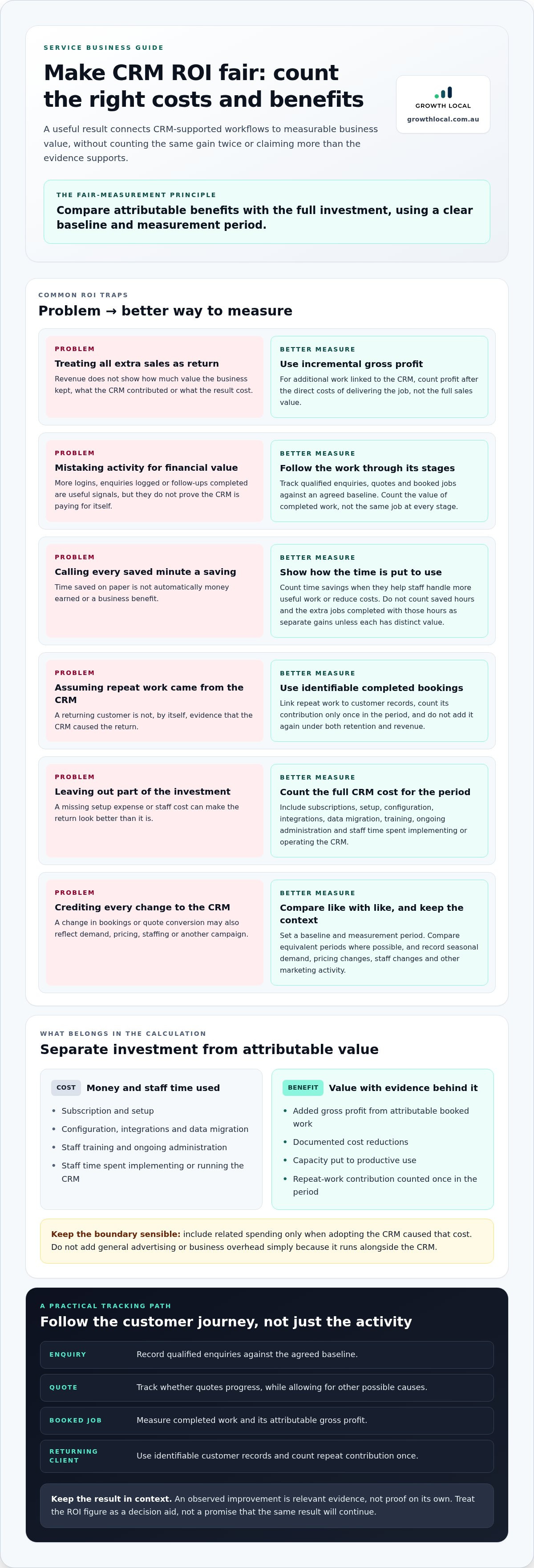
Start with incremental gross profit, not the full value of sales. If better follow-up helps you win more jobs, count the additional profit after the direct costs of delivering that work. This gives a more realistic picture than treating all new revenue as a return.
Time savings can count too, but only when they have practical value. If a workflow reduces the time staff spend searching for customer details, that time is a benefit only if it frees them to handle more useful work or helps reduce costs. Time saved on paper isn’t automatically money earned.
Repeat work and retention may also contribute when customer records let you identify returning clients reliably. Use evidence such as completed bookings linked to identifiable customers, rather than assuming every returning client came back because of the CRM.
Why a CRM ROI figure needs context
A percentage without context can mislead. The measurement period, starting baseline and normal business conditions all shape the result. Compare equivalent periods where possible, and record changes such as seasonal demand, new pricing, staff changes or other marketing activity that could affect enquiries and bookings.
Separate an observed change from one reasonably attributable to CRM use. If more quotes turn into booked jobs after the team starts using structured follow-ups, that’s relevant evidence, but it isn’t proof on its own. Demand may have risen, or another campaign may have brought in better-qualified leads. Clear lead stages and consistent records make the connection easier to assess.
So, how to calculate CRM ROI for service business owners starts with a fair question: what changed, what might the CRM have influenced and what did the business invest? Treat the ROI percentage as a decision aid, not a promise that the same result will continue. It can help you decide what to investigate or improve next while allowing for uncertainty.
Which CRM costs and benefits belong in the calculation?
A fair ROI figure starts with a complete cost list and a careful choice of benefits. Leave out a setup expense and the return looks better than it is. Count the same improvement twice and it looks better still. Choose one measurement period and set clear rules for what qualifies.
CRM tools can support different parts of customer management, from sales records to service workflows. Understanding CRM and its applications can help clarify the system’s scope, but your calculation should reflect the features and processes your business actually uses.
Build a complete CRM investment figure
Choose a period first. Then include recurring expenses that fall within it and one-off implementation expenses relevant to that period. Record subscriptions, setup, configuration, integrations, data migration, staff training and ongoing administration. Include internal staff time when employees spend working hours setting up or operating the CRM.
Keep the boundary sensible. Don’t add general advertising or business overhead simply because it runs alongside the CRM. Include related spending only when adopting the CRM caused that cost.
Value service-business benefits without double-counting
Choose a small set of outcomes that connect the workflow to completed work. For example, track qualified enquiries, quote conversion and booked jobs against an agreed baseline. A CRM-supported follow-up may help a quote progress, but don’t count the same job as a full benefit at every stage.
Estimate the gross profit from additional work reasonably linked to the CRM, not the job’s full sales revenue. If a customer books repeat work, count its contribution only once in the period. Don’t add it again under both retention and revenue.
Apply the same care to time saved. If staff spend less time finding enquiry details, explain whether that time is used to handle more quotes or reduce paid hours. Don’t count saved hours as a benefit and then count the extra jobs completed with those hours as a separate gain, unless you can show each represents distinct value.
Quick checklist: costs are the money and staff time used to implement and run the CRM; benefits are attributable gross profit, documented cost reductions and capacity put to productive use.
- Direct costs: subscription, setup, configuration, integration, migration, training and ongoing administration.
- Business benefits: added gross profit from attributable booked work, evidenced cost reductions and capacity put to productive use.
To make the figures more reliable, align CRM lead stages with the real path from enquiry to quote to booked job. If that path is hard to measure, improve the workflow before calculating ROI. This gives your CRM setup and measurement a practical starting point.
How to calculate CRM ROI step by step
A useful calculation follows one defined workflow from its starting point to a business result. For a practical way to calculate CRM ROI for service business operations, focus on the path from enquiry to quote to booked work, then use figures from the same period. The Calculating CRM ROI step-by-step guide also highlights the need to identify relevant costs, benefits and performance measures.
Set the baseline and choose a fair comparison
Before measuring change, write down what was happening before the CRM workflow changed: enquiry volume, how follow-ups were handled, quote conversion, booked jobs and relevant costs. Choose a comparison period that suits your business and note factors such as shifts in demand, pricing or staffing. Be specific about which workflow the CRM is meant to affect, so the calculation doesn’t claim credit for every change.
- Set the scope. Choose the workflow, team and measurement period. For example, assess how structured follow-up affects quotes for one service line.
- Record the baseline. Capture starting enquiry and sales measures, along with the process and costs involved. Use the same definitions throughout, so “booked job” means the same thing in both periods.
- Measure outcomes. Compare the baseline with the later period. Identify changes in qualified enquiries, quotes progressed and jobs booked, then estimate only the benefit reasonably attributable to the CRM workflow.
- Total CRM costs. Add the relevant costs for that period, including recurring and one-off expenses allocated to it. Keep the basis consistent with how you measure benefits.
- Calculate and interpret. Subtract CRM costs from attributable benefits, divide by CRM costs and multiply by 100.
Calculate and explain the result
Use this formula: ROI = (attributable benefits − CRM costs) ÷ CRM costs × 100. Benefits and costs must cover the same period and use consistent units. If benefits are gross profit measured in Australian dollars, compare them with CRM costs in Australian dollars for that period, not with total sales revenue or costs from a different timeframe.
Here’s a made-up example to show how the calculation works, not to set a benchmark. Assume a business estimates A$12,000 in additional gross profit attributable to improved quote follow-up over a chosen period. Its CRM costs for the same period total A$6,000.
(A$12,000 − A$6,000) ÷ A$6,000 × 100 = 100% ROI. Keep the inputs visible beside the result. If the extra profit is uncertain, record the assumption rather than presenting it as proven. A negative result, or one that’s difficult to attribute, is still useful evidence. It shows what to investigate, such as incomplete records, a workflow the team isn’t using or an unreliable baseline.
How to test whether CRM gains are real and worth improving
A stronger result on a CRM dashboard doesn’t automatically mean the system caused business growth. More booked jobs might follow a rise in demand, a pricing change, extra staff or another campaign. Correlation between CRM adoption and growth doesn’t prove that CRM caused the growth. Treat the figures as evidence to investigate, not a reason to claim every improvement as a CRM win.
Use a small scorecard tied to the path from enquiry to completed work. Compare the same measures before and after the workflow change, define each measure clearly and note where its data comes from. You don’t need to track everything. Focus on whether the CRM is helping at the point where work moves forward or gets stuck.
Choose measures that match the service workflow
Pick measures your team can define consistently and verify in its records. A practical scorecard might include:
- Lead response: elapsed time from receiving an enquiry to the first recorded follow-up. Source: enquiry and activity records.
- Quote follow-up: share of eligible quotes with a recorded follow-up. Source: quote records and CRM activities.
- Quote conversion: share of quotes that become booked jobs. Source: quote outcomes and booking records.
- Booked work: number or value of completed bookings linked to the relevant enquiry or quote. Source: job or booking records.
Compare each measure with its baseline and use the same definitions in both periods. Before relying on a pipeline report, check that customer records are complete and staff update lead stages consistently. If stages are skipped or bookings aren’t linked back to enquiries, the report may show a tidy funnel that doesn’t reflect what happened. Include repeat work only when customer records let you identify returning clients reliably.
Find the bottleneck before changing the system
Follow a sample of enquiries through the actual hand-offs: who receives the lead, who prepares the quote, how follow-up is recorded and where a booking is entered. Then compare that path with the CRM workflow. A drop between enquiry and quote may point to a different issue from quotes sitting without follow-up.
Look for the cause before adding fields or automation. Staff may not be using the workflow, the stages may not match how jobs are sold, or key information may be missing. Each problem needs a different fix. Aligning CRM stages with real work is a practical part of CRM implementation for small businesses, rather than simply adding more measures to a dashboard.
For a fair view of how to calculate CRM ROI for service business workflows, record what changed alongside the scorecard. Note changes in demand, pricing, staffing and campaigns, then distinguish confirmed results from plausible CRM contributions and uncertain effects. If the signal is weak, improve the records or fix one hand-off before drawing a firm conclusion.
Turn your CRM ROI findings into a practical improvement plan
An ROI figure is useful when it leads to a clear decision. Keep the current workflow, refine it, expand it or reassess whether it suits how your team handles enquiries and jobs. Don’t respond to a disappointing result by adding more features straight away. First, identify what the evidence says is getting in the way.
Choose one bottleneck to address, such as enquiries not progressing to quotes or quotes not receiving timely follow-up. Set a baseline, name the person responsible for the change and choose a review date. Keep the same measure during the review so you can see whether the adjustment made a difference.
Choose the next action based on the evidence
Match your response to the problem. If staff aren’t using the CRM, find where the workflow creates friction and make it easier to follow before adding complexity. If records are incomplete, improve enquiry capture and clarify what each lead stage means. If the process is working, test one improvement against the existing baseline rather than changing several things at once.
- Retain: The workflow is being used and the results support its value.
- Refine: A specific hand-off or stage is slowing progress.
- Expand: The workflow is consistent and there’s a clear reason to apply it elsewhere.
- Reassess: Data or results don’t yet support a confident decision.
Connect measurement to a better-built system
Reliable measurement starts with a workflow that reflects how your team handles leads. Growth Local sets up CRM and marketing systems for service businesses, aligning lead stages and processes so enquiries can be followed through to outcomes. A connected lead-generation system setup can make the hand-off from incoming lead to CRM record easier to track, without confusing more activity with better results.
Use a simple action plan to keep the next test grounded:
- Bottleneck: Name the one point in the customer journey you want to improve.
- Owner: Assign someone to maintain the workflow and check the records.
- Baseline: Record the current measure using a consistent definition.
- Review date: Set a point to check the result and decide whether to retain, refine, expand or reassess.
This makes the answer to how to calculate CRM ROI for service business owners more than a percentage. It becomes a repeatable way to spot gaps, make a measured change and learn from the result. If your current stages don’t match the real journey from enquiry to booked work, start by aligning the setup with that journey before judging the return.
Make your next CRM decision with confidence
Think of CRM measurement as part of business planning, not a one-off check. As your services, customer expectations and team responsibilities change, the information your team needs may change too. Reviewing the system regularly can help you plan capacity, support staff and make investment decisions with less guesswork.
If you’re ready to explore how your systems could support the way your business works, a demo is a practical place to start.
Each improvement in clarity gives you a stronger footing for what comes next. Keep building, keep learning and help your team make steady progress.
Frequently Asked Questions
How do you calculate CRM ROI for a small service business?
Use ROI = (attributable benefits − CRM costs) ÷ CRM costs × 100. To calculate CRM ROI for service business operations, choose a baseline and compare costs and benefits over the same period, using attributable gross profit rather than sales revenue alone. Start with a few measures you can verify, such as quote conversion, booked work and documented time savings. Reconcile bookings against completed job records to catch quotes that never became work.
What costs should be included when calculating CRM ROI?
Include subscriptions, setup, configuration, integrations, data migration, training and ongoing administration where applicable. Include internal staff time if it represents a genuine investment in implementing or operating the CRM. For a practical audit, check supplier invoices and log staff hours during setup or data clean-up. Keep costs within the period being assessed, and leave out unrelated expenses unless the CRM change caused them. This makes it easier to explain how you arrived at the total.
Should CRM ROI be calculated using revenue or profit?
Use attributable gross profit where you can calculate it reliably. Revenue records the sale value, but doesn’t show the direct cost of delivering the booked work, such as labour or materials. If job-level costs are difficult to isolate, state how you estimated gross profit and treat the result cautiously. Check whether cancellations or incomplete jobs affect the figures too. A rise in sales revenue alone shouldn’t be reported as profit or net benefit.
How long should you wait before measuring CRM ROI?
There’s no single measurement window that suits every service business. Base the review on how long your enquiries typically take to reach a meaningful outcome, such as a completed booking, rather than choosing an arbitrary date. Separate open quotes from won or lost work so unfinished opportunities don’t distort the result. If a group of leads is still progressing, mark it as pending and revisit it instead of treating it as a final outcome.
Can you measure CRM ROI if you cannot prove the CRM caused more sales?
Yes, but distinguish observed results from a proven cause. Note other changes, such as a new campaign or revised sales process, and use lead-source records to see whether results differ across enquiry types. Response and follow-up records can show whether the team is using the workflow as intended, but they don’t establish that the CRM created extra sales. Label uncertain benefits as estimates and avoid presenting them as confirmed financial gains.
What does a negative CRM ROI mean?
It means the benefits counted for the period were lower than the costs counted, based on the assumptions used. Before making a decision, check whether the result reflects recurring fees, one-off setup work or benefits that haven’t had time to appear. Then decide whether to improve the workflow, gather stronger evidence or reassess whether the current investment fits the business. A negative figure is a reason to investigate, not an automatic instruction to abandon the CRM.
Is CRM ROI the same as CRM payback period?
No. ROI describes the return compared with the investment over a chosen period; payback estimates when cumulative benefits have covered the initial outlay. For example, ROI can help compare the overall value of two workflow changes, while payback can support cash-flow planning. Use both if you need to judge value and recovery timing, but base each on the same clearly recorded investment assumptions. Neither measure guarantees future results.
What CRM metrics matter most for a service business?
Choose metrics that help answer the decision you’re facing, rather than filling a dashboard with activity counts. Depending on the workflow, track qualified enquiries, quote follow-up, conversion to booked work, repeat business or administration time. Give each measure a clear definition and reliable data source. It can help to select one primary outcome and one supporting check, such as booked jobs alongside quote follow-up, so a change in activity isn’t mistaken for a business result.


