

Handle Too Many Inbound Leads with Smarter Routing
More leads won’t fix a slow handover. Knowing how to handle too many inbound leads starts with routing each enquiry to an accountable person, scoring it by intent and setting a clear response target. For most B2B teams, aim to make the first call attempt within 5 minutes during business hours.
It’s frustrating when a busy team can’t follow up promptly or sales spends time on leads that aren’t ready to talk. A clear process helps you prioritise the right enquiries without letting others slip through the cracks.
This article explains how to set up lead routing, qualification and scoring, then use automation to acknowledge and nurture enquiries while your team is busy. You’ll also learn how to set response-time targets, create a follow-up process and keep conversations personal as lead volume grows.
Key Takeaways
- Route each enquiry to a clearly accountable person using rules such as round-robin, territory or account ownership.
- Score leads by fit and buying intent so your team can prioritise sales-ready prospects and nurture others.
- Use automated acknowledgements and follow-up workflows to keep enquiries moving when your team is busy.
- Set a clear response target, with a first call attempt within 5 minutes during business hours for most B2B teams.
- Keep automated messages relevant by tailoring them to the lead’s needs, activity and stage in the buying process.
1. Lead distribution and sales rep routing
When inbound enquiries pile up, unclear ownership creates delays and duplicate calls. Set a routing rule before the next campaign sends traffic into your funnel. For example, connect each completed form to a named sales representative and record the assignment in your CRM. With automated routing, a representative can be on the phone with a prospect within seconds of submitting their details.
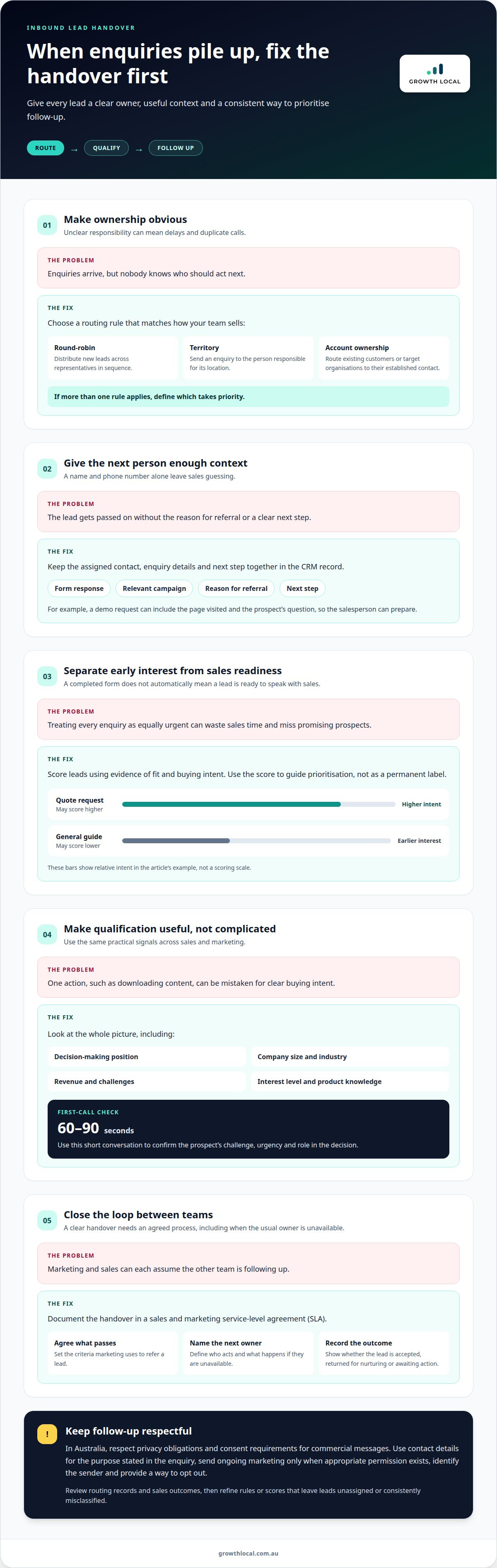
Choose a rule that matches how your team sells. Round-robin routing distributes new leads across representatives in sequence. Territory assignment directs an enquiry to the person responsible for its location. Account-based ownership sends existing customers or target organisations to their established contact. If a lead matches more than one rule, define which takes priority so ownership stays clear.
Make new leads easy to act on. Keep the assigned contact, enquiry details and next step in the same CRM record, then alert the relevant representative. For example, a product demonstration request could include the page visited and the prospect’s question. That context helps the salesperson prepare instead of opening a record with only a name and phone number.
Marketing should qualify enquiries before handing them to sales, using agreed criteria such as the prospect’s needs and level of interest. The handover should include more than a name: capture the form response, relevant campaign and reason for referral. Sales can then see why the lead entered the funnel and what conversation should follow.
Document the handover in a sales and marketing service-level agreement, or SLA. Both teams should agree which leads marketing passes on, what information accompanies them and how sales handles each type. For example, define one route for a high-intent product enquiry and another follow-up for someone who has only downloaded an introductory guide.
A useful SLA also says who owns an enquiry when the assigned representative is unavailable. Set a backup route and make reassignment visible in the CRM. Marketing can then see whether a lead is accepted, returned for more nurturing or awaiting action. This closes the handover loop instead of leaving both teams to assume someone else is following up.
Before contacting a B2B prospect, sales should review their employer, department, position, responsibilities, concerns and decision-making influence. Use those details to open with the prospect’s situation, not a generic product pitch. If a lead seems lukewarm, avoid a hard sell. Explain how the offering could address the challenge they shared and invite a relevant next step.
Review routing records with sales and marketing. Look for unassigned enquiries, repeated ownership changes and handovers returned without a clear reason. Use these examples to refine the routing rules and SLA. Marketing system setup can connect campaign capture, CRM records and handover steps, helping teams manage lead flow without manual sorting.
2. Lead qualification and scoring
Assess each inbound lead consistently instead of guessing from the form alone. Lead scoring assigns a numerical value to show where someone sits between early interest and sales readiness. For example, a prospect requesting a quote may score higher than someone downloading a general guide, particularly if other details match your ideal customer profile.
In Australia, inbound follow-up should respect privacy obligations and consent requirements for commercial messages. Use contact details for the purpose stated in the enquiry, and send ongoing marketing only when appropriate permission exists. Identify the sender and provide a way to opt out of marketing messages.
Build qualification around evidence your team can capture and use. For a B2B enquiry, consider the person’s decision-making position, company size, industry, revenue, challenges, interest level and product knowledge. A smaller company with an urgent need may deserve a conversation, while a large organisation with no clear interest may need more information first.
Keep the scoring model simple enough for sales and marketing to apply consistently. Assign points to useful signals, such as a relevant role, a clear business need or a request to discuss next steps. Subtract or withhold points when key details are missing. A score should guide prioritisation, not replace a conversation or become a permanent label.
Clear accountability matters as much as the score. Assign one or more people to manage inbound enquiries instead of making the whole team responsible. When everyone owns a lead, no one may take the next step. A named owner can review the score, record the outcome and return unsuitable or early-stage leads for further nurturing.
A common mistake is treating every form completion as sales-ready. Another is judging intent from one action, such as a content download, without checking the prospect’s needs or fit. Sales can gather essential qualification information during the first 60-90 seconds of a call. Use that short conversation to confirm the challenge, urgency and role in the decision.
AI voice agents can support initial qualification by asking consistent questions and capturing responses for a human representative. For example, an agent might ask which service the prospect needs and when they hope to proceed. Set clear boundaries for what it handles, and route complex or sensitive enquiries to a person.
Review scores against actual sales outcomes, then adjust criteria that consistently misclassify leads. A walkthrough of an automated qualification workflow can help clarify how scoring, follow-up and human handover fit together.
3. Automated email, demos and chatbots
An automated acknowledgement confirms that an enquiry has arrived, even when nobody can respond immediately. For a form submission, send a short email that names the requested service, explains the next step and sets a clear expectation for follow-up. Keep it useful, not pushy. A generic “we’ll be in touch” gives the prospect little context and doesn’t help your team continue the conversation.
Timing matters after hours. Picture a prospect sending a request at 9 PM on Friday, when the sales team isn’t available. An immediate automated acknowledgement can confirm receipt, then a person can follow up by the next business morning. For after-hours enquiries, a practical workflow can prompt a person to respond within the first hour of the next business day.
Use a chatbot to collect details that will help prepare the next conversation. It might ask what the prospect needs, which service they’re interested in and whether they’d like to book a meeting. Keep each prompt focused and offer a clear way to speak with a person. If the enquiry needs a detailed answer, capture the question and pass it to the right team member rather than guessing.
Automated demonstrations can help prospects understand an offer before speaking with sales. For example, a confirmation email might include a short, relevant demonstration and a way to request a tailored discussion. Match the demonstration to the enquiry: someone asking about a particular feature shouldn’t receive an unrelated product overview. Track whether they watched or requested a meeting, then use that activity to guide human follow-up.
For teams handling high lead volumes in Australia, compare tools by the job they do. CRM workflows organise records, assign tasks and show follow-up status. Email automation sends acknowledgements and planned messages. Chatbots capture information through website conversations. A connected setup can pass chatbot responses into the CRM, while separate tools may require manual updates or integration work.
Choose features to support your handover process, not for a long list of software functions. Check that a workflow can store an enquiry, alert the right person, record communication and stop automated messages when a human takes over. Test a sample lead from form submission through CRM follow-up. This can reveal missing fields, duplicate emails or a chatbot sending enquiries to the wrong place.
Keep automated messages personal by using details the prospect supplied, such as their service interest or stated challenge. Don’t pretend an automated message came from a person, and don’t keep sending a sequence after a representative has started a direct conversation. A lead follow-up workflow demonstration can show how email, chat and CRM steps fit together.
4. Response-time targets for inbound leads
A response target only works if it’s measurable and tied to business hours. For most B2B teams, the recommended target is a first call attempt within 5 minutes during business hours. Set that target in your CRM, then track the time between form submission and the first recorded call.
Speed matters because interest can fade while a lead waits. The MIT Lead Response Management study found the connect rate for a lead contacted within 5 minutes was roughly 100 times the rate after 30 minutes. The same study found qualification odds were roughly 21 times higher within 5 minutes than after 30 minutes.
Use response tiers to protect time for the most engaged prospects. High-intent actions, such as a request for a quote, can trigger an immediate call task. For high-intent page visits and repeat visitors, the guide recommends a 15-minute response target. Content downloads and newsletter sign-ups can receive a response within 2 hours or enter a nurture workflow.
Measure the full sequence, not just the first call. Track median time from submission to first call, the share contacted within your target, connection rate and qualification rate. Then compare qualified leads with sales outcomes. Calculate conversion rates by dividing the leads reaching a chosen stage by the leads entering that stage. Calculate cost per acquisition by dividing campaign spend by acquired customers.
Set a practical follow-up pattern for missed connections. Make 2 call attempts in the first 24 hours, and send an email within 2 minutes after a missed call. Another suggested pattern sends an email within 10 minutes of the first call attempt. Record every attempt, so the next representative can see what happened and avoid duplicate outreach.
Respond promptly to inbound leads, then review any records that are not handled in a timely way. Harvard Business Review follow-up research found companies responding within 1 hour were 7 times more likely to have a meaningful conversation with a decision-maker than companies responding later. Treat that as a backstop, not the goal for high-intent enquiries.
Review results by source, lead type and time of day. If submissions from one campaign wait longer, check whether routing or staff coverage is causing the delay. If calls happen quickly but few connect, compare call outcomes and follow-up attempts. This helps identify whether the bottleneck is speed, contactability or lead quality, so you can improve the process instead of simply asking sales to work faster.
5. How can businesses automate lead routing, qualification and follow-up without losing personalisation?
Automation works best when each lead follows a clear path with human judgement built in. If you’re deciding how to handle too many inbound leads, start by mapping what happens after each enquiry arrives. Set rules for what information to capture, who reviews it and what action follows. Keep exceptions visible so unusual enquiries don’t disappear into a standard workflow.
Use information a prospect has already shared to make each step relevant. If someone describes difficulty managing bookings, send material that addresses that challenge. If they ask about a specific service, direct the enquiry to a representative who can discuss it. Personalisation means matching the message to the person’s needs, not simply adding their name to a generic email.
Build qualification rules around useful signals, such as industry, role, challenge and product knowledge. Don’t ask prospects to repeat details already included in their form. If an answer reveals a complex requirement, create a task for a person to take over. This gives the team a clear route for cases outside the usual workflow without forcing every enquiry through the same script.
Design nurture sequences around what each group still needs to learn. A lead that fits your criteria but shows limited interest could receive helpful material addressing common concerns. Someone who needs to understand how the service works could receive a straightforward process overview. Use a change in activity or a direct reply to prompt a review, rather than letting someone continue through a sequence that no longer fits.
Build handovers and stop rules into the workflow from the start. Pause automated messages when a prospect replies, books a meeting or asks not to receive further contact. If a representative takes ownership, make the change visible in the record. These controls prevent a scheduled email from arriving just after a salesperson starts a personal conversation.
To test how to handle too many inbound leads, run sample enquiries through every route. Include a straightforward request, an incomplete form and a question that needs a human response. Check that each record reaches the right queue, retains its context and prompts an appropriate next step. Review the results with sales and marketing, then adjust rules that create unnecessary handovers or leave gaps.
Automation should handle repeatable steps, while people add context to nuanced conversations. This balance helps teams manage volume without making every interaction feel scripted. If you’re working out how to handle too many inbound leads, map one workflow first, then expand it based on what your team learns.
Growth Local: Lead Generation System Setup
Growth Local helps businesses create a clearer path from new enquiry to sales follow-up through Lead Generation System Setup, CRM Setup and Marketing System Setup. If leads arrive faster than your team can organise them, these services can bring capture, ownership and follow-up into a more structured process. An AI Receptionist can also support the handling of incoming enquiries.
Turn to Growth Local when manual sorting slows your response or your team needs a more consistent way to manage lead flow. The right setup depends on where enquiries come from and how your team qualifies and follows up with them.
Contact Growth Local to discuss your lead-handling needs.
Build a lead process that can grow with you
If you’re still deciding how to handle too many inbound leads, focus on the next operational bottleneck, not another layer of complexity. Are enquiries getting lost before assignment, or are promising prospects waiting while your team catches up? Identifying the pressure point gives you a practical place to start.
From there, build a process your team can use. Keep ownership visible, make follow-up easy to track and leave room for people to respond with context when a prospect needs more than an automated message. Growth Local can help turn those priorities into a connected lead-handling system tailored to how your business works.
A manageable system gives your team more room to focus on conversations that move the business forward. Take the next step when you’re ready and build from there.
Frequently Asked Questions
How do you prioritise inbound leads by intent, fit and urgency?
Rank leads using all three signals rather than treating one action as proof someone is ready to buy. For example, a prospect who fits your target customer profile and requests a proposal with a clear timeframe should take priority over a poor-fit enquiry browsing general information. Record why each lead was prioritised so sales understands the decision.
What is a practical lead scoring model for inbound leads?
Use a simple tier model: strong fit and clear buying intent, potential fit needing more context, and poor fit or low intent. Decide which answers or actions move a lead between tiers, then test those rules against records that progressed to a sale. Remove any signal that doesn’t help distinguish promising enquiries. The model should guide sales’ next action, not make the decision for them.
How quickly should sales teams respond to inbound leads, and what do response-time studies show?
Make the first attempt as soon as a lead reaches its assigned representative, and set a clear target for business hours. The MIT Lead Response Management study and Harvard Business Review follow-up research both report that delays reduce the likelihood of connecting or having a meaningful conversation. Use CRM timestamps to see whether your process meets its target, then investigate delays by lead source and handover stage.
How should sales teams segment leads and set up nurture sequences for leads not ready to buy?
Group leads by what they need to learn or resolve, not just by the form they submitted. A prospect comparing service options could receive a plain-language comparison, while someone unsure about implementation might get a process overview. Make each message answer a likely concern and give the reader a relevant next step. Change the sequence when new activity or a direct reply shows that their needs have shifted.
How can a business increase inbound lead capacity without hiring too many sales staff?
Automate routine administration and let people handle conversations that need judgement. For example, a workflow can capture enquiry details and flag incomplete records, while a representative handles complex requirements or objections. Set a capacity limit for each queue based on who can actively follow up. When that limit is reached, direct new leads to an appropriate holding or nurture path.
What are the risks of over-automating inbound lead follow-up, and how can teams prevent them?
Over-automation can send irrelevant messages, continue after a prospect replies or leave a complex question unanswered. Add stop rules for replies, booked meetings and requests not to receive further contact. Test unusual cases, such as a lead asking about a service outside the usual workflow, and ensure the system routes them to a person. Regularly review sample conversations for missed context and awkward handovers.


