
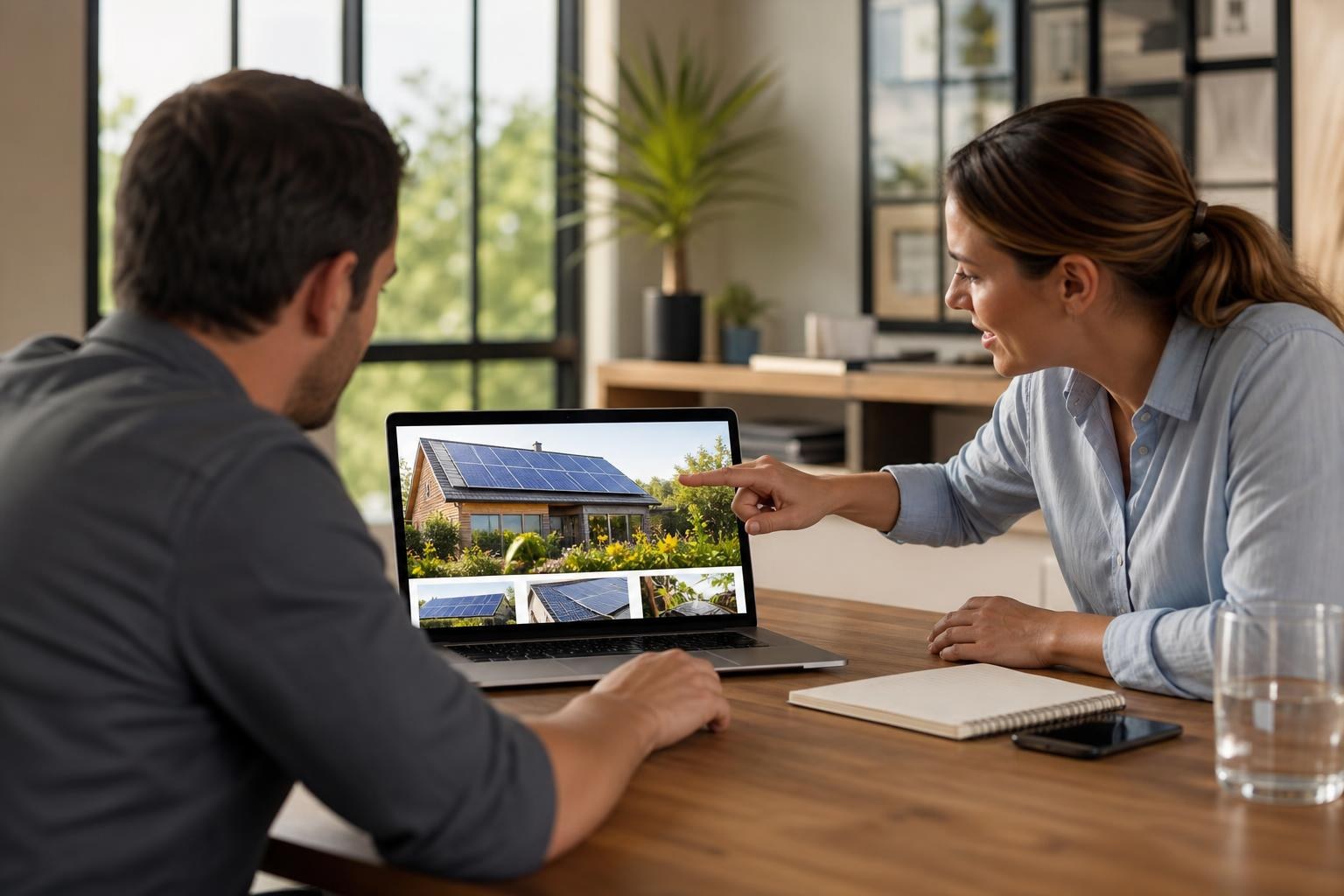
Effective Website Design for a Solar Business
A solar company's website isn't just a digital brochure: it's the first handshake with every potential customer. In Australia, where rooftop solar adoption continues to climb and homeowners are comparing three or four installers before picking up the phone, your site needs to do heavy lifting from the first click. The reality is that most solar businesses lose leads not because their panels or pricing are bad, but because their web presence fails to convert curious visitors into genuine enquiries. Solar-plus-storage demand has increased by 21 percent in recent years, and that growing market means fiercer competition for every click. Getting your website design for a solar business right isn't optional anymore: it's the difference between a pipeline full of qualified leads and a quiet inbox. What follows is a practical breakdown of how to build a solar website that actually works, from visual identity and user experience to technical performance and future-proofing.
Table of Contents
Defining the Digital Identity of a Modern Solar Brand
Establishing Trust through Professional Visuals and Certifications
Communicating Sustainability and Long-Term Value
User Experience Strategies for High-Conversion Solar Leads
Implementing Interactive Solar Savings Calculators
Optimising Mobile Responsiveness for On-Site Enquiries
Streamlining the Quote Request Process
Showcasing Technical Expertise and Case Studies
Developing a Portfolio of Residential and Commercial Projects
Highlighting Real-Time Performance Data and Testimonials
Educational Content and SEO for Renewable Energy
Addressing Common Customer Concerns via Knowledge Hubs
Targeting Local Keywords for Regional Solar Installations
Technical Performance and Compliance Standards
Ensuring Fast Loading Speeds for Media-Heavy Sites
Defining the Digital Identity of a Modern Solar Brand
Your brand identity online is more than a logo and a colour palette. It's the complete impression a visitor forms within the first three to five seconds of landing on your homepage. For solar companies, that impression needs to communicate reliability, technical competence, and environmental responsibility all at once.
The best solar websites in 2026 achieve this through clean layouts, consistent typography, and imagery that feels authentic rather than stock-photo generic. Think real photos of your crew on a rooftop in Western Sydney, not a smiling model pointing at a panel in a field that looks suspiciously Californian. Visitors can spot the difference, and authenticity builds trust faster than any slogan.
Your brand voice matters too. A sparky running a solar installation business in Brisbane speaks differently from a corporate energy retailer. Let that personality come through in your copy. Short sentences, plain language, and a tone that says "we know what we're doing and we won't waste your time" resonates far better with Australian homeowners than jargon-heavy corporate speak.
Establishing Trust through Professional Visuals and Certifications
Trust is the single biggest barrier between a website visitor and a quote request. Homeowners are spending $8,000 to $15,000 on a solar system: they need to feel confident before handing over their details. Professional visuals help, but certifications seal the deal.
Display your Clean Energy Council accreditation prominently. If you're a Tesla Powerwall Certified Installer or an LG Energy Partner, those badges belong above the fold on your homepage, not buried in a footer. The same goes for any relevant electrical licences, public liability insurance details, and warranty information.
Before-and-after project photos with real addresses (with permission, obviously) outperform generic gallery images. Pair them with specific system details: "6.6kW Jinko panels with a Fronius inverter, installed in Penrith, February 2026." That level of specificity signals expertise and gives visitors confidence that you've done this hundreds of times.
Communicating Sustainability and Long-Term Value
Solar buyers are motivated by two things: saving money and reducing their environmental footprint. Your website needs to speak to both motivations without leaning too hard into either one.
The financial angle is straightforward: show estimated savings, payback periods, and current feed-in tariff rates for your state. But the sustainability message requires more nuance. Rather than vague claims about "saving the planet," quantify the impact. A 10kW system in Melbourne offsets roughly 13 tonnes of CO2 annually: that's the equivalent of taking nearly three cars off the road. Specific numbers like these resonate far more than abstract green messaging.
Consider a dedicated page that explains your own sustainability practices: how you recycle packaging, what happens to old panels you remove during upgrades, and whether your supply chain aligns with ethical sourcing standards. These details matter to an increasingly informed buyer.
User Experience Strategies for High-Conversion Solar Leads
A beautiful website that frustrates visitors is worthless. User experience is where design meets revenue, and for solar businesses, the conversion path from "just browsing" to "request a quote" needs to be as short and frictionless as possible. The average conversion rate for solar and renewable energy websites sits around 2.5 to 4 percent, which means most of your traffic leaves without taking action. Every UX improvement you make directly impacts that number.
Implementing Interactive Solar Savings Calculators
Nothing keeps a visitor engaged like a tool that answers their most pressing question: "How much will I actually save?" Interactive solar savings calculators have become standard on high-performing solar websites, and for good reason. They turn passive browsers into active participants.
Renewable energy companies using web-based calculators see significantly higher engagement and lead capture rates compared to static quote forms. A good calculator asks for the visitor's postcode, average electricity bill, roof orientation, and household size, then spits out an estimated system size, annual savings, and payback period within seconds.
The key is keeping it simple. Don't ask for 15 fields of data: five or six is the sweet spot. And always gate the detailed results behind a name and email capture. The visitor gets their estimate; you get a warm lead with enough context to follow up intelligently.
Optimising Mobile Responsiveness for On-Site Enquiries
More than 70 percent of solar research now happens on mobile devices. Homeowners are Googling "solar installers near me" from the couch after dinner, scrolling through options on their phone while watching the footy. If your site doesn't load properly on a mobile screen, you've already lost.
Mobile responsiveness isn't just about shrinking your desktop layout. It means designing for thumb navigation, ensuring buttons are large enough to tap without zooming, and making your phone number clickable so visitors can call with a single tap. Your quote request form should be no more than one scroll on a mobile screen.
Test your site on at least five different devices before launching. What looks perfect on an iPhone 16 might break on a Samsung Galaxy or a budget Android handset. Google's mobile-first indexing means your mobile experience directly affects your search rankings too, so this isn't just about aesthetics: it's about visibility.
Streamlining the Quote Request Process
Every extra field on your quote form costs you leads. The data backs this up: forms with three to five fields consistently outperform those with eight or more. For a solar business, you really only need a name, phone number, suburb, and a rough idea of their electricity bill to start a meaningful conversation.
If you want to qualify leads further without adding form fields, consider using an AI chatbot that asks follow-up questions in a conversational format. Growth Local, for example, has built AI chatbots for trade businesses that handle initial lead qualification 24/7: collecting job details, filtering out tyre-kickers, and even booking site inspections directly into the installer's calendar. With over 1,300 calls handled by their AI receptionists, the approach clearly works for businesses that can't afford to miss enquiries while they're on the tools.
Place your primary call-to-action button on every page, not just the homepage. A visitor reading your blog post about battery storage should be able to request a quote without navigating back to the homepage.
Showcasing Technical Expertise and Case Studies
Solar is a technical product, and buyers want proof that you know your stuff. Case studies and project portfolios do this better than any amount of marketing copy.
Developing a Portfolio of Residential and Commercial Projects
Your project portfolio is your most powerful sales tool online. Structure it by project type (residential, commercial, off-grid) and include enough detail to satisfy both casual browsers and technically minded buyers.
Each case study should include the system size, panel and inverter brands, total cost range, estimated annual generation, and a brief narrative about any challenges you overcame during installation. Did the roof have an unusual pitch? Was there significant shading from neighbouring trees? These details demonstrate problem-solving ability and set you apart from competitors showing nothing but generic gallery images.
For commercial projects, include energy production data and ROI figures where possible. A business owner considering a 100kW system for their warehouse wants to see that you've done similar work and delivered measurable results.
Highlighting Real-Time Performance Data and Testimonials
If your monitoring software allows it, embedding real-time or near-real-time performance data from completed installations is incredibly persuasive. Showing that a system you installed last year is generating 28kWh on a sunny Tuesday in March makes your claims tangible.
Testimonials remain one of the highest-trust elements on any website, but they need to feel genuine. Video testimonials from real customers outperform written ones significantly. Even a 30-second clip filmed on an iPhone of a homeowner saying "our bill dropped from $600 to $80 a quarter" carries more weight than a polished written review.
Automate your review collection process so you're consistently gathering fresh testimonials. Platforms that send automated Google review requests after job completion keep your review count growing without you having to remember to ask every customer.
Educational Content and SEO for Renewable Energy
A solar website that only sells will struggle to rank. Google rewards sites that genuinely help visitors, and educational content is how you earn that trust with both search engines and humans.
Addressing Common Customer Concerns via Knowledge Hubs
Every solar installer hears the same questions: "Will panels damage my roof?" "What happens during a blackout?" "Are batteries worth it yet?" Your website should answer all of these before a prospect ever picks up the phone.
Build a knowledge hub (call it a learning centre, FAQ section, or resource library: the label matters less than the content) that addresses these concerns with honest, detailed answers. The EnergySage marketplace report shows that informed buyers move through the sales process faster and are less likely to ghost after receiving a quote. Educated leads are better leads.
Structure your content around the actual questions people type into Google. Use tools like AnswerThePublic or Google's "People Also Ask" section to identify these queries. Each question becomes a blog post or FAQ entry that can rank independently in search results.
Targeting Local Keywords for Regional Solar Installations
Solar is an inherently local business. Nobody in Townsville is hiring an installer from Hobart. Your SEO strategy should reflect this reality with aggressive local keyword targeting.
Create dedicated landing pages for each suburb or region you serve. "Solar panel installation in [Suburb]" pages with unique content about local conditions (average sun hours, common roof types, council regulations) perform far better than a single generic service page. Solar marketing data shows that localised content drives significantly higher organic traffic for installation companies compared to broad, non-geographic pages.
Don't forget your Google Business Profile. Keep it updated with fresh photos, respond to every review, and post regular updates about completed projects in your service area. This profile often appears above your actual website in local search results, so treat it with the same care.
Technical Performance and Compliance Standards
A slow, non-compliant website undermines everything else you've built. Technical performance is the foundation that all your design and content efforts sit on.
Ensuring Fast Loading Speeds for Media-Heavy Sites
Solar websites are naturally image-heavy: project photos, infographics, product images, and increasingly, embedded video content. All of that visual content creates a loading speed challenge. A site that takes more than three seconds to load on mobile will lose roughly half its visitors before they see a single panel.
The cost of building a solar company website in 2026 varies significantly depending on performance requirements, but investing in proper image compression, a content delivery network (CDN), and lazy loading for below-the-fold images pays for itself through improved conversion rates.
Use WebP or AVIF image formats instead of traditional JPEGs. Compress all images to under 200KB where possible without visible quality loss. Host videos on YouTube or Vimeo and embed them rather than self-hosting large video files. Run Google PageSpeed Insights monthly and treat any score below 85 on mobile as a problem that needs fixing.
Meeting Data Protection and Privacy Requirements
Australian solar businesses must comply with the Privacy Act 1988 and the Australian Privacy Principles (APPs). If you're collecting names, emails, phone numbers, and electricity bills through your website, you're handling personal information that requires proper protection.
Your website needs a clear, accessible privacy policy that explains what data you collect, why you collect it, how you store it, and who you share it with. If you're using third-party tools like Google Analytics, Facebook Pixel, or CRM systems, these need to be disclosed.
SSL certificates (HTTPS) are non-negotiable in 2026: both for security and because Google penalises non-secure sites in search rankings. Ensure your forms transmit data over encrypted connections and that any customer data stored in your CRM meets current security standards.
Future-Proofing Your Solar Website for Growth
The solar industry is moving fast. Battery storage adoption is accelerating, virtual power plants are becoming mainstream, and EV charger installations are increasingly bundled with solar quotes. Your website needs to accommodate these expanding service lines without requiring a complete rebuild every 18 months.
Build your site on a flexible CMS (WordPress remains the most practical choice for most solar businesses) with a modular page structure. New service pages, landing pages for seasonal promotions, and blog content should be easy to add without developer involvement. Effective solar marketing strategies in 2026 emphasise the importance of adaptable digital infrastructure that can respond to market shifts quickly.
Think about integration too. Your website should connect directly to your CRM, your quoting software, and your review management platform. Running disconnected systems: one tool for leads, another for scheduling, a third for invoicing: creates gaps where leads fall through. Growth Local has helped trade businesses consolidate these operations into a single platform, saving over $300K in combined software costs across their client base while ensuring every enquiry gets an instant response.
Plan for scalability. If you're currently a three-person crew doing residential installs, your website should still be structured to accommodate commercial services, battery storage, and EV charging when you're ready to expand. The cost of retrofitting a poorly structured site always exceeds the cost of building it right from the start.
Your solar website is the hardest-working member of your team: it never sleeps, never takes a sick day, and talks to more prospects in a week than your sales team does in a month. Investing in proper design, strong UX, quality content, and solid technical foundations isn't a luxury: it's the most cost-effective growth move you can make. If you're ready to stop losing leads to a website that isn't pulling its weight, book your free Growth Call with Growth Local. They'll map out a plan to keep new, repeat, and referral business flowing in without the constant chasing.


