

Compare receptionist alternatives by staffing and service
A kiosk can handle straightforward visitor check-ins, but it won’t cover every task a receptionist handles. Receptionists in Australia earn between A$43,000 and A$70,000 per annum on average, so the right alternative to hiring a receptionist in Australia depends on whether your main pressure is staffing cost, call volume or in-person service.
If calls go unanswered while your team is busy, or reception duties keep people from their main work, alternatives to hiring a receptionist in Australia may help. The right fit depends on what callers and visitors need and when demand peaks.
This comparison covers kiosks, call routing, shared staffing and virtual receptionist services, including what each can and can’t take off your team’s plate. It also explains how busy periods affect the decision, so you can choose a setup that matches the work instead of paying for coverage you don’t need.
Key Takeaways
- Compare a receptionist’s salary, superannuation and other employment costs with the amount of coverage your business actually needs.
- A kiosk can streamline basic visitor check-ins, while call routing can help direct incoming calls to the right person.
- Part-time or shared staffing can match reception coverage to peak periods without assigning the role to one full-time employee.
- Phone-based virtual receptionist services can help manage calls, but consider which interactions still need a person on site.
- Map your busiest periods and recurring reception tasks before choosing a setup, so you can target the real bottleneck.
1. Receptionist salary and employment costs
A receptionist’s salary is only one part of the employment commitment. A virtual receptionist salary listing states that an additional 11% superannuation applies. Allow for this when comparing employee pay with other reception arrangements. Recruitment, onboarding, payroll administration, equipment and supervision also take time and resources. The exact mix depends on whether the role is mainly phone-based, front-of-house or a blend of both.
For outsourced receptionists handling customer or personal information, Australian privacy obligations depend on the business and the information involved. Give reception staff written instructions about what they may collect, access, record and disclose. Restrict access to the systems and customer details needed for their tasks.
Start with the duties, not the job title. A receptionist may greet visitors, answer calls, coordinate appointments, handle deliveries or support clerical work. A business with regular visitors needs a different setup from one where reception mainly involves managing enquiries and records. Listing the duties makes the staffing decision more practical.
Next, identify which tasks need consistent coverage and which occur only at certain times. For example, a consultancy might need someone to greet booked visitors while its team handles specialist work. If administrative tasks are steady throughout the day, a dedicated employee may fit. If work comes in short bursts, another arrangement may better match demand.
Include the supporting work in your comparison. Recruitment takes time, and a new employee needs training in your processes and systems. If the role involves customer relationship management software, decide who will explain record updates, enquiry handovers and follow-up responsibilities. Clear training helps the receptionist work consistently and gives your team a process to maintain.
Write a role scope that reflects the actual workload. Note whether the person will greet visitors, handle customer enquiries, coordinate appointments or update records. List the software and equipment used, such as a laptop, phone or data-entry system. A specific scope helps distinguish a role requiring broad daily coverage from one focused on particular reception tasks.
Then compare the full employment commitment with the work you need covered. An employee can make sense when reception duties are regular and include in-person responsibilities. If the workload centres on a limited set of calls or administrative tasks, consider whether another staffing model can handle them. Match the decision to the tasks, coverage and support required, not salary alone.
2. Call routing and communications integrations
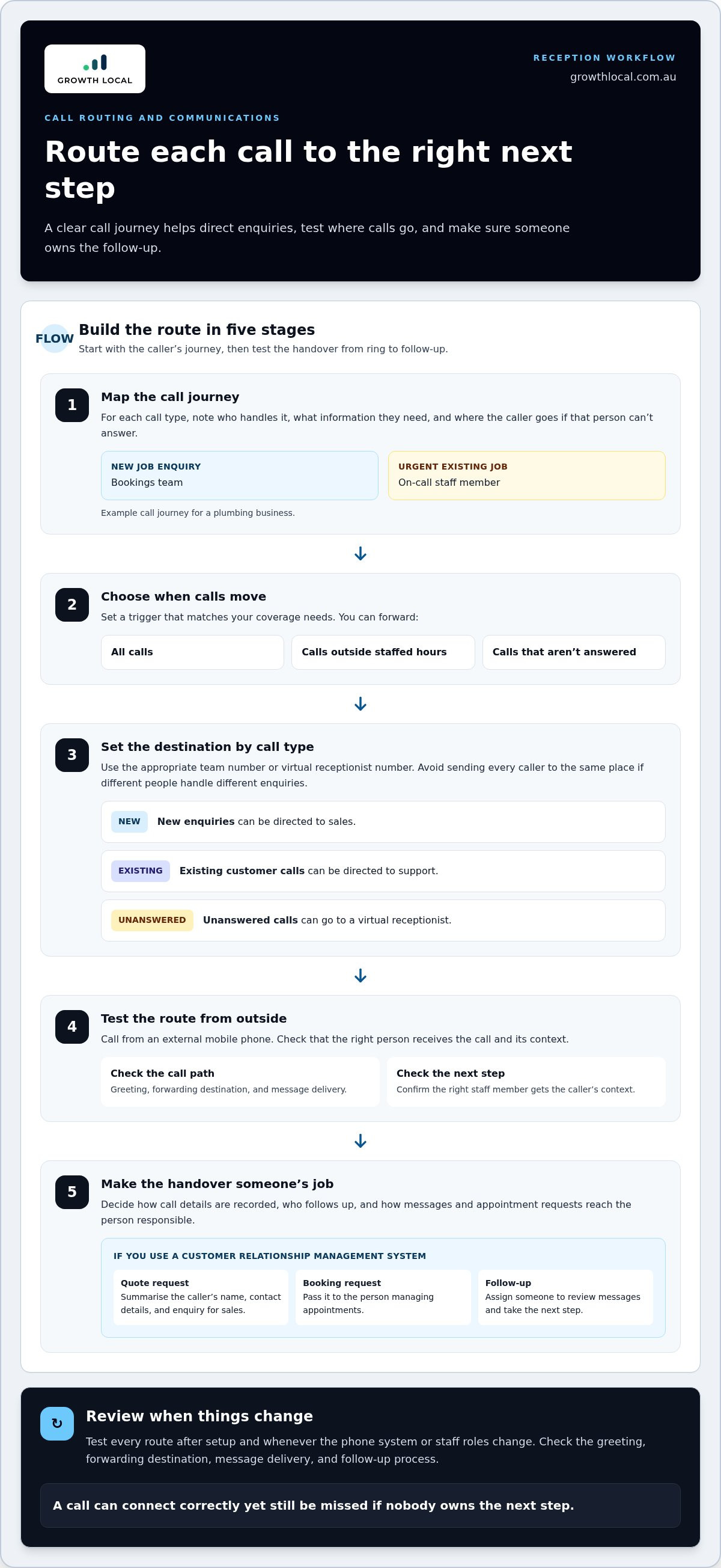
Call routing can send incoming calls to the right person without someone sitting beside the phone. A business can direct new enquiries to sales, existing customer calls to support, and unanswered calls to a virtual receptionist. Set routing rules around how your team actually works instead of sending every caller to the same destination.
To forward calls to a virtual receptionist, use your business phone system or carrier settings to direct calls to the service number. Choose when forwarding applies, such as when the line is busy or unanswered, then test an incoming call from an external mobile phone.
Before changing settings, map the call journey from the first ring to the next action. For example, a plumbing business might route new job enquiries to its bookings team, while urgent calls about existing jobs go to an on-call staff member. Record who handles each call type, what information they need and where the caller goes if that person can’t answer.
- Choose the trigger: forward all calls, calls made outside staffed hours, or calls that aren’t answered.
- Set the destination: use the appropriate team number or virtual receptionist number for that call type.
- Test the route: call from an external phone and confirm the right person receives the call and its context.
- Review the handover: check how messages, appointment requests and follow-ups reach the staff member responsible.
Integrations matter once the call connects. If your business uses a customer relationship management system, decide how call details should be recorded and who follows up. For example, a caller requesting a quote could have their name, contact details and enquiry summarised for sales. A booking request may need a different handover to the person managing appointments.
Keep the caller experience simple. A long menu can make a straightforward enquiry harder, especially when callers can’t identify the right option. Use clear choices such as “new enquiry” and “existing booking”, with a direct path to a person for anyone who needs help. Review the wording when your services or team responsibilities change.
Test every route after setup and whenever the phone system changes. Check the greeting, forwarding destination, message delivery and follow-up process. A call can connect correctly yet still be missed if nobody owns the next step. Assign someone to review messages and update routing rules when staff roles change. This makes call forwarding part of your reception workflow, rather than a forgotten setting.
3. Part-time or shared reception staffing
Reception demand doesn’t always fill a full-time role. Part-time staffing can cover specific periods, such as morning appointment enquiries or afternoon visitor arrivals. Shared staffing goes further: one receptionist handles front-desk duties for more than one business or combines reception with another role. Both options aim to match coverage to actual demand.
Part-time work is already common in this occupation. In the 2021 Census, 67.5% of medical receptionists worked part time in their main job. That figure applies to medical receptionists, not every receptionist role, but it shows how part-time hours fit a real Australian workplace setting.
Peak-hour coverage can also change the cost equation. Part-time receptionist coverage during peak hours can reduce labour costs by 40 to 50 percent. The practical value depends on whether those scheduled hours line up with calls, bookings and walk-ins. A shift that misses the busy window won’t relieve the team when pressure builds.
Start by tracking reception tasks across a normal working week. Note when calls arrive, when visitors turn up and when staff need help with bookings or administration. A dental practice might need cover during appointment-heavy periods, while a small trade office may need someone to handle calls during its busiest enquiry window.
Then define the role clearly. Specify which hours need coverage, which tasks the receptionist owns and who takes over outside those hours. For shared staffing, assign responsibility for each business’s calls, messages and records. A written handover process helps prevent one company’s enquiry from being mistaken for another’s.
- Match hours to demand: schedule coverage around recurring call and visitor peaks.
- Separate responsibilities: define the business, task and system each shift covers.
- Plan handovers: record what remains unfinished and who handles the next action.
- Review the fit: compare missed calls, waiting visitors and unfinished admin against the roster.
Shared reception has limits. A receptionist dividing time between businesses must identify the right organisation, follow its call-handling process and keep information separate. In-person service also requires someone to be physically present at the workplace. A shared employee working remotely can answer calls, but can’t greet visitors at your front desk.
Choose this model when reception work comes in predictable blocks and responsibilities can be divided clearly. It’s less suitable when visitors need continuous on-site attention or urgent enquiries arrive unpredictably. Compare the roster with actual workload patterns, then adjust the hours or combine part-time staffing with call routing for periods without reception cover.
4. Phone-based virtual receptionist services
A phone-based virtual receptionist answers or manages calls remotely, following your instructions. For example, a caller to a plumbing business can provide job details that are passed to the person handling bookings. This can suit teams that need call coverage but don’t need someone greeting visitors on site. It won’t provide a physical front desk or handle walk-ins.
How much does a virtual receptionist service cost in Australia? The price depends on the service and is provided after a quote request. Call volume, coverage needs, call-handling tasks and integrations all affect what’s required.
Privacy and security risks with an offshore answering service can include unauthorised access to customer details, misdirected messages and information being stored or handled across borders. Limit the information shared, set clear access permissions and give staff specific instructions for recording and passing on enquiries. For example, a receptionist may need a caller’s name and booking request, but not access to unrelated customer records.
Businesses with frequent calls, appointment requests or service enquiries may benefit from phone-based reception support. A medical clinic may need help directing appointment calls; a property business may receive viewing enquiries; and a trades team may need job details while staff are on site. The fit depends on whether calls follow repeatable steps that can be explained clearly.
Set up the service with a short call-handling guide. Include your business name, greeting, common enquiry types, details to capture and the person responsible for follow-up. A building company, for instance, could ask callers for their suburb, job type and preferred contact method. Keep the script practical and explain what to do when a caller has an urgent or unusual request.
- Define the handover: say who receives new leads, booking requests and customer messages.
- Set information limits: specify which customer details the receptionist needs for each call.
- Clarify escalation: provide steps for complaints, urgent requests and enquiries outside the usual script.
- Review call outcomes: check whether messages include enough detail for staff to act.
Before adopting this model, compare the calls you want answered with the work that still needs in-person attention. A virtual receptionist can capture enquiries and pass on messages, but can’t welcome visitors at your counter. If missed calls are the main bottleneck, phone-based support may help. If visitors and physical reception tasks dominate, combine phone support with on-site coverage.
Reception workload during busy periods
Reception workloads can spike around opening time, appointment blocks, deliveries or a rush of customer calls. A full-time receptionist typically covers one shift, five days a week, but that pattern may not match the busiest parts of your day. Map the pressure points before adding permanent coverage.
Start with a simple reception log. For each busy period, note the type of work, who needs attention and what gets delayed. A property office might receive viewing enquiries while visitors arrive for appointments. A trades business might have staff on jobs while new callers want quotes. These situations need different coverage, even if both teams describe the problem as “too many calls”.
Demand can change over time, too. SEEK’s Employment Dashboard shows that job-ad demand in Australia fluctuates from month to month. For your own operation, compare call logs, bookings and visitor patterns across busy and quieter periods. This helps distinguish a temporary rush from a workload that repeatedly overwhelms the team.
Then decide which tasks need immediate attention and which can wait. Calls about new work may need prompt capture, while routine administration could be scheduled for a quieter period. A receptionist, shared staff member, call-routing setup or virtual service can each cover different parts of the workload. Match the option to the task instead of treating every interruption as the same problem.
- Calls: identify which enquiries need a live response and who should receive them.
- Visitors: decide whether someone must be physically present to greet or direct them.
- Bookings: define who records appointment requests and updates the relevant system.
- Follow-up: assign an owner to messages that arrive during the rush.
Test your plan during a known busy period. For example, route incoming calls to the designated backup while the usual receptionist handles visitors. After the rush, review missed calls, incomplete messages and unfinished administration. If the same task keeps falling behind, change its coverage or handover process.
Don’t staff for a peak that rarely occurs without considering quieter periods, too. A seasonal business may need extra call handling during its busiest trading window, while a clinic may need reliable appointment support throughout its usual schedule. A short-term surge may call for temporary workload changes; a recurring bottleneck may justify a different ongoing setup.
Use the pattern you’ve recorded to choose a practical mix: on-site cover for visitors, call routing for overflow, or virtual support for calls and messages. Assign a named person to each follow-up, then review the workflow when demand shifts. This gives you a clear way to capture enquiries without leaving the rest of the team to manage reception by guesswork.
Growth Local: Lead Generation System Setup
Growth Local’s Lead Generation System Setup can organise how new enquiries are captured and followed up. If calls are missed or leads get lost between reception and sales, a clearer process can give each enquiry a defined next step.
This is a practical option when the reception bottleneck affects lead handling, rather than the in-person service visitors need at a front desk. Start by identifying where enquiries stall and what your team needs to capture and act on. Contact Growth Local to discuss your options.
Build a reception setup that can grow with you
Before making a change, decide what a good customer handover should look like. From the first enquiry to the next action, make sure each step has a clear owner. This gives your team a practical standard for reviewing the setup as the business changes.
Choosing among alternatives to hiring a receptionist in Australia is also an opportunity to improve how enquiries become lasting customer relationships. Growth Local can help businesses connect lead generation, customer records and marketing processes, giving enquiries a clearer path through the business.
You don’t need to overhaul every process at once. Start with the reception bottleneck that matters most, then build from there. A clear plan can help your team stay responsive as the business grows.
Take the next step when you’re ready, and keep building a customer experience your team can manage with confidence.
Frequently Asked Questions
Can a kiosk replace a receptionist?
A kiosk can replace a receptionist only when the visitor journey is simple and predictable. For example, visitors could enter their name and the person they’re meeting. Before relying on self-service, consider what happens if someone arrives without an appointment, needs help with the screen or has a question the kiosk can’t answer. A clear fallback, such as a phone number or staffed point, helps prevent visitors getting stuck.
Is an automated receptionist right for a small office?
It can work if you define a narrow, consistent task for the system. Start with one common call type and write the response or next step in plain language. Then have staff review how those calls are handled and refine any confusing instructions. A small trial can show whether the process is straightforward enough to automate without changing how every customer contacts the business at once.
Ready to Rethink Your Front Desk?
Set a simple service standard before changing your setup. For example, decide what callers should know before a call ends, how staff should receive important messages and who owns the next action. Write those expectations down and use them to assess the new process. This keeps the focus on a consistent customer experience, not adopting a tool simply because it’s available.
What are the alternatives to hiring a full-time receptionist in Australia?
Options include sharing reception duties among existing staff, using online forms for routine requests or setting a clear callback process for calls that don’t need an immediate response. These approaches work best when someone owns each task and customers know what to expect. For example, a service business could collect job details through a form, then assign follow-up to the team member responsible for that enquiry type.
What do Australian answering services charge per call or per month?
Answering services may charge per call or through a monthly arrangement, depending on how the service is structured. Compare what counts as a billable call, whether transfers are included, how unused allowances are treated and what happens when usage exceeds the plan. These details can make arrangements with similar headline pricing work very differently for a business receiving short enquiries versus longer, more involved calls.
How do virtual receptionists compare with in-house receptionists on cost and service?
The key difference is how closely reception work connects with daily operations. An in-house employee can build familiarity with internal processes through regular contact with the team. A virtual receptionist relies on the instructions and information provided. For unusual enquiries, consider how much context staff need to respond accurately and how often those instructions change.
What receptionist tasks can AI phone answering systems handle in Australia?
AI phone-answering systems work best with tasks that have clear boundaries and a defined next step. Prepare approved wording for routine situations, along with rules for transferring calls or recording them for staff follow-up. Review how the system handles less common requests, including complaints or questions outside its instructions. This helps the team identify gaps and update the process before edge cases become a regular source of confusion.


