

Best Solar Lead Tracking Software: 2026 Aussie Guide
Did you know that as of August 2026, more than 4.5 million solar power systems have been installed across Australia? With household penetration now sitting at 41.3%, the market is more competitive than it has ever been. If you are still trying to manage your pipeline with messy spreadsheets or sticky notes, you aren't just being "old school"; you are actively losing thousands of dollars to faster, more organised competitors. It is a frustrating reality that many installers face: paying for premium leads only to watch them go cold because a call was missed or a follow-up was delayed by a few hours.
We understand that you're here to grow your business, not to become a full-time data entry clerk. This guide is designed to help you master your solar lead tracking system setup by identifying the tools that actually deliver results in the current Aussie landscape. You will discover how to implement a system that automatically qualifies your enquiries, provides clear visibility on your marketing ROI, and secures more booked site visits with significantly less manual admin. We are moving past the gimmicks to focus on the pragmatic software solutions that turn your sales process into a streamlined, high-efficiency engine.
Key Takeaways
- Stop losing money to "leaky bucket" sales pipelines by understanding why generic CRMs often fail to handle the unique complexities of the Aussie solar market.
- Learn how instant response automation and AI receptionists can capture every enquiry before your competitors have a chance to pick up the phone.
- Gain full visibility on your marketing spend by using multi-channel attribution to see exactly which advertising channels are actually booking site visits.
- Discover why a professional solar lead tracking system setup is the best way to avoid the "DIY trap" and save over 100 hours of technical headaches.
- Follow a clear 30-day roadmap to audit your current lead flow and build an automated sales engine that works while you're out on-site.
Why Standard CRMs Fail Australian Solar Companies
Most Aussie solar installers start with a simple spreadsheet or a generic CRM, thinking it's enough to keep track of a few names and numbers. It isn't. The Australian solar market is a high-stakes environment where 4.5 million systems have already been installed, meaning you're often fighting for the remaining households or competing for upgrades. A generic system treats a solar enquiry like a retail transaction, but we know that selling a system involves site inspections, technical designs, and government rebates. When your software doesn't understand these steps, you end up with a "leaky bucket" where expensive leads simply vanish.
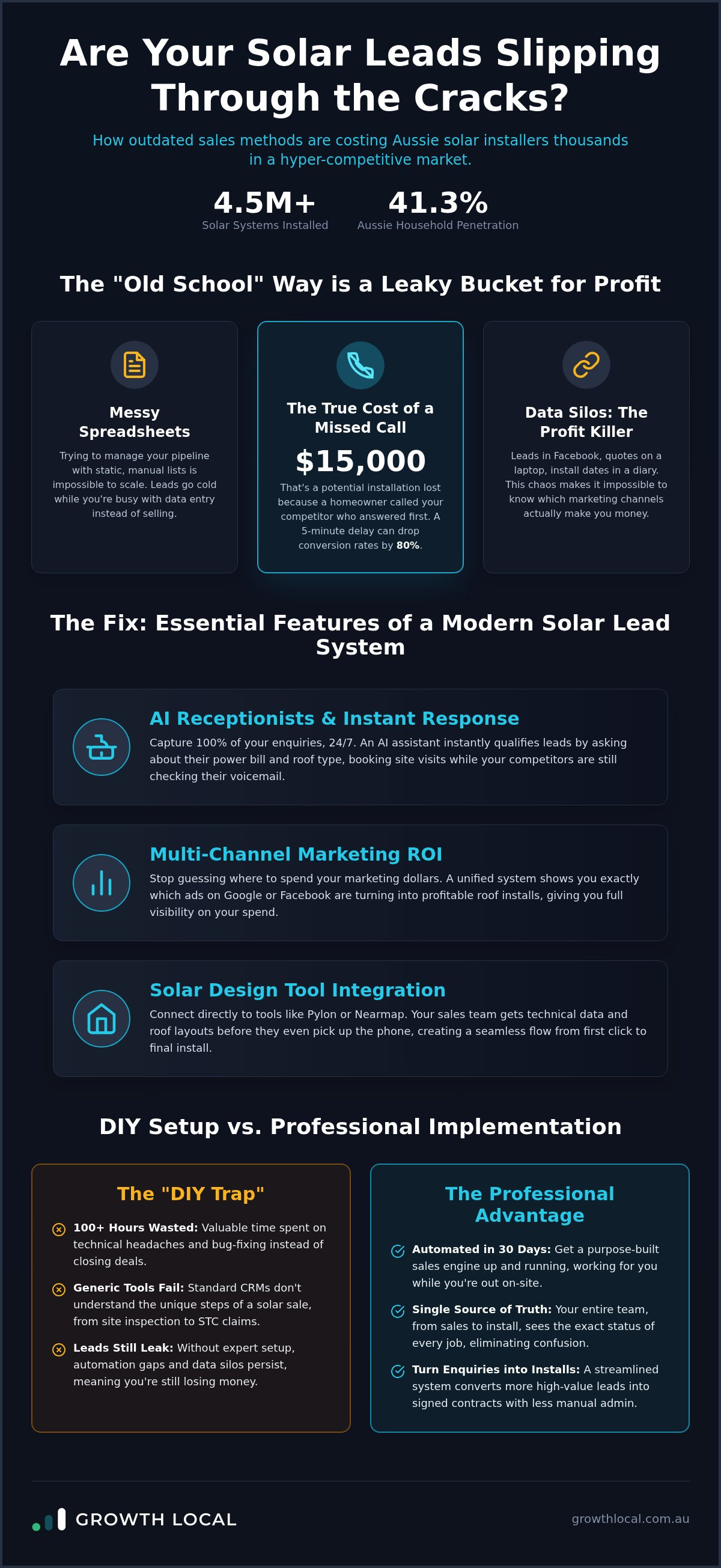
The core issue is that standard platforms aren't built for the speed required in 2026. If a lead isn't contacted within five minutes, your chances of conversion drop by 80%. Spreadsheets are the primary enemy here; they are static, manual, and impossible to scale. A proper solar lead tracking system setup replaces these manual lists with an automated engine that moves as fast as the customer does. It bridges the gap between a raw enquiry and a signed contract by managing the specific technical milestones that a standard CRM simply ignores.
The True Cost of a Missed Call in the Solar Industry
Think about the last time you missed a call while you were on a roof or driving between sites. In the solar game, that single missed notification could represent a $10,000 or $15,000 installation. Australian homeowners are savvy; they've done their research and they're usually looking for multiple quotes simultaneously. If you don't pick up, they've already clicked the next ad on Google before your voicemail even finishes playing. Understanding basic lead management principles is vital, but you need the technology to back it up. Relying on "calling them back later" is a guaranteed way to hand your profit straight to your competitors.
Data Silos: The Silent Profit Killer
Profitability dies when your information is scattered across different apps. You might have leads sitting in Facebook, quotes saved as PDFs on a laptop, and install dates scribbled in a physical diary. This lack of organisation makes it impossible to see which marketing channels are actually making you money. A unified solar lead tracking system setup creates a single source of truth for your entire team. It ensures that everyone, from the sales rep to the installer, knows exactly where a job stands. Without this integration, you are flying blind, wasting ad spend on leads that never turn into a finished roof install.
Essential Features of Solar Lead Tracking Software in 2026
A successful solar lead tracking system setup isn't just a digital filing cabinet for names and phone numbers. It's an active participant in your sales process that works while you're on a roof or driving between jobs. In 2026, the best systems connect directly to solar design tools like Pylon or Nearmap. This integration ensures your sales team has technical data and roof layouts ready before they even pick up the phone. It's about creating a seamless flow from the first click to the final STC claim without manual data entry slowing you down.
Knowing exactly where your money goes is non-negotiable for a scaling business. Multi-channel attribution allows you to see if a high-value install came from a Facebook lead form, a Google Search, or a local referral. Without this visibility, you're just guessing where to spend your next marketing dollar. Following best practices for CRM implementation means building a system that tracks the entire customer journey, not just the final sale. This level of detail helps you cut out dead-end lead sources and double down on the channels that actually book site visits.
AI Receptionists: The 24/7 Sales Team You Don't Have to Manage
Most solar business owners are on-site or managing teams during peak enquiry hours. An AI receptionist solves the missed call problem by handling the initial "tyre-kickers" instantly. It qualifies the lead by asking about their current electricity bill or roof type and logs every detail in your CRM. This happens at 9 PM on a Sunday just as easily as 10 AM on a Tuesday. It's about capturing 100% of your opportunities without the overhead of a human call centre. If you're curious about how this looks in a real-world workflow, you can book a walkthrough of our automated systems.
Automated Follow-Up Sequences That Don't Feel Like Spam
The "Rule of 7" suggests it takes multiple touchpoints to close a complex deal like a solar installation. You need automated sequences that sound like a local Aussie expert, not a generic robot. Instead of constant "buy now" messages, use SMS to confirm site visits or send a quick "thanks for the chat" email with a link to your recent projects. Automated reminders significantly reduce no-shows for design consultations. By customising these templates to match your brand voice, you maintain a personal touch while the solar lead tracking system setup handles the heavy lifting of the follow-up process.
The 2026 Roundup: Top Lead Tracking Systems Compared
Choosing the right platform for your solar lead tracking system setup isn't just about picking the one with the flashiest logo. You need to balance ease of use with the depth of functionality required to manage site visits and quote approvals. While some platforms excel at high-level reporting, others are built for the grit of daily sales calls and automated follow-ups. For Aussie tradies, the mobile experience is the make-or-break factor; your reps need to be able to update a lead status or upload site photos while they are still standing in the customer's driveway.
Hidden costs are another trap to watch for in 2026. Beyond the sticker price, you have to account for API fees, per-message SMS charges, and the hundreds of hours of lost productivity spent on a botched DIY implementation. A system that looks cheap on paper can quickly become a financial burden if it doesn't integrate seamlessly with your existing tools or requires a full-time IT expert just to keep the lights on.
HubSpot: The Enterprise Choice for Large Solar Groups
HubSpot is the gold standard for data visualisation and polished user interfaces. It offers a massive feature set that can track every single interaction a lead has with your brand. The pros include world-class reporting and a very high level of reliability. On the downside, the monthly costs are significant, and the learning curve is steep. It's best for companies with 50 or more employees and a massive marketing budget that justifies a dedicated CRM administrator.
GoHighLevel: The All-in-One Automation Workhorse
GoHighLevel has become a favourite for growing solar installers because it bundles SMS, email, and funnel building into a single subscription. It is an automation powerhouse that allows you to consolidate your tech stack. However, it can be incredibly overwhelming to configure from scratch. If you aren't tech-savvy, you'll likely find yourself stuck in "YouTube University" trying to fix broken triggers. It's the ideal choice for businesses that want to automate everything under one roof but have the patience for a complex backend.
Growth Local Custom Setup: The Done-For-You Alternative
We believe that software is only as good as the implementation behind it. A customised setup beats a "naked" software subscription because it's built around the specific rhythms of the Australian solar industry. We don't just give you a login and wish you luck; we build the entire sales engine for you. You can check out our CRM setup for solar installers to see how we map out a professional implementation that saves you from technical headaches and lost leads.
DIY Setup vs. Professional Implementation: What's Right for You?
Many solar installers fall into the trap of thinking that buying a software subscription is the same as having a working sales process. It isn't. Buying a high-end CRM without a professional solar lead tracking system setup is like buying a Ferrari and leaving it in the garage because you don't have the keys. You might spend dozens of hours in "YouTube University" trying to figure out how to link your Facebook ads to your SMS triggers, only to find that half your leads are disappearing into a digital black hole. This DIY approach often costs more in lost revenue than the price of an expert implementation.
A professional setup doesn't just save you from technical headaches; it future-proofs your business for the 2026 market. We've seen business owners waste over 100 hours trying to configure their own systems, only to end up with a messy backend that their staff refuses to use. Adoption is everything in this industry. If your sales reps find the software clunky or confusing, they'll go back to their old notebooks and spreadsheets, and your investment will be wasted. An expert ensures the system is intuitive, fast, and actually helpful for the people on the ground.
The Risks of a Poorly Configured CRM
When an automation loop breaks, leads can get stuck in a "no-man's land" where they are never assigned to a rep. This is the worst-case scenario for any installer paying for premium enquiries. Even more dangerous is incorrect data attribution. If your system can't tell you which ad spend is actually turning into a roof install, you'll keep pouring money into marketing channels that don't convert. A poorly configured solar lead tracking system setup doesn't just fail to help; it actively creates more manual work for your team as they try to fix errors and hunt for missing information.
Why a 'System' Beats a 'Tool' Every Time
You must define your sales process before you touch a single piece of software. A tool is just a static object, but a system is a living engine built around your specific business goals. Professional implementers look at your entire workflow, from the initial enquiry to the final STC claim, and build the automation to support that journey. This is how you actually move the needle on your ROI. For a deeper look at this approach, read our guide on how to scale your solar business with automation.
Winning the Solar Game: Implementation and Next Steps
You have seen the software options and you know why messy spreadsheets are killing your profit margins. Now it's time to build the engine. A successful solar lead tracking system setup starts with a brutal audit of your current lead flow to find exactly where you are losing money. Are your leads going cold because of a three-day delay in follow-ups? Is your ad spend being poured into channels that never book a site visit? Identifying these bottlenecks is the first step toward a 30-day roadmap that replaces manual chaos with automated precision.
Getting your sales team to actually love using a CRM is the next hurdle. Tradies and sales reps hate admin; they want to be on the phone or out on-site closing deals. To ensure high adoption, you need to show them how the system makes their lives easier. When the software handles the data entry and reminds them exactly when to call a prospect, they can focus on their commissions instead of fighting with technology. We reckon the KPIs that actually matter for your bottom line are simple: speed to lead, appointment set rate, and cost per acquisition. If the system doesn't improve these three numbers, it isn't doing its job.
Capturing Every Opportunity with AI
Your business shouldn't stop just because you are on a roof or it's after-hours. By integrating your website forms, Facebook ads, and phone lines into one centralised dashboard, you ensure no enquiry falls through the cracks. We use AI to set up "Speed to Lead" alerts that notify your top-performing reps the second a high-value lead arrives. This level of responsiveness is what separates the market leaders from the installers who are just scraping by. If you want to see where your current process is leaking cash, you can contact Growth Local for a no-BS system audit.
Scaling Without the Headcount Headache
The beauty of a professional solar lead tracking system setup is that it allows you to scale your lead volume without immediately doubling your office staff. Automation handles the heavy lifting of qualification and follow-up, which means your current team can handle twice the workload with half the stress. This frees you up as the business owner to focus on high-level strategy and growth rather than getting bogged down in daily data entry. To get started on building a more profitable future, explore our Solar CRM Setup Services AU: Build a High-Performance Sales Engine.
Building Your Automated Solar Sales Engine
The Australian solar market moves too fast for manual spreadsheets and missed calls. Mastering your solar lead tracking system setup is the difference between struggling for scraps and scaling a high-performance business. We have shown that generic software isn't enough; you need a system that understands site inspections, design tools, and the 24/7 nature of modern enquiries. By integrating AI receptionist technology and solar-specific automations, you stop the leaky bucket syndrome and ensure every lead is captured, qualified, and followed up instantly.
As specialised Aussie solar CRM experts, we provide a no-BS, results-driven implementation that works for your team on the road. It is time to stop fighting with technology and start using it as your greatest competitive advantage. You have already done the hard work of building a reputation for quality installs. Now, let's build the automated engine that makes sure you never miss another opportunity to grow.
Take the first step toward a more organised and profitable future. Your sales team will thank you, and your bottom line will show the results.
Frequently Asked Questions
What is the best lead tracking software for a small solar company?
GoHighLevel is often the strongest contender for smaller Aussie installers because it bundles SMS, email, and funnel building into one subscription. It is much more cost-effective than enterprise tools like HubSpot, which often require a dedicated administrator to manage. For the best results, you want a system that scales with you without adding technical bloat. A customised setup ensures you only pay for the features that actually help you book more site visits.
How much does a professional solar CRM setup cost in Australia?
Professional implementation costs vary depending on the complexity of your sales pipeline and the number of integrations required. While we don't provide a flat fee without knowing your specific business needs, it's helpful to view this as an investment in your infrastructure rather than a simple expense. A well-built system often pays for itself by capturing just one or two high-value installs that would have otherwise been lost to a missed call or a slow follow-up.
Can I integrate my current solar design software with a new CRM?
Yes, most modern CRMs can integrate with industry-standard design tools like Pylon or Nearmap. This connection is vital for a smooth workflow as it allows your sales team to access roof layouts and technical specs directly within the lead's profile. Integrating these tools eliminates the need for double data entry and ensures that your reps have all the information they need to close a deal during their very first follow-up call with the homeowner.
How does an AI receptionist help with solar lead tracking?
An AI receptionist acts as your 24/7 front desk, capturing every enquiry that comes in after-hours or while your team is on a roof. It qualifies leads by asking specific questions about their energy bills or property type and then logs that data straight into your CRM. This ensures that you never lose a $10,000 install to a competitor simply because you couldn't pick up the phone at that exact moment.
Do I really need a specialised solar CRM, or is a generic one okay?
A generic CRM can work, but it often requires hundreds of hours of customisation to handle the specific milestones of an Australian solar sale. A specialised solar lead tracking system setup is built around the industry's unique rhythms, such as managing site inspections and tracking STC claims. Using a system that already speaks your language saves you from the technical headache of trying to force a retail tool to work for a complex service business.
How long does it take to get an automated lead tracking system up and running?
Most professional implementations take approximately 30 days to get fully operational. This timeframe includes an initial audit of your current lead flow, the technical build-out of your automations, and the final training for your sales team. While a DIY attempt might seem faster, it often leads to broken triggers and lost leads. A methodical, month-long rollout ensures that your sales engine is robust and ready for long-term growth across the country.
Will my sales team find a new lead tracking system too difficult to use?
No, provided the system is designed with the actual user in mind. We find that sales reps actually prefer automated systems because they eliminate the manual data entry they hate. If the software makes it easier for them to track their commissions and follow up with prospects, adoption happens naturally. The goal of a professional setup is to make the technology feel like a helpful assistant rather than a complicated administrative burden.
How do I track which leads came from Google Ads vs. Facebook?
You track lead sources by using multi-channel attribution within your solar lead tracking system setup. This involves using tracking codes and UTM parameters that tell your CRM exactly where a lead clicked before they filled out your form. Having this visibility allows you to see which advertising channels are delivering the highest ROI, so you can stop wasting money on dead leads and double down on the platforms that actually book jobs.


