

The Cost of Missed Leads for Australian Service Businesses
What’s the cost of missed leads for service business Australia owners who are on the tools when the phone rings? It’s not just one unanswered call. Enquiries can arrive during a job or after hours, then go cold when follow-up is patchy. If you can’t see which leads were answered, contacted and booked, it’s also hard to tell whether your marketing is paying off.
You don’t need to guess or buy new software straight away. Start with the numbers you already have: how many enquiries come in, how many become paying jobs, and what an average job earns in gross profit. That gives you a practical way to estimate the opportunity that may be slipping through the cracks.
This article shows you how to make that estimate, find weak points between enquiry and booking, and compare practical ways to capture, qualify and follow up leads. We’ll look at people, processes and tools, including CRM setup and AI receptionist technology, so you can choose a fix that addresses the real bottleneck instead of assuming software alone will solve it.
Key Takeaways
- Assess the cost of missed leads for service business Australia by separating potential lost job profit from wasted marketing effort and staff time.
- Use qualified missed enquiries, your observed booking rate and average gross profit per job to build a practical estimate.
- Compare manual follow-up, shared inboxes, CRM workflows and AI-assisted capture against the gaps in your current process.
- Review enquiry sources and outcomes consistently to spot where leads stall and who needs to own the next step.
- Connect enquiry capture, CRM records and outcome tracking so missed opportunities are easier to see and address.
Cost of missed leads for service business Australia: what to measure
Estimate the impact using your own qualified enquiries, booking history and gross profit per job. Keep potential opportunity cost separate from confirmed lost bookings, wasted marketing effort and staff time. This gives you a clearer starting point for deciding whether the main issue is enquiry capture, follow-up or tracking.
What is the cost of missed leads for an Australian service business?
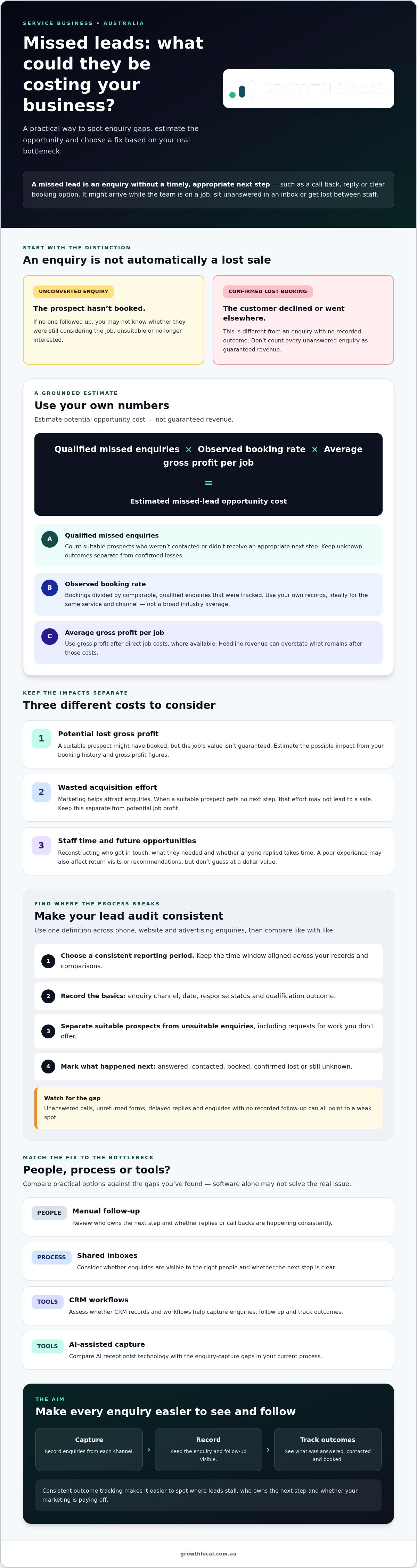
A missed lead is an enquiry that doesn’t receive a timely, appropriate next step, such as a call back, a reply or a clear booking option. It might come in while the team is on a job, sit unanswered in an inbox or get lost between staff members. The cost of missed leads for service business Australia owners need to assess isn’t simply the value of every enquiry that didn’t become a job. It’s the potential impact of gaps in how enquiries are captured and handled.
An unconverted enquiry is a prospect who hasn’t booked; a confirmed lost booking is an opportunity the customer has declined or taken elsewhere. If nobody followed up, you may not know which outcome applies. Treating every unanswered enquiry as guaranteed revenue overstates the loss, while ignoring enquiries with no recorded outcome can hide a process problem.
Which enquiries count as missed leads?
Include unanswered calls, unreturned forms, delayed replies and enquiries with no recorded follow-up. Then separate prospects who appear suitable for your services from enquiries that are genuinely unsuitable, such as requests for work you don’t offer. A qualified prospect who wasn’t contacted points to a different issue than an enquiry that couldn’t become a job.
Set one clear definition and apply it across phone, website and advertising enquiries. Use it consistently for each reporting period so you can compare like with like and identify where follow-up is falling through.
Where does the financial impact come from?
There are three distinct effects to consider:
- Potential lost gross profit: A suitable prospect might have booked, but the job’s value isn’t guaranteed revenue. Estimate the possible impact using your own booking history and gross profit figures rather than assuming every missed enquiry would have converted.
- Wasted acquisition effort: Advertising and other marketing help attract enquiries. If a suitable prospect receives no next step, that effort may not lead to a sale. This is separate from the profit a completed job could have earned. Customer Acquisition Cost is a useful concept for understanding what it takes to acquire a customer.
- Staff time and future opportunities: Reconstructing who contacted the business, what they needed and whether anyone replied takes time. A poor experience may also affect a customer’s willingness to return or recommend the business, though the dollar impact varies and shouldn’t be guessed.
Keep these effects separate in your assessment. That gives you a more useful picture of the problem and a better starting point for measuring it with your enquiry and sales figures.
How to calculate the cost of missed leads using your own numbers
A useful first estimate is simple:
Qualified missed enquiries × observed booking rate × average gross profit per job = estimated missed-lead opportunity cost
This gives you a grounded way to estimate the cost of missed leads for service business Australia owners may be facing, without treating every enquiry as a sale you would definitely have won. It’s an opportunity-cost model, not guaranteed revenue.
Which business figures should you collect?
Choose a consistent period, then gather enquiry records with the channel, date, response status and qualification outcome. Include only suitable prospects that didn’t receive an appropriate next step in your missed-enquiry count. Keep leads with an unknown outcome separate from those confirmed as lost.
- Qualified missed enquiries: Count suitable prospects who weren’t contacted or followed up appropriately.
- Observed booking rate: Divide bookings by comparable, qualified enquiries that were tracked. Use your own records, ideally for the same service and channel, rather than a broad industry average.
- Average gross profit per job: Use gross profit after direct job costs, where available. Headline revenue can make the estimate look larger than the amount left to cover overheads and contribute to profit.
Keep the inputs aligned. If you count missed enquiries from a particular period and channel, use a booking rate and job-profit figure that reasonably match that same service, channel and period.
How do you avoid overstating the missed-lead cost?
Before calculating, remove spam, duplicate records, out-of-area requests and enquiries for work you don’t offer. Don’t count every unanswered enquiry as a qualified opportunity. Check CRM entries against invoices and booking outcomes, and label any assumptions clearly.
For example, say a business recorded 8 qualified missed enquiries during its chosen review period. If its observed booking rate for comparable enquiries was 25%, and average gross profit per completed job was A$400, the estimate would be 8 × 0.25 × A$400, or A$800. These figures are illustrative only. They aren’t an industry benchmark or a prediction that the business would have secured two jobs.
If your booking rate or job margins are uncertain, calculate a lower and upper estimate using reasonable figures from your records. State the assumptions beside the result and show unknown outcomes separately. Research reported by Harvard Business Review Analytic Services on the costly gap between sales potential and actual results also points to missed opportunities and inefficiencies from fragmented sales processes.
If records are too scattered to check these inputs, a consistent CRM process can help centralise enquiry ownership and follow-up. You can review lead generation and marketing system setup as one possible implementation option.
Manual follow-up, CRM or AI receptionist: which fix suits your business?
The right fix depends on where enquiries are slipping through, not which tool sounds most advanced. A clear manual routine may be enough for a small, manageable flow. If ownership is unclear, records are scattered or follow-up keeps getting missed, a shared inbox, CRM workflow or AI-assisted capture may help make the process more reliable.
Compare each option against the same practical checks:
- Response coverage: Can enquiries be captured when the usual person is busy?
- Ownership: Is it clear who handles the next step?
- Follow-up consistency: Is there a dependable way to track whether a prospect was contacted again?
- Visibility: Can the team see the enquiry’s status and outcome?
- Setup effort: What needs to be organised, configured and maintained?
A tool supports a defined process. It can’t create staff capacity, good sales judgement or suitable service availability on its own. That matters when weighing the cost of missed leads for service business Australia owners are trying to reduce: the practical answer may be a better handover, not more technology.
When can a manual process be enough?
For a modest enquiry flow, a shared inbox or basic form can work if one person is clearly responsible for checking it, recording the outcome and handing enquiries over when needed. Agree on who owns calls and forms, what counts as a suitable lead, and how follow-up is recorded.
Missed handovers, scattered notes and callbacks that rely on memory are warning signs that the process needs attention. Document responsibilities first. Buying software before agreeing how the team should use it can simply move the confusion into a new system.
When might CRM or an AI receptionist help?
A CRM can centralise enquiry details, ownership, status and follow-up activity, making it easier to see what needs attention and what happened next. It’s useful when multiple people handle enquiries or when records across channels are hard to reconcile. The workflow still needs clear stages and staff who keep records up to date.
An AI receptionist can support automated enquiry capture and initial interactions. It isn’t a human call handler, and it won’t suit every caller or situation. Consider the kinds of enquiries you receive, what information needs to be captured and how a person will take over when needed. For a deeper look at the approach, continue to the planned article on AI Receptionist Australia.
Choose the lightest option that closes the gap you’ve identified, then check whether it improves coverage, ownership and visibility. CRM and marketing system setup can be an implementation option once the process requirements are clear.
How to audit missed leads and prioritise the next fix
A useful audit follows each enquiry from first contact to a recorded outcome. Choose a recent period that suits your business, then use the same period when you repeat the review. The aim is to find where the process breaks down, not to assume every enquiry without a booking was a lost sale.
How do you find where enquiries are leaking?
Start by mapping enquiry sources, such as advertising, search and referrals. Trace each one through first contact, qualification, follow-up and booking. Compare call logs, web forms, inboxes and CRM records to spot enquiries that disappear between channels or staff handovers.
Classify each record consistently: contacted, awaiting follow-up, booked, unsuitable, declined or outcome unknown. Missing statuses and unclear ownership are signals to investigate, not proof that a sale was lost. For each enquiry, record its source, status, response and outcome:
| Enquiry source | Status | Response | Outcome | Before change | After change |
|---|---|---|---|---|---|
| Call, form, search or referral | Use the same status labels | Record what happened | Booking or other known result | Enter audit finding | Enter repeat-audit finding |
Fill the before and after columns using the same definitions and comparable review periods. This makes it easier to see whether a process change improved enquiry tracking or follow-up, without claiming it caused every change in bookings.
What should you fix first?
Prioritise the bottleneck with the clearest evidence. Weigh how often it appears, the likely recoverable value, the effort to address it and whether the change fits the way your team works. A recurring handover gap may call for a named owner and a simple recording routine before you introduce a new tool.
Test one process change at a time. Keep tracking the same fields and outcome measures so you can compare results fairly. If the audit shows the issue sits across several channels or handovers, a broader lead generation system setup framework may help you plan how capture, CRM records and follow-up fit together.
A repeatable audit gives you evidence to estimate the cost of missed leads for service business Australia businesses may face, then directs attention to the next practical fix. Keep the findings visible, assign an owner and review the process again using a consistent period.
Build a lead-capture system that makes missed opportunities visible
An enquiry is easier to manage when it moves through a clear path: capture, record, assign, follow up and track the outcome. Each step addresses a different gap. Capturing contact details helps prevent enquiries being overlooked; a CRM record shows who owns the next action; outcome tracking helps you see whether the lead booked, declined or is still unresolved.
What should a connected lead workflow include?
Build the workflow around the channels your business actually uses, such as phone, website forms, advertising and referrals. Keep the enquiry source and contact details with the record, use clear statuses, and assign responsibility for the next step. Follow-up actions should suit your team’s capacity and the way it handles real enquiries.
Review outcomes regularly. If records show which channels bring suitable enquiries and what happens after first contact, you can make marketing and sales decisions using evidence rather than guesswork. A connected system won’t guarantee bookings, but it can make gaps easier to spot and address.
How can you assess an implementation partner?
Before choosing a partner, ask how they’ll understand your current process, configure the CRM, shape workflows and hand the system over to your team. Confirm which platforms and integrations are supported, what each party is responsible for, and what ongoing support is available. Don’t assume a particular feature or integration is included without checking.
Growth Local provides CRM and marketing system setup for Australian service businesses. Its AI receptionist integration is an option for automated lead capture and initial customer interactions, not a human call centre. The right implementation should match the bottleneck you’ve identified, whether that’s scattered enquiry records, unclear ownership or inconsistent follow-up. It can support better visibility, but it can’t promise a specific revenue result.
If you’re weighing up implementation, review the CRM and marketing system pricing information and ask what the proposed setup covers. You can also ask whether the approach fits your existing workflow before committing to changes.
Discuss whether a lead-system setup is right for your business.
Turn your lead audit into a practical next step
The cost of missed leads for service business Australia owners face is worth measuring with their own enquiry, booking and gross profit records, not guesswork. Separate qualified prospects from unsuitable or unknown enquiries, then use a consistent audit to find where responses, handovers or follow-up are breaking down.
Fix the clearest bottleneck first. A straightforward process may be enough, while scattered records or unclear ownership could point to a need for CRM setup or a more connected workflow. Tools can support consistent lead handling, but they work best when responsibilities and next steps are clear.
Growth Local offers CRM implementation and marketing system setup, as well as AI receptionist integration for automated lead capture and initial customer interactions. These options can help organise the process, but they’re not a guarantee of additional revenue. Start by checking what would fit your team and the gap you’ve identified.
You don’t need to overhaul everything at once. A clearer view of each enquiry is a solid first step towards more dependable follow-up.
Frequently Asked Questions
How much can missed leads cost a service business?
There’s no single figure that applies to every service business. The impact depends on how many suitable enquiries don’t receive a next step, how often comparable enquiries become jobs and the gross profit those jobs generate. Estimate these inputs from your own records, and keep unknown outcomes separate from confirmed lost bookings. This gives you a more useful view of the potential cost than treating every unanswered enquiry as guaranteed revenue.
How do I calculate the cost of a missed lead?
Multiply qualified missed enquiries by your observed booking rate for comparable enquiries, then by average gross profit per completed job. Use figures from the same service and a consistent period where possible. Exclude spam, duplicate records and requests you couldn’t service. If your booking or margin data is uncertain, show a range and list the assumptions. The result is an estimate of opportunity cost, not a promise of revenue you would have earned.
What happens if a service business does not follow up a lead?
The prospect may contact another provider, decide not to proceed or remain interested but unbooked. Without a recorded outcome, you can’t know which happened. Missed follow-up can also leave staff searching through call logs and inboxes to reconstruct the enquiry. Record whether each suitable prospect was contacted, what happened next and whether they booked. That makes it easier to identify a follow-up gap without assuming every unanswered enquiry became a lost sale.
Can a CRM stop a service business from missing leads?
A CRM can help reduce process gaps by bringing enquiry details, ownership, status and follow-up activity into one place. It can’t guarantee that every enquiry is handled or replace clear responsibilities, staff capacity and good customer conversations. Set up the stages and actions to match how your team works, then keep records current. Regularly check unresolved enquiries so the CRM remains a useful working record, not just another place where information can sit untouched.
Is an AI receptionist suitable for every Australian service business?
No. An AI receptionist may suit businesses that want automated lead capture and initial customer interactions, but its fit depends on the enquiries callers make and the kind of conversation they expect. Consider what details need to be captured, when a person should take over and how the approach will work alongside your team’s process. It’s automated technology, not a human call centre, and it won’t be the right option for every caller or business.
How can I tell whether missed leads are caused by marketing or follow-up?
Track each enquiry’s source, suitability, response status and final outcome using consistent labels. If enquiries from a channel are often unsuitable, review how that channel is attracting prospects. If suitable enquiries arrive but have no recorded response, unclear ownership or an overdue next step, investigate the follow-up process. Compare records across calls, forms, inboxes and your CRM before drawing conclusions. Missing data is a tracking gap to resolve, not proof that marketing or staff caused a lost booking.


