

Scaling an Australian Service Business: 2026 Framework
More demand won’t fix a service business that relies on the owner to keep every job moving. It can expose the cracks faster: enquiries slip through, delivery becomes inconsistent and cash flow gets harder to manage. For Australian operators, the real question is how to scale a service business AU without adding more operational chaos.
It’s tempting to chase more leads or hire quickly, but growth works best when your capacity can handle it. Start by finding the bottleneck. Then improve the processes that help your team respond, deliver and follow up reliably, even when you’re not across every detail.
This guide sets out a practical framework for sustainable growth in 2026. You’ll learn how to spot what’s holding the business back, build repeatable workflows and track whether changes are helping. We’ll also look at how connected lead capture, CRM and marketing systems can reduce manual handling, so more demand doesn’t mean more dropped balls.
Key Takeaways
- Scaling means increasing sustainable capacity, not simply taking on more work. Identify pressure points before demand puts delivery or cash flow under strain.
- Map the customer journey from first enquiry to follow-up to see where leads, time or jobs are getting stuck.
- Compare growth levers by the capacity and workload they require, then choose one that suits your business model.
- Use a flexible 90-day plan to implement one change and review practical business measures as you go.
- Learn how to scale a service business AU with connected systems that support lead capture, customer records and consistent follow-up.
How to scale a service business in Australia without creating more chaos
More work is only useful if your business can deliver it well and retain enough return after accounting for the time and resources involved. Scaling means increasing sustainable capacity, not just booking more jobs. Revenue can rise while profit and service quality fall if every extra job requires more owner involvement, overtime or rework. A practical approach to how to scale a service business AU starts with what the business can reliably deliver, not just how many enquiries it can attract.
Scalability is about whether a system or process can handle growth without breaking down. In a service business, check how work moves from enquiry to delivery and payment, and whether the team can follow each step consistently. More enquiries can expose gaps in follow-up, scheduling or handover that were easier to manage at a lower volume.
Use a clear sequence: diagnose the constraint, strengthen delivery, then increase demand. This helps avoid paying to bring in more work before your team and systems are ready to handle it.
Growth versus scaling: what changes inside the business?
Growth often means more sales, jobs or staff. Scaling changes how the work gets done, so the business can take on more without relying on the owner to make every decision or catch every missed step. Documented processes, clear responsibilities and reliable customer records help the team deliver a consistent service as the workload changes.
For example, a maintenance business might receive more bookings after a marketing push. If the owner still has to confirm every appointment, brief each worker and chase every invoice, extra jobs could create delays and frustrated customers. A shared booking process and clear job handovers can make those tasks easier to manage.
Which signs show your business is ready to scale?
Look for recurring demand, repeatable delivery steps and a visible limit on capacity. Use records such as enquiry logs, booking calendars, job notes and invoices to tell a consistent pattern from a short busy spell. Check whether enquiries turn into suitable work and whether completed jobs lead to repeat bookings or referrals.
- Recurring demand: similar customers request the same service over time.
- Predictable delivery: the team can follow key job steps without the owner filling in the gaps each time.
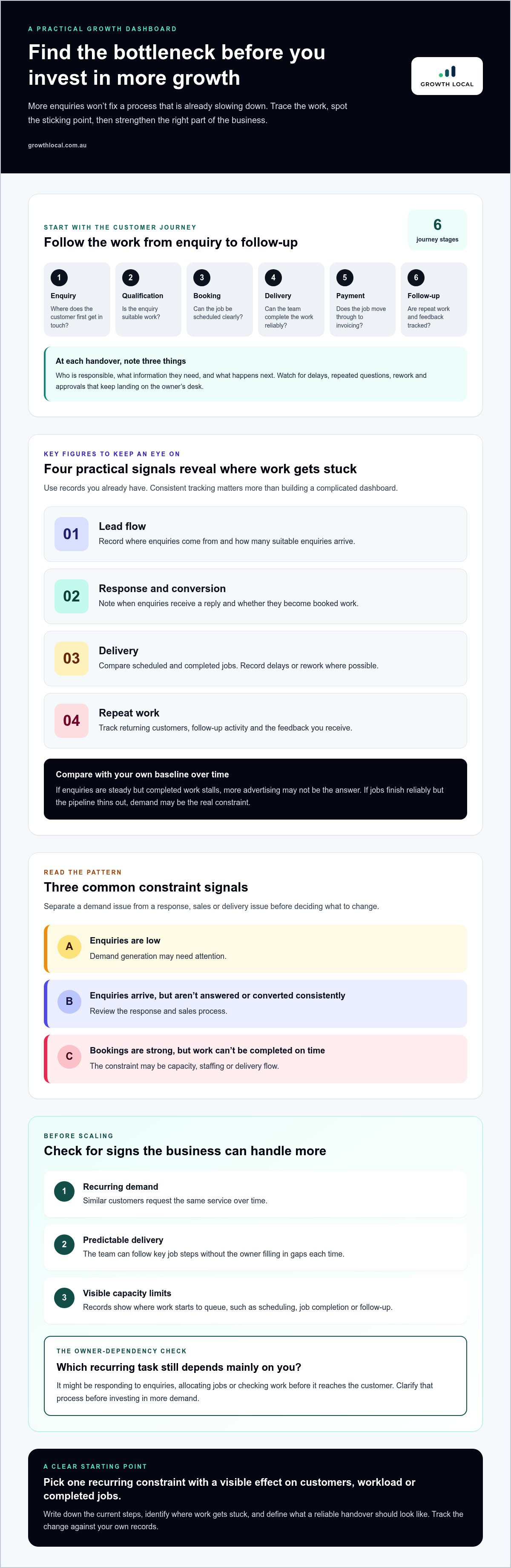
- Visible capacity limits: records show where work starts to queue, such as scheduling, job completion or follow-up.
Then ask yourself: which task still depends mainly on me? It might be responding to new enquiries, allocating jobs or checking work before it goes to the customer. That task may be the first process to clarify before you invest in generating more demand.
Find the bottleneck before you invest in more growth
Before spending more on marketing or adding jobs to the schedule, work out where the current process slows down. A business can have plenty of enquiries but still lose work through delayed replies, limited job capacity or inconsistent follow-up. More demand won’t solve those issues. It can make them harder to manage.
Map the customer journey from first enquiry through qualification, booking, delivery, payment and follow-up. For each step, note who is responsible, what information they need and what happens next. Look for delays, repeated questions, rework and approvals that keep landing on the owner’s desk. This gives you a practical starting point for how to scale a service business AU without mistaking a process problem for a marketing problem.
Next, separate the possible constraints. If enquiries are low, demand generation may need attention. If enquiries arrive but aren’t answered or converted consistently, review the response and sales process. If bookings are strong but the team can’t complete work on time, the issue may be capacity, staffing or delivery flow.
Which numbers help reveal a service-business constraint?
Use records you already have, such as enquiry logs, calendars, job notes, invoices and customer feedback. Consistent tracking matters more than building a complicated dashboard. Start with measures that show where work enters, moves through and exits the business:
- Lead flow: record enquiry source and how many suitable enquiries arrive.
- Response and conversion: note when enquiries receive a reply and whether they become booked work.
- Delivery: compare scheduled and completed jobs, and record delays or rework where possible.
- Repeat work: track returning customers, follow-up activity and feedback you receive.
Compare these measures with your own baseline over time rather than relying on generic industry benchmarks. If enquiries are steady but completed work stalls, more advertising may not be the answer. If jobs finish reliably but the pipeline thins out, demand may be the real constraint.
How do you spot owner dependency and process gaps?
List the recurring tasks that pause when you’re unavailable. These might include approving quotes, assigning jobs, answering common customer questions or checking that an invoice has been sent. Then trace the handovers: where does customer information move between people or tools, and where is it missed, duplicated or left waiting?
Choose a recurring constraint with a clear effect on customers, workload or completed jobs. Don’t try to overhaul every process at once. Write down the current steps, identify where work gets stuck and define what a reliable handover should look like. That turns a vague feeling of being flat out into a specific issue you can address and measure.
Choose growth levers that match your capacity and business model
Once you’ve identified the constraint, choose a growth lever that addresses it. More advertising won’t fix slow follow-up, and adding a new service won’t help if the current work already depends on the owner at every step. Choose the move that eases the pressure point without creating a new one.
Compare the likely workload and trade-offs before committing. These options can overlap, but start with the lever that best fits the constraint you’ve identified.
| Growth lever | Best suited to | Likely workload and trade-off |
|---|---|---|
| Demand generation | Businesses with delivery capacity and too few suitable enquiries. | Requires channel planning and consistent enquiry tracking. More leads also mean more follow-up and sales work. |
| Customer retention | Services where customers may need repeat work, maintenance or related support. | Calls for reliable customer records and timely follow-up. Repeat work may take time to build and won’t suit every service. |
| Operational efficiency | Teams slowed by manual admin, unclear handovers or repeated owner approvals. | Needs time to document and improve processes. It can free up capacity, but changing routines takes team effort. |
| Service expansion | Businesses with a clear customer need and the capability to deliver an additional service well. | Requires planning for skills, scheduling and delivery. A broader offer adds complexity and may distract from core work. |
When should a business improve lead flow?
Consider demand generation when the team can take on more suitable work without stretching delivery. Connect each channel to enquiry quality, response and conversion so you can see whether it brings the right opportunities and what happens next. Structured enquiry capture makes those handovers easier to track. A lead generation system framework can help you plan that process. Advertising may increase enquiries, but it won’t resolve a sales or delivery bottleneck on its own.
When should a business strengthen delivery or retention?
Focus on delivery first if work quality or completion depends heavily on individual knowledge. Clarify job steps, responsibilities and handovers so the team can provide a consistent experience. Where repeat work suits your service, organised follow-up can help maintain customer relationships. A CRM can keep customer information and next steps in one process. This CRM implementation guide explores how to approach it.
Use the same practical test for every option: will this lever ease the constraint you found, and can the business handle the work it creates? That’s a useful starting point for how to scale a service business AU without following a trend for its own sake.
Build a practical 90-day plan to scale your service business
A useful growth plan doesn’t need a long list of targets. It needs a clear starting point, one priority and a way to check whether the change is helping. Treat the next 90 days as a focused improvement cycle, not a deadline to transform every part of the business.
Give each action an owner, even if that person is you. Schedule regular progress reviews and use the same business measures throughout the plan. Milestones should record work completed, such as documenting a process or introducing a consistent handover, alongside what your records show. Avoid setting arbitrary growth targets without a reliable baseline.
Days 1 to 30: establish a clear baseline
Map how an enquiry becomes completed work. Include customer handovers, delivery steps and recurring admin, then note where tasks wait, get repeated or need your approval. Gather the records you already use, such as enquiry details, booking calendars, job notes and invoices. Choose one constraint with a clear effect on capacity or customer experience, rather than trying to fix every frustration at once.
Days 31 to 90: implement and review one improvement
Write down the revised process in plain language. Make responsibilities clear, identify what information must pass between people and specify what happens next at each handover. If the change involves automating parts of enquiry follow-up or another sales task, the sales workflow automation guide can help you think through the workflow before choosing tools.
Review progress regularly with the people doing the work. Compare the same measures you recorded at the start, and ask whether the change has reduced the original constraint or created extra admin elsewhere. Note customer feedback, delays and any work that still relies on you. If the process isn’t being followed, find out why before adding another system or expanding the plan.
At the end of the cycle, decide whether to keep the change, adjust it or test a different constraint. For example, if clearer enquiry handovers help but customer details are still scattered, the next step may be to improve how those records are managed. This measured approach makes how to scale a service business AU more practical: test a change, learn from the records and build on what works.
Use connected systems to support sustainable service-business growth
Once you know where work is getting stuck, choose systems that address that gap. The aim isn’t to add software for its own sake. It’s to help people follow a clear process, keep useful information together and reduce avoidable manual handling. Tools can support good service delivery, but they can’t replace it.
What should a service-business growth system connect?
Think of the customer journey as one connected flow: an enquiry is captured, its details are organised, the next action is clear and the outcome is recorded. A team member should be able to see what a customer asked for and whether someone needs to follow up, rather than relying on scattered notes or memory.
Consistent information helps the team manage each handover with less guesswork. Agree on what details to record, where they belong and how to note the next step. Keep the process straightforward. If it’s hard to maintain during a busy day, it’s less likely to support the work as intended.
An AI receptionist can support initial interactions and automated lead capture. It should sit within a wider process that makes clear how enquiries are handled and what happens next. Choose a setup that fits your service and customer journey, rather than adopting technology just because it’s trending.
How can CRM and automation reduce manual handling?
A CRM can organise lead details, customer information and sales activity in a central process. With clear records, the team can track where an enquiry stands and what follow-up is due. Automated workflows can support repetitive admin, such as moving information between steps or prompting a planned action, when they’re designed around how the business actually works.
- Capture: bring enquiry details into an organised process.
- Record: keep relevant customer and sales information together.
- Follow up: make the next action clear to the person responsible.
Start with the friction you’ve already identified. If staff are copying enquiry details into several places, review that handover before automating it. If follow-up is inconsistent, clarify the process and responsibilities first. Automation built on unclear steps can simply move the confusion faster.
Growth Local sets up CRM and marketing systems and AI automations for businesses working through a systems gap. The focus is on a practical fit between your process and the tools, not on a promise that technology alone will fix delivery or create growth. People still need clear responsibilities, sound service processes and regular oversight.
Connected systems can make it easier to capture, organise and act on information as demand changes. Keep reviewing whether the setup supports your team and customer experience, then adjust it as the business evolves.
Make your next growth move a deliberate one
Your next step doesn’t need to be a major overhaul. Choose one change that addresses a real constraint, give someone responsibility for it and make time to see how it works in practice. This keeps growth manageable while your team builds confidence in the process.
A practical approach to how to scale a service business AU is to make each improvement support the next. As the business evolves, revisit your workflows and systems so they continue to fit the way your team serves customers. Focus on capacity you can sustain, not growth for its own sake.
Growth Local supports Australian service businesses with lead-generation and marketing-system implementation, CRM setup and AI receptionist integration. These systems can provide operational support when they’re matched to your process and the gap you’re working to solve.
Take the next step at a pace that works for your business. With a clear priority and the right support, you can build a stronger foundation for growth.
Frequently Asked Questions
How do you scale a service business without hiring more staff?
You can often create more room before recruiting by documenting recurring tasks, removing duplicate data entry and planning jobs around the time and skills available. For example, standardise the information collected before confirming a booking so the team spends less time chasing missing details. Automation may reduce some manual steps, but it won’t remove the need for enough people to deliver the work. First identify whether the constraint is admin, scheduling or hands-on capacity.
What is the best way to scale a small service business?
The best approach is to fix the constraint limiting useful growth, rather than copy another business’s playbook. If suitable enquiries are scarce, demand may be the priority. If jobs queue up, improve delivery capacity. If customers rarely return, assess retention. If admin consumes the day, simplify operations. To work out how to scale a service business AU, record a baseline, change one area, then review workload, customer feedback and business performance before choosing the next move.
Can automation help a service business grow?
Yes, automation can support growth by handling defined, repeatable steps, such as placing enquiry details in an organised record or prompting a planned follow-up. First map who checks the information and responds, so a customer doesn’t disappear into an unattended workflow. For example, a workflow might route a new enquiry to the person responsible for assessing it. Its value depends on process design, implementation and fit, not on a guaranteed increase in revenue or reduction in staffing.
How do I know whether my service business is ready to scale?
Readiness is about whether you can absorb extra work without losing control of delivery, not reaching a particular turnover figure. Check records for repeat demand, then make sure staff know the key job steps and that available time or equipment is accounted for. Ask whether decisions still wait on you and whether customers receive consistent updates. If demand is uneven or quality slips during busy periods, strengthen the operating setup before widening the pipeline.
What should I measure when scaling a service business?
Measure the points that expose friction, not just total sales. Record where enquiries came from, how long responses take using your existing timestamps, which enquiries become bookings, completed jobs, delivery duration and instances of rework. Add customer feedback if you collect it. Keep definitions consistent, then compare each review period with your starting position. A rise in enquiries alongside unchanged bookings, for instance, may point to a follow-up or qualification issue rather than a need for more reach.
When should a service business invest in a CRM?
Consider a CRM when customer details sit across inboxes, spreadsheets or staff members’ memories, making it hard to see the next sales action. Before implementation, decide which fields matter, who updates them and how a lead moves from enquiry to decision. A CRM can give the team a shared view of activity, but it won’t decide ownership or repair a confusing workflow. Define the process first, then configure records around it.


