

Local SEO for Australian Service Businesses: 2026 Guide
A Google Maps listing or website visit is only valuable if it reaches the right customer and gives them a clear way to enquire. Local SEO for service businesses Australia-wide works best when visibility, enquiry capture and follow-up are connected, rather than treated as separate jobs.
You probably know local search matters, but it’s easy to get stuck deciding whether to prioritise your Google Business Profile, service pages, reviews or location content. And when enquiries arrive by phone, form and message, it can be hard to see what’s working or make sure each lead gets followed up.
This guide sets out a practical local SEO plan for your service business: how to improve your chances of appearing for relevant service and location searches, make your business information clear and credible, and organise enquiries once they come in. The aim is to connect local visibility to a reliable path from discovery to follow-up, without relying on rankings alone.
Key Takeaways
- Local SEO for service businesses Australia-wide starts with helping customers find accurate information about your services and coverage.
- Keep your Google Business Profile accurate and complete, then build service pages that reflect the work you do and where you genuinely operate.
- Look beyond rankings and impressions. Track whether local visibility is bringing relevant enquiries to your business.
- Prioritise the essentials: define your coverage, update your profile, strengthen your pages, build trust and measure enquiries.
- Use CRM workflows to organise incoming leads, assign ownership and keep follow-up activity on track.
What local SEO means for Australian service businesses
Local SEO helps your business appear when someone searches online for a service in a relevant area. It can involve improving your website, business details and other online signals so people can find and assess your services through Google Search or Google Maps. A practical approach to local SEO for service businesses Australia-wide starts with matching what customers need to the areas you genuinely serve.
Local SEO improves visibility in searches with local intent, while general organic SEO focuses more broadly on relevant searches regardless of location. The two overlap: a useful service page can support both, while local SEO also considers the searcher’s location and your business’s local presence. For a broader overview, see What is Local Search Engine Optimization?
Google Search and Google Maps can display local businesses in different ways. A search may show standard website results, map results or a mix, depending on the query and context. Local visibility is influenced by how relevant your business appears to the search, the location context and your prominence online. These factors affect where and how you appear, but no activity can guarantee a particular ranking.
How local searches connect customers with service businesses
Think of someone looking for an electrician in their area. A local result could introduce them to businesses they hadn’t heard of. They then compare options by checking services, coverage, reviews and contact details. If a business looks suitable, they may visit its website, call or send an enquiry.
Each step depends on clear information. If your profile says you handle residential electrical work but your website only describes commercial projects, a potential customer may hesitate or move on. Spell out what you do, who you help and where you operate. This gives people a better basis for deciding whether to get in touch and ensures your online presence reflects the business accurately.
Which Australian service businesses can benefit?
Local SEO can help trades, professional services and other businesses that serve customers at home or on-site. That includes teams who travel to clients and businesses customers visit in person. The right approach depends on how you deliver the service, which customers you want to reach and the areas you genuinely cover.
If you serve a defined area, explain that coverage clearly without implying you travel everywhere. If your business operates from multiple locations, make each location and its services easy to understand online. These are different operating models, so they shouldn’t be squeezed into the same template. Accurate, specific information helps potential customers understand what to expect before they enquire and gives your local SEO a solid foundation.
The building blocks of local SEO, from Google Business Profile to service pages
Local visibility isn’t built with one profile update or a page full of location keywords. Your Google Business Profile, website and reputation should give customers a consistent picture of your business: what you do, where you work and why they can trust you. Your profile helps people find and assess you, your website explains your services, and your reputation gives prospective customers added confidence.
For local SEO for service businesses Australia-wide, accurate foundations matter more than creating lots of thin pages or adding your details to every directory you can find. Keep your core business information consistent wherever customers might reasonably look, then update it when your services or operating details change.
Build a useful Google Business Profile
Treat your profile as a practical information source, not a one-off setup task. Check that your business name, contact details, categories and service information are accurate. Describe your work in plain language, and keep opening information current where it applies. If a customer can’t tell whether you provide the service they need, your profile needs more useful detail.
Reviews are part of the picture, too. Encourage genuine customers to share their experience and respond thoughtfully to feedback. A useful reply can thank someone for a specific comment or acknowledge a concern without sounding canned. Don’t offer incentives for reviews or pressure customers to leave only positive feedback. The aim is an honest reflection of the customer experience that helps people make an informed choice.
Make website pages useful for local searchers
Give each core service a page that answers real customer questions. Explain what the service involves, who it suits, what the process generally looks like and how to enquire. Use original, specific details from your business instead of repeating generic copy across several pages. A visitor should understand what you offer without having to piece it together from a long list of keywords.
Location pages can help explain genuine service coverage, but create one only when you have something useful and distinct to say about serving that area. Swapping a place name into near-identical pages adds little value and can confuse customers about where you actually work. Be precise about your coverage instead.
Make it easy to move between related information. Link a service page to relevant supporting services, explain how they fit together and provide a clear next step, such as calling or sending an enquiry. Apply the same principle to business details across relevant online listings: use consistent names, contact information and service descriptions, and update outdated entries where you can. There’s no magic number of listings to chase. Prioritise accuracy and relevance.
Getting these pieces aligned takes steady attention. To discuss how to strengthen your profile and service pages together, talk with Growth Local about your local SEO approach.
How to assess local SEO priorities, progress and lead quality
A higher position in search results can feel like progress, but it doesn’t tell you whether the right customers are finding you or getting in touch. Measure local SEO at two levels: visibility and business outcomes. Impressions and rankings show whether your business is appearing. Relevant visits, calls and enquiries help show whether that visibility is useful.
Rankings can change depending on the search, location and time. A single result or short-term shift doesn’t prove that your marketing is producing valuable work. Local SEO can’t guarantee a fixed position or a set volume of leads. The practical goal is to understand what’s improving, what’s bringing in suitable enquiries and where customers are dropping out.
Which local SEO measures are worth reviewing?
Use Google Search Console to review how your website performs in search, including the queries that lead people to your pages and the visits those pages receive. Google Business Profile performance information can also show how people find and interact with your profile, where those details are available. Treat each source as one part of the picture, not a verdict on its own.
Look for patterns over time. Are relevant service pages being seen? Are visitors taking the next step, such as calling or submitting a form? If visibility is increasing but enquiries aren’t, check whether the page answers the searcher’s need and makes it clear how to contact you.
How to tell whether visibility creates business value
Record each enquiry in a CRM or a simple lead log. Capture its source where known, the service requested, whether it fits your business and what happened next. Apply the same labels consistently so you can compare like with like. A spike in enquiries may look positive, but it matters whether those leads need services you provide and progress towards a genuine opportunity.
This comparison helps connect marketing activity to what happens after someone gets in touch:
Measure: Search impressions or ranking changes. What it tells you: Whether your business is appearing for relevant searches. What it doesn’t tell you: Whether a suitable customer made an enquiry.
Measure: Website visits and calls or form submissions. What it tells you: Whether people are taking an action. What to check next: The service requested and whether the enquiry suits your business.
Measure: Enquiry source and follow-up status. What it tells you: Which channels appear to contribute leads and whether those leads are progressing.
Separate SEO from other channels where your tracking allows. Note whether an enquiry came through organic search, a profile interaction, paid advertising or another known source. Attribution won’t always be complete, so mark unknowns rather than guessing. For local SEO for service businesses Australia-wide, consistently recording source, fit and follow-up gives you a clearer basis for deciding what to improve next.
A practical local SEO action plan for service businesses
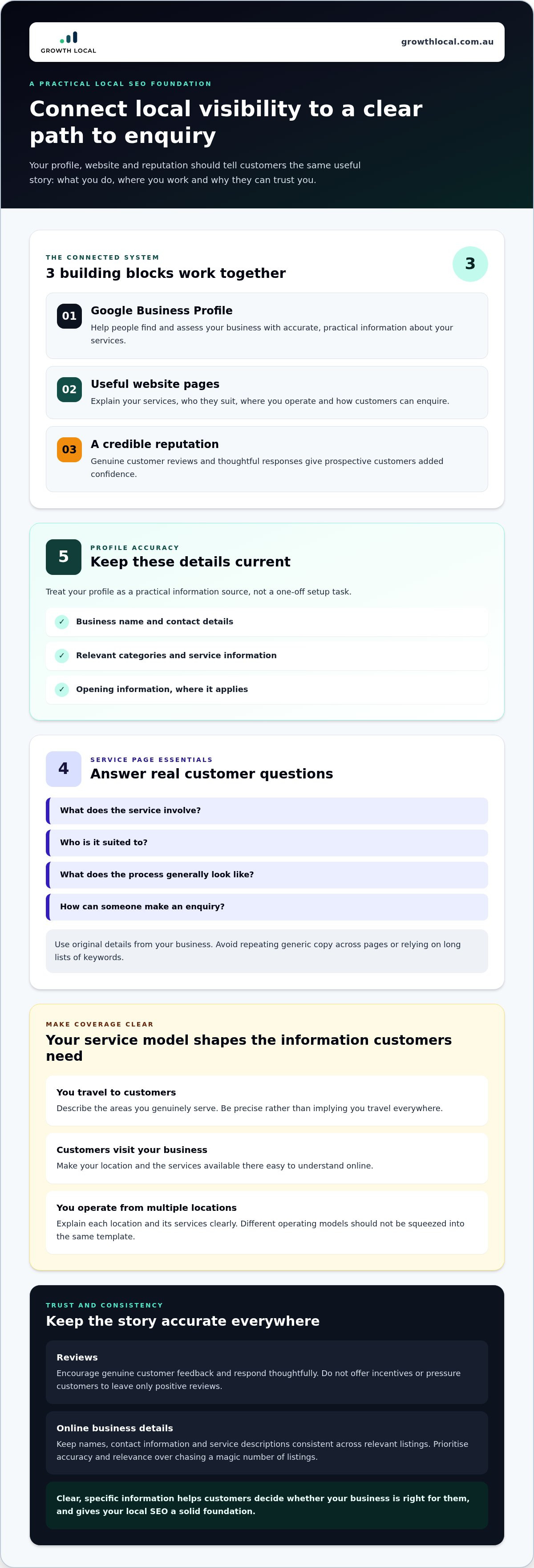
Local SEO can feel like a long list of tasks. Start with the information customers rely on, then build out work you can maintain. This sequence helps Australian service businesses focus on discovery and make it easier to turn relevant searches into enquiries. Get the foundations right first. More pages and listings won’t fix unclear services or inaccurate coverage.
- Define your service coverage. List your core services and the areas you can genuinely serve. Make sure your website and business profile describe the same scope, and don’t imply you cover areas your team can’t reach.
- Fix profile basics. Check that your business name, contact details, categories and service information are accurate. Update details that have changed before adding more marketing activity.
- Strengthen your service pages. Give each core service a clear page with useful information and a direct next step. Prioritise real customer questions over repetitive pages that only swap one location name for another.
- Build trust. Make it easy for customers to understand your offer, review genuine customer feedback and see a consistent picture of your business across relevant listings.
- Measure enquiries. Track where enquiries come from, what service they need and whether they progress. Use what you learn to decide what needs attention next.
Set a realistic service-area and content plan
Plan around your actual capacity. Map each service to the areas your business can serve, then prioritise pages that answer distinct customer needs. Helpful content can explain what a service involves, what information customers should prepare and how to request a quote, without making unsupported claims about expertise or coverage. For a trade-focused perspective, the Local SEO for Tradies guide offers a more specialised companion to this plan.
Resist the urge to publish a batch of near-identical location pages just to make the site look bigger. Add a page when it gives customers genuinely useful, specific information. Otherwise, improve your core service pages first and keep them current as your services or capacity change.
Connect local enquiries to lead management
Every relevant page should make the next step obvious, whether that’s calling or submitting an enquiry form. Then record the source, requested service and follow-up status in your CRM or lead log. This makes it easier to spot unanswered enquiries, understand which services attract suitable work and adjust your plan without relying on rankings alone. The Lead Generation System Setup Australia guide can help if you’re planning the wider process from enquiry capture through follow-up.
Review results regularly and adapt your activity to the quality of enquiries and the work your business can take on. A sensible local SEO plan should be maintainable, not another pile of jobs that never gets finished.
Turn local SEO visibility into a workable growth system
A local search result can put your business in front of someone who needs help, but visibility is only the start. That person still needs to understand your offer, make an enquiry, receive a response and decide whether to move ahead. If those steps aren’t connected, good marketing can still leave you with missed calls, scattered messages or leads that don’t get followed up.
What happens after a prospective customer finds you?
Map the journey from the customer’s point of view: they see a search result, visit your website or profile, choose how to enquire, then wait for a response and have a sales conversation. Each handover is a chance for information to get lost. A call may not be linked to the page that prompted it. A form submission may sit in an inbox with no clear owner or next step.
A practical system makes these handovers visible. Marketing brings people to relevant information, clear contact options make it easier to enquire, and CRM workflows help organise what happens next. A CRM can record the enquiry, note the service requested, assign ownership and track follow-up activity. Your team can then see what needs attention without piecing the history together across emails, call notes and spreadsheets.
An AI receptionist can also support initial lead capture. It can collect enquiry details and pass them into an organised process, while your team handles the next steps and sales conversation. It’s technology for capturing information, not a human-staffed call centre. The right setup depends on how your business receives enquiries and what information your team needs to act on them.
When a connected marketing system makes sense
Connected systems are useful when enquiries arrive through several channels, lead ownership is unclear or you can’t easily tell which marketing activity is contributing to suitable work. They’re also worth considering when your business is growing and manual tracking is becoming harder to maintain. Start with the gaps you can see, then build a process that fits your team’s capacity.
Growth Local sets up lead-generation and marketing systems for Australian service businesses, including local SEO, CRM workflows and AI receptionist integration where relevant. Connecting these parts can help you follow the journey from local visibility to enquiry and follow-up, with a clearer record of what’s happening. It doesn’t guarantee rankings or sales, but it can make the process easier to manage and assess.
If you’re weighing up where your enquiry process is getting stuck, a Growth Local demo can show how connected marketing and lead management could fit your business.
Make your next local SEO move count
Pick one practical improvement to make next. It might be clarifying a service page, checking whether a recent enquiry was followed up or making it easier to see where leads come from. A focused step gives you something useful to act on without adding busywork for its own sake.
That’s the mindset behind local SEO for service businesses Australia-wide: build a process your team can manage, then use real enquiry patterns to guide what comes next. Growth Local works with Australian businesses nationally, connecting local visibility with the systems that support lead management.
To explore how that could fit your business, book a Growth Local demo.
With a clear next step and a process you can keep improving, you’re in a stronger position to turn local discovery into lasting business growth.
Frequently Asked Questions
What is local SEO for a service business?
Local SEO for a service business improves its visibility in searches with local intent, helping potential customers discover and assess the business. Unlike broader SEO, it pays particular attention to service details, business profiles and whether stated coverage reflects how the business operates. Local SEO for service businesses Australia-wide should help relevant customers understand what’s available, but it can’t promise a specific position in results or a set number of enquiries.
Does a service-area business need a Google Business Profile?
Eligibility and setup depend on how the business serves customers and Google’s current guidelines. A tradie who travels to customers should represent that operating model accurately, rather than presenting a misleading customer-facing shopfront. Check Google’s current Business Profile eligibility guidelines before creating or changing a profile. Having one doesn’t guarantee visibility for every relevant search.
How long does local SEO take to show results?
There’s no reliable fixed timeframe because progress depends on your website’s starting point, competition, the accuracy of your business information and the work completed. Avoid treating an early ranking change as proof of lasting progress. Instead, review search visibility, relevant website activity and qualified enquiries over time. If people are finding a page but not contacting you, use that signal to reassess the page or the next step it offers.
Can a business rank in areas where it does not have an office?
A business may appear in local results beyond the area where it has a physical office, but visibility depends on several factors and isn’t guaranteed. Be clear about where you genuinely provide services, and don’t suggest you have an office or customer-facing location where you don’t. Useful service-area information can help set expectations, while relevant website content can explain the work you do. Neither a page nor a profile guarantees visibility in a particular area.
Do customer reviews help local SEO?
Reviews contribute to your online presence and help prospective customers judge whether your business may suit their needs. Ask genuine customers for honest feedback, and respond professionally to positive and critical comments. A considered response can clarify how you handle an issue without becoming defensive or revealing private details. Reviews don’t guarantee a particular ranking, so avoid buying or fabricating them, or presenting feedback in a way that gives customers a misleading impression.
What is the difference between local SEO and Google Ads?
Local SEO aims to earn visibility through relevant business information, website content and reputation, while Google Ads are paid placements that can offer more control over when and where an advertisement appears. Each channel has different costs, controls and measurement considerations. Assess them against your goals, budget and capacity to manage enquiries. Paid visibility doesn’t replace accurate service details or honest coverage, and the two channels shouldn’t be measured as if they work in the same way.
How should a service business track leads from local search?
Use a CRM or lead log to record each enquiry’s source, requested service, date and follow-up status. For example, note whether someone called after viewing a profile or submitted a form from a service page, if your tracking can show that. Review whether enquiries fit your services and progress to a sales conversation. Consistent data entry makes comparisons more useful, but don’t attribute every enquiry to SEO without evidence.


