

Lead Management for Australian Plumbers: 2026 Buying Guide
You’re under a sink when another enquiry comes in. Later, there’s a missed call to return, a website form to find and a quote to follow up. If you’re comparing a lead management system for plumbers Australia has to offer, the real test is whether it connects each enquiry to a clear next step without adding more admin.
Plumbing enquiries arrive through different channels, and time on the tools can make prompt replies and consistent follow-up difficult. A practical setup gives you one place to see each enquiry, who’s handling it and what needs to happen next.
This guide compares the systems and workflows that can help you capture enquiries, follow up and progress suitable leads into jobs. You’ll see how a CRM differs from plumbing job management software, which capabilities matter in day-to-day work and how to choose a setup your team can use. We’ll also cover a manageable rollout, including how connected lead capture, CRM and follow-up workflows can reduce manual handling.
Key Takeaways
- Map each enquiry from first contact to outcome so it has a clear status, owner and next action.
- Use a practical checklist to assess whether a system records the details your team needs to qualify plumbing work.
- Compare CRMs, plumbing job management software and connected systems by how well they fit your workflow and reduce admin.
- Choose a lead management system for plumbers Australia businesses can use consistently, starting with common enquiry paths and a few clear statuses.
- A tailored setup can connect lead capture, CRM and follow-up, with AI receptionist technology supporting initial customer interactions.
Why a lead management system matters for Australian plumbers
A plumbing enquiry can come in while you’re on a job, driving between call-outs or talking with a customer. If the details stay in a voicemail, text message or someone’s memory, it’s easy to miss who needs a reply and what was agreed. A lead management system gives your business a consistent process for capturing and progressing each enquiry.
In plain English, lead management is how your plumbing business records each potential job, tracks its progress and makes sure someone takes the next step. The system might be a CRM, a dedicated lead tool or a workflow connected to other software. What matters is that an enquiry has a clear path from first contact to an outcome.
A simple enquiry journey looks like this:
- Contact: Record who got in touch and whether they called, used a website form or contacted you through another channel.
- Job details: Note the issue, property or site, and the information needed to understand the request.
- Next action: Assign a practical step, such as returning the call, asking for more details or preparing a quote.
- Outcome: Record whether the enquiry became a job, was declined or didn’t proceed.
This makes hand-offs visible. Anyone picking up the enquiry can see what’s happened and what still needs attention, rather than restarting the conversation or guessing.
Where plumbing enquiries get stuck
Picture a customer calling while you’re working under a sink. You plan to return the call, but by the time you finish, the number is buried in your call history. Or you send a quote and move on to the next job without recording when to follow up. Neither problem needs a complicated fix. It needs a reliable place to capture the enquiry and its next action.
Scattered messages and informal handovers leave gaps. A colleague may not know a call came in, or a note may not say whether the customer is waiting for a reply or a quote. A shared record keeps the enquiry together, including its source, key details and follow-up history.
Lead management versus plumbing job management software
Lead management focuses on potential work: capturing enquiries, assessing whether they’re suitable and tracking the next sales action. Plumbing job management software generally takes over once work is accepted, helping coordinate the job itself. The two needs can overlap, but they aren’t the same. A CRM, part of the wider Customer Relationship Management (CRM) approach, organises customer information and interactions. Job software supports delivery after an enquiry becomes a job.
Some plumbing businesses use separate tools; others need a connected workflow that carries relevant enquiry details into their job system. The right fit depends on the tools you already use and where information gets stuck. A lead management system for plumbers Australia-wide should make that hand-off clearer, not add another disconnected place to check.
Which lead management system features should plumbers assess?
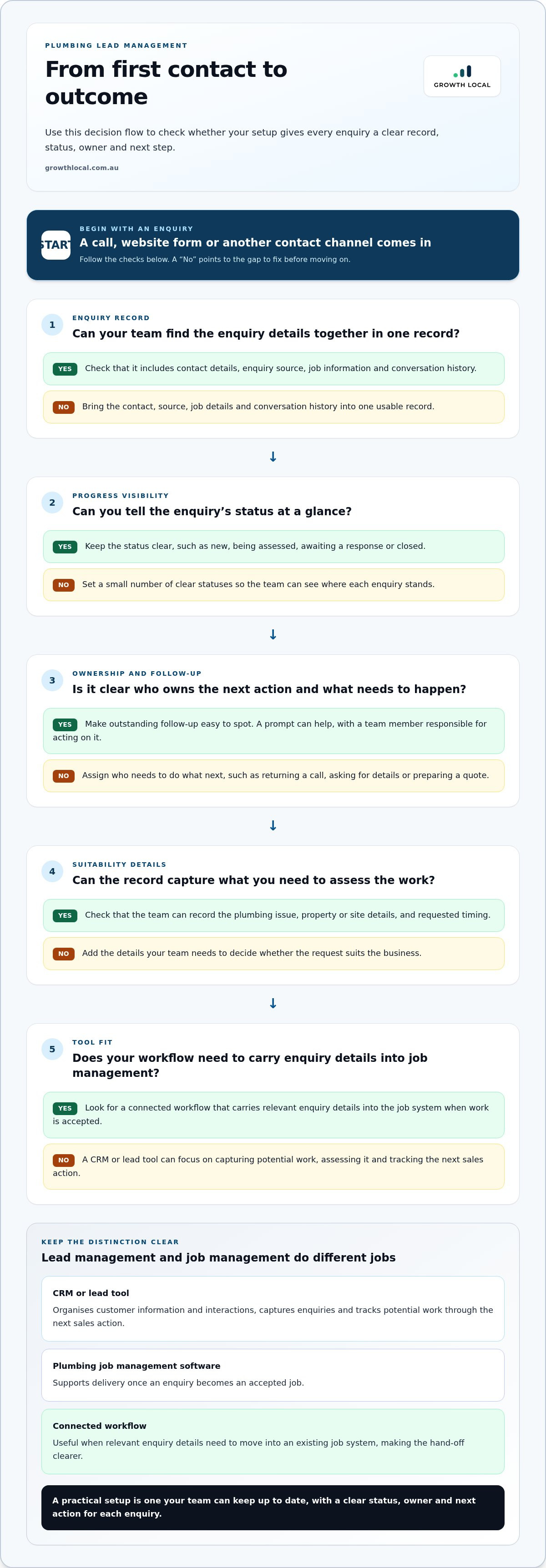
A long feature list won’t help if an enquiry still has no owner, clear status or next step. Assess each option against the work your team actually does, from first contact to deciding whether the request is suitable and progressing it. A useful lead generation system setup framework starts with that workflow, then matches tools to the gaps.
Use this checklist to compare systems and setups:
- One record per enquiry: Can your team find the contact details, enquiry source, job information and conversation history together?
- Clear status: Can you tell at a glance whether an enquiry is new, being assessed, awaiting a response or closed?
- Assigned next action: Is it clear who needs to do what next, and can the team spot outstanding follow-up?
- Useful qualification details: Can you record what’s needed to decide whether the work suits your business, such as the type of plumbing issue, property or site details, and requested timing?
- Practical follow-up: Can the workflow prompt a team member to act, or support automated follow-up where appropriate?
For a lead management system for plumbers Australia businesses can rely on, prioritise visibility and consistent use over an impressive list of features. A simple setup that staff can keep up to date is more useful than a complex one that creates extra steps.
Capture and organise plumbing enquiries
Start by listing where enquiries come from, such as phone calls, website forms or other channels your business uses. Then assess how the setup brings those details into a workflow your team can access. Aim for one usable record with an owner and contact history, rather than a trail of messages to piece together later.
Keep the information focused on qualifying the request. A burst pipe may need prompt triage, while a planned maintenance enquiry may need more details before a response. Different requests can follow different next steps without creating a maze of statuses.
Follow-up, visibility and existing tools
Outstanding enquiries should be easy to spot, with a clear view of who owns each follow-up and what action is due. Assess whether reminders or automation can support your chosen process instead of assuming every system handles them the same way. A prompt can flag work, but someone still needs to be responsible for acting on it.
Next, map what happens when an enquiry progresses. Decide which details should move from the CRM into any existing job management tool, and where the team will update the record. Include tools such as Xero in integration planning if they’re part of your current setup, but avoid adding connections that don’t support a real hand-off. A clear process keeps information useful without making the workflow harder to manage.
Compare CRM, trade software and a connected lead management system
There isn’t one setup that suits every plumbing business. A CRM-led approach can bring enquiry tracking and follow-up into focus. Trade software may already cover the operational tools your team relies on. A connected system links the two, making the hand-off from potential work to an accepted job clearer.
Use this comparison to identify where your current process needs support. These are general differences between approaches, not a ranking of products.
| Approach | Enquiry visibility | Plumbing workflow fit | Hand-offs and admin |
|---|---|---|---|
| CRM | Provides a central place for customer and enquiry records, depending on how it’s configured. | Can be shaped around assessing potential work and managing follow-up. | May require details to be transferred into separate job software once work is accepted. |
| Plumbing job management software | Enquiry visibility depends on its lead-handling features and setup. | Can bring lead handling into the tools used to coordinate plumbing work. | May reduce switching between systems, but the fit depends on how your team handles early enquiries. |
| Connected system | Can give the team a clearer view across enquiry and job stages. | Links lead follow-up with existing plumbing workflows. | Needs a deliberate hand-off design to avoid duplicated or inconsistent records. |
Think about your current tools, who handles enquiries and how much the type of work varies. A solo operator with a straightforward enquiry path may need a different setup from a team where office staff capture leads and plumbers assess jobs in the field. The best lead management system for plumbers Australia-wide is the one that fits those real roles and makes the next action clear without adding unnecessary admin.
When a CRM-led approach may fit
A CRM-led setup may suit a business that needs clearer enquiry records, follow-up ownership and a consistent way to track potential work. The workflow can be configured around how your team qualifies enquiries and progresses sales conversations. It doesn’t automatically replace specialist plumbing job software, so consider how accepted work will move into the tools used to deliver it.
A CRM implementation framework for small businesses can help structure decisions around processes and tools. The practical question is whether your existing systems support the full journey or whether you need a defined hand-off.
When trade software or connected tools may fit
If your team already relies on job management software, keeping it in place and improving the lead hand-off may be more practical than shifting every process. Fergus, Podium and TradiePad illustrate different approaches discussed in the market, from trade operations to enquiry communications and software support. Focus on the gap in your own workflow, rather than assuming one approach suits every plumber.
Before choosing, trace one enquiry from first contact to accepted work. Note which details need to carry across, who is responsible at each stage and where staff currently re-enter information. This can reveal whether you need a CRM, trade software with suitable lead handling or connected tools. If you’re weighing up implementation investment, see Growth Local pricing details. A tailored setup can connect lead capture and CRM workflows. A walk-through of a connected lead workflow can help make the approach more concrete.
How to choose and roll out a plumbing lead management system
Choose a system around the way enquiries actually move through your plumbing business, not around a long feature list. Keep the first version small: cover your most common enquiry paths, make ownership clear and give every lead a sensible next step. Then improve the workflow based on what the team uses.
Work through these steps in order:
- Map enquiries. Note where potential work comes from, who first receives it and what information the team needs to assess it.
- Define stages. Start with a few plain-language statuses, such as new, being assessed, follow-up due, quoted and closed. Adjust them to match your process.
- Choose tools. Decide whether a CRM, your existing plumbing software or a connected setup best fits your current tools and team roles.
- Configure the workflow. Add only useful fields and actions. Assign an owner to each enquiry and clarify who takes over when it moves from initial contact to assessment or quoting.
- Test real scenarios. Run a typical phone enquiry and website enquiry through the setup. Check that details are captured, the status makes sense and the next person knows what to do.
- Review and refine. Ask the team where steps are being missed or repeated. Update the workflow when there’s a clear reason, rather than adding complexity by default.
This sequence helps you compare the system against the work it needs to support. A lead management system for plumbers Australia businesses can use consistently should make ownership and follow-up easy to understand, even when enquiries change hands.
Map the workflow before configuring software
Write down your common enquiry routes and the details needed to decide what happens next. For example, a service request may need different information from a planned maintenance enquiry. Define stages that reflect your real process, then agree who updates each record and who owns follow-up at every hand-off. If responsibility changes, make the transfer explicit instead of relying on a verbal reminder.
Keep adoption practical for a busy team
Start with the fields, statuses and workflows staff need to handle enquiries, not every edge case. Show the team how to record a new lead, find its status and identify the next action. Test the process with the people who’ll use it, then simplify steps that feel like duplicate admin. Consistent use matters more than a fully loaded setup.
See how the workflow could fit your business in a lead management system demo.
Set up a lead management system for your plumbing business with Growth Local
Choosing tools is only part of the job. Your lead generation process also needs to reflect how your plumbing business captures enquiries, decides what to do with them and follows up. Growth Local sets up lead generation and CRM systems around a business’s workflow, connecting tools and hand-offs that can otherwise leave information scattered.
The aim is practical: clearer enquiry records, more structured follow-up and less manual handling. A tailored setup can account for where leads arrive, who manages them and what happens when an enquiry progresses. It supports your team’s process without promising a particular number of leads, jobs or sales.
What a tailored system setup can address
Start with the real process, not assumptions about how a plumbing business should work. Growth Local configures lead capture, CRM records and follow-up workflows to reflect your enquiry sources, team responsibilities and existing tools. That means defining what information needs to be recorded, who owns the next action and how relevant details move between systems.
For example, an enquiry may start with an initial customer interaction before a team member assesses the work. The workflow can make that hand-off clearer. The CRM supports enquiry and customer information, while your existing job management tools can remain part of the process for coordinating accepted work.
- Lead capture: Organise how enquiries from the channels you use enter the workflow.
- CRM records: Give the team a consistent place to manage enquiry details and interaction history.
- Follow-up steps: Set out who is responsible for the next action and how the enquiry progresses.
AI receptionist integration can automate lead capture and initial customer interactions. It’s one option for supporting the front end of the process, alongside the CRM and follow-up workflow. The setup should fit the way your team handles enquiries, rather than adding technology for its own sake. For further context, the AI receptionist guide for Australian service businesses explores this type of support.
Plan your next step with Growth Local
Before changing systems, identify where your current process gets held up. Is it capturing enquiries from different sources, assigning follow-up or transferring information into the tools your team already uses? Bringing a specific bottleneck to the conversation helps shape a setup around the work that needs attention.
Growth Local can connect lead generation and CRM workflows to your plumbing business’s process, with the aim of making enquiry handling more organised and reducing manual steps. To get started, explain how enquiries arrive today, who handles them and where the hand-off becomes difficult.
See how a tailored setup could fit your enquiry process.
Make your next enquiry easier to manage
You don’t need to change everything at once. Pick one recurring snag, such as unclear ownership or a missed hand-off, and use it to guide your next decision. The right lead management system for plumbers Australia businesses choose should solve a real problem in the way the team works.
Before making changes, jot down how an enquiry moves through your business and where it tends to stall. That gives you a practical starting point for deciding what to improve first.
Start with one clear improvement, then build from there.
Frequently Asked Questions
What is a lead management system for plumbers?
It’s the process your team uses to keep potential customer enquiries from being forgotten or duplicated. For example, if an existing customer calls about a different property, staff can distinguish the new request from the customer’s previous history. Agree which details matter for your business, such as the best contact method or access notes, so the record helps the next person handle the enquiry without relying on memory.
How is a lead management system different from plumbing job management software?
Use the point where your team commits to delivering work as a practical boundary between the two. Before that point, staff may still be checking details, confirming suitability or preparing a proposal. After it, the focus shifts to carrying out the agreed work. If the boundary isn’t clear, decide what triggers a job record, such as customer approval, and who is responsible for creating it.
Can a CRM work for a plumbing business?
Yes, particularly if your office team needs a consistent way to manage customer conversations before work is accepted. Test it with a repeat customer who has more than one request: can staff quickly identify which conversation relates to which property and issue? Set conventions for naming and recording these details, then decide how relevant information will reach the person handling the work.
What should a plumber look for in lead management software?
Check how the system handles everyday exceptions, not just a straightforward new enquiry. Can staff tell whether a message follows an earlier request? Can they correct a contact detail without losing useful context? Try these situations using the device and process the team will use day to day. This can reveal practical friction that a feature list or product tour may not show.
Can a lead management system help with urgent plumbing enquiries?
It can support your internal process by making the reason for urgency visible, but the business needs clear boundaries for what staff should do. Decide which situations require escalation, who makes that decision and what to record if the details are incomplete. For example, staff can capture the customer’s description and flag it for review, rather than assuming a system label alone determines priority.
How much does a lead management system for plumbers cost?
The total investment depends on the software and how much setup is needed to fit your current process. When comparing options, account for recurring software charges as well as any configuration or connection work your workflow requires. Growth Local tailors lead generation and CRM setup to the project. Use the pricing information as a starting point when considering the setup you need.
How do you get a plumbing team to use a new lead management system?
Make the system part of an existing work habit, such as reviewing open enquiries during a regular office check-in. Ask staff to point out records that are hard to interpret or steps they’re tempted to skip. A team lead can clarify the process and keep the setup practical. This feedback loop helps the system stay useful as the business’s enquiry patterns and responsibilities change.


