

How to Stop Losing Business from Missed Calls: A Practical Guide
A missed call isn’t the whole problem. The real leak is what happens next: no one captures the enquiry, follows up or records who needs to respond. If you’re working out how to stop losing business from missed calls, start by making sure every unanswered call triggers a clear next step.
It’s frustrating when enquiries come in while your team is on-site, helping customers or off the clock. Relying on callers to leave a voicemail, try again or wait for someone to check the call log leaves too much to chance. A reliable process captures the caller’s details and reason for calling, then makes follow-up easier to manage without making your business feel impersonal.
This guide explains how to build that process: what to capture, how to respond consistently and how to keep follow-up visible in one organised workflow. You’ll also see where an AI receptionist can support initial enquiry capture and how CRM setup can help track details, tasks and lead status. The aim is simple: fewer enquiries slipping through, with a clear handover for each one.
Key Takeaways
- Learn how to stop losing business from missed calls by giving every unanswered call a tracked next step, rather than relying on memory.
- Build a simple recovery workflow to capture caller details, enquiry type and follow-up status.
- Compare voicemail, staff callbacks, answering services and an AI receptionist to find an approach that suits your business.
- Measure missed calls, contact attempts and completed conversations to see where follow-up is falling short.
- Connect phone enquiries with CRM records and follow-up tasks so leads stay organised and handovers are clear.
How missed calls lead to lost business, and where recovery breaks down
A phone rings while your team is on-site, serving a customer or away from the desk. The caller may leave a voicemail, try again or move on. A missed call isn’t automatically a lost sale: it could be an existing customer, a supplier or a wrong number. The risk is not knowing which it was, or letting a genuine enquiry disappear without a clear follow-up.
Recovery often breaks down in small, familiar ways. The caller doesn’t leave a message. A callback is delayed because everyone is busy. The number appears in the call log, but the caller’s name and reason for calling aren’t recorded. Or several staff members assume someone else will follow up. Good customer service best practices depend on making support accessible and responding appropriately, whether help comes from a person or an automated system.
Missed-call recovery is the process of capturing an enquiry, responding to it and tracking the follow-up until there’s a clear next step. A missed call becomes recoverable when its status is recorded and someone, or a defined workflow, owns the next action. That doesn’t mean every caller is a qualified lead. It means you can identify what happened and decide what to do next.
Which missed calls deserve follow-up first?
Start by separating new enquiries from existing-customer calls, supplier calls and wrong numbers. Then use criteria that suit your business, such as what the caller wants, whether you provide the requested service and how urgent the enquiry appears. A brief call might be a valuable new enquiry; a long one might not be. Call duration alone can’t tell you whether a lead is worth pursuing.
Record the details your team needs to make that decision: caller name and number, enquiry type, call time, follow-up status and required action. If the caller’s intent is unclear, note that too. A relevant follow-up based on the information available is more useful than an assumption.
Where does a typical callback process fall short?
Paper notes can be misplaced, personal mobiles can keep call history separate from business records, and shared inboxes can leave ownership vague. A callback without context may make the caller repeat their request, adding friction before the conversation gets going. Choose one place to record calls and assign a person or role to own the next action.
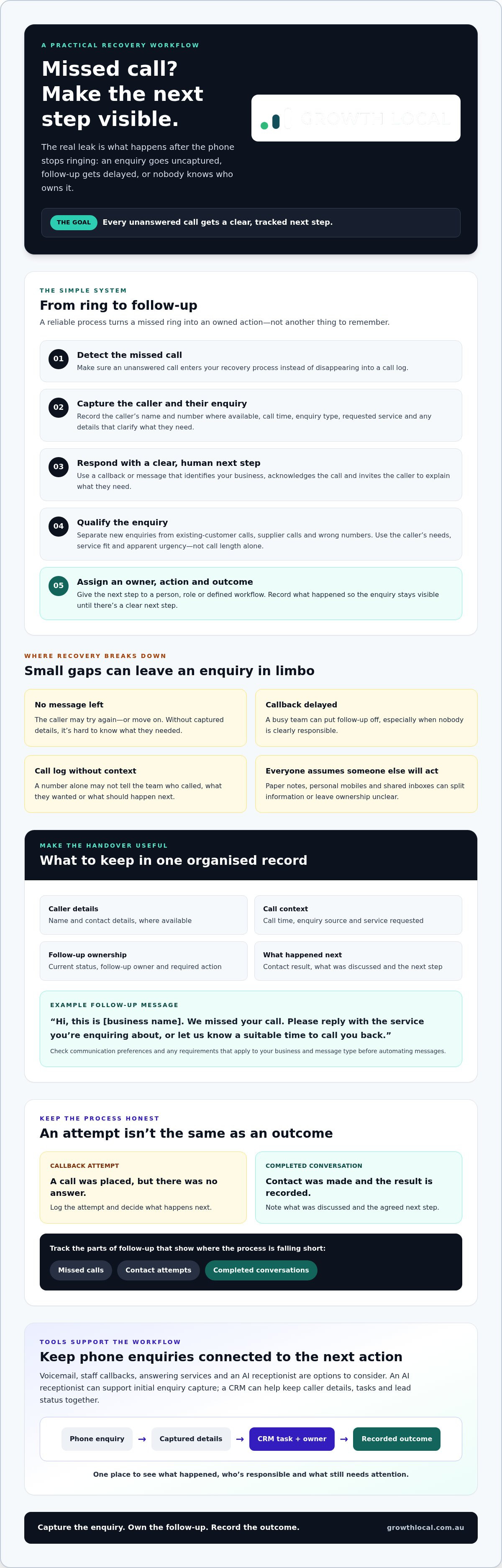
Also distinguish an attempt from an outcome. A call placed with no answer is a callback attempt, not a completed follow-up. Record whether contact was made, what was discussed and what happens next. That basic discipline is a practical starting point for how to stop losing business from missed calls: you can see which enquiries still need attention instead of relying on memory.
Build a missed-call recovery workflow: ring to follow-up
A reliable process turns a missed ring into an owned action, not another item someone has to remember. Set the sequence before choosing tools: detect the missed call, capture the details, respond, qualify the enquiry and assign the next step. The caller should have a clear path forward, while your team can see what’s happened so far.
A missed call becomes a trackable CRM task when the caller’s details and enquiry are logged, an owner and next action are assigned, and the outcome is recorded. A CRM helps keep that information together instead of splitting it between paper notes, personal mobiles and inboxes.
What should happen immediately after a missed call?
Decide who owns each missed enquiry, or set up an automated action to prompt the right person. Use a callback or message that identifies the business, acknowledges the call and invites the caller to explain what they need. For example: “Hi, this is [business name]. We missed your call. Please reply with the service you’re enquiring about, or let us know a suitable time to call you back.”
Before automating messages, check the caller’s communication preferences and any requirements that apply to your business and message type. Automation should make the handover more consistent, not send messages without suitable context.
How should the CRM record and route the enquiry?
Keep the record practical. Capture the caller’s name and contact details where available, the call time, enquiry source, service requested, current status and follow-up owner. Route enquiries using agreed criteria, such as service type or staff responsibility. The right setup depends on your process, so check which fields and integrations are available before configuring it.
Create a task with a clear action, such as “call back to discuss the requested service”, then record the result. If there’s no answer, log the attempt and decide what happens next. If contact is made, update the status and note the agreed next step. That gives the next staff member context and helps prevent duplicate or forgotten follow-up.
Phone calls are one part of customer communication, alongside options such as live chat and automated support. Forbes Advisor discusses these different methods of communication; choose a mix that suits your customers’ preferences and your team’s ability to follow through.
If you’re connecting this workflow to your lead-generation process, Growth Local sets up CRM workflows and AI receptionist integration for Australian service businesses. Explore lead-generation system setup as one way to organise enquiry capture and follow-up.
Voicemail, callbacks or an AI receptionist: which recovery option fits?
There’s no single best option for every business. The right fit depends on call patterns, staffing, how complex enquiries are and whether your existing systems can record what happens next. Use this comparison to weigh the trade-offs, not as a promise that any approach will answer every call or convert every enquiry.
| Option | Availability and caller experience | Enquiry capture and follow-up visibility |
|---|---|---|
| Voicemail | Callers can leave a message when the team can’t answer, but some may hang up instead. | Details depend on what callers leave and how often staff check messages. |
| Staff callbacks | A personal conversation can suit detailed or sensitive enquiries, but relies on staff capacity and follow-through. | Capture and visibility are strong when callbacks and outcomes are logged consistently. |
| Answering service | A third-party service may answer calls under an agreed arrangement; check its hours, handling process and caller experience. | Find out what information it records and how messages or enquiries reach your team. |
| AI receptionist setup | May support initial enquiry capture and routine interactions, depending on its configuration. | Ask which details and integrations it can handle, and how enquiries are handed over and tracked. |
Response timing matters, but speed alone isn’t a complete process. Harvard Business Review’s research on lead response times highlights the value of prompt follow-up when qualifying leads. Build a process your team can maintain, with a clear owner and a recorded outcome.
When can voicemail and manual callbacks be enough?
They can work when call volume is manageable and someone is responsible for checking messages, recording caller context and closing the loop. Look for missed follow-ups, growing delays or notes that others struggle to find. These are signs the manual process needs clearer ownership or better visibility.
When might AI receptionist integration be worth considering?
It may suit businesses that want support capturing initial details or handling routine interactions. Set clear boundaries: complex, sensitive or unsuitable enquiries need a route to a person, and the handover should include useful context. Confirm available functions and integrations before choosing a setup. For a deeper overview, see AI Receptionist Australia: 2026 Service Business Guide.
If you’re weighing up how to stop losing business from missed calls, start with the option that matches your call patterns and follow-up capacity. Automation can support the workflow, but it shouldn’t replace good judgement or a reliable human handover.
How to implement and measure a missed-call process in your business
A missed-call process only works if it fits the way your team handles enquiries. Roll it out in stages: map what happens now, assign responsibility, configure call and enquiry capture, then test the handover before relying on it. The aim is a workflow people can follow consistently, whether follow-up is manual or supported by automation.
What should you check before switching on automation?
Start with the current call path. Confirm where calls go, what business details callers hear, who handles each enquiry type and what should trigger escalation to a staff member. Check that CRM fields, notifications and follow-up ownership are set up as intended. Test the system before relying on it to capture the right details.
Run practical scenarios before launch:
- A call comes in outside your usual staffed hours.
- The person responsible for follow-up is unavailable.
- A caller gives incomplete details or asks to speak with a person.
- An enquiry needs to go to a different staff member or service team.
For each test, check what the caller experiences, where the enquiry is recorded and who receives the next task. Fix unclear handovers before switching the process on.
Which measures show whether recovery is improving?
Track the missed-call count, contact attempts, completed conversations and whether each enquiry has a recorded next step. One useful measure is the proportion of missed calls with a follow-up action recorded. You can also track time to first follow-up, but define when the clock starts and what counts as a response so comparisons stay consistent.
Review the numbers over consistent periods and look for patterns. If follow-up actions are recorded more often but conversations aren't being completed, check whether call ownership or callback attempts are getting stuck. These measures show how the workflow is operating; they don't prove that a particular sale came from a missed-call recovery. Investigate changes before drawing conclusions about business results.
For a broader view of how lead capture and follow-up fit together, see Lead Generation System Setup Australia: The 2026 Professional Framework. A connected setup can help keep call records and CRM tasks organised, while staff provide the judgement and service each enquiry needs. That's a practical part of how to stop losing business from missed calls.
Discuss CRM workflow setup with Growth Local
Make missed-call recovery part of a connected lead-generation system
A call log on its own won’t keep an enquiry moving. The value comes from connecting phone capture, a CRM record and a follow-up task: caller details reach the right team member, the enquiry’s status stays visible, and the next action doesn’t rely on someone remembering what happened.
What does a connected recovery system need to do?
Start with a clear handover. Relevant caller information should be recorded and available to the person responsible for the enquiry. The CRM should show call outcomes, lead status and follow-up actions together, so staff can quickly see whether contact is still needed or a next step has already been agreed.
Automation can support that workflow, but it isn’t a substitute for good service. If an automated interaction can’t handle an enquiry, the caller needs a clear route to a person, and the team needs enough context to continue the conversation without starting from scratch.
Growth Local sets up lead-generation systems, CRM workflows and AI receptionist integration for Australian service businesses. Its role is system setup and workflow automation, not staffing a 24/7 human call centre or brokering leads directly. The aim is to organise enquiry capture and follow-up, not promise that every call will become business.
For a wider view of how connected processes can support service businesses, see Sales Workflow Automation Australia: 2026 Trends for Service Businesses.
What is the next step if calls are still slipping through?
Before adding another tool, map the journey a call takes now: where it rings, what gets recorded, who responds and how the outcome is tracked. Then pinpoint the biggest gap. Is it enquiry capture, response, routing or follow-up visibility? That gives you a practical starting point for deciding what to change.
If you’re considering how to stop losing business from missed calls, an implementation discussion can help clarify how your call process and CRM workflow should fit together. Outline what happens today, identify where enquiries stall and explore a suitable setup without assuming automation is the answer to every problem.
Make every missed call easier to act on
A dependable recovery process doesn’t need to be complicated. Capture the caller’s details, assign a clear follow-up action and record what happens next. Then review missed calls, contact attempts and completed conversations to spot where your process needs attention.
That’s the practical answer to how to stop losing business from missed calls: connect call handling with CRM records and accountable follow-up, while keeping a person involved when an enquiry needs one. The right setup depends on your business, call patterns and existing systems.
Growth Local sets up CRM and lead-generation systems for Australian service businesses, including AI receptionist integration. Confirm specific capabilities and handovers against your workflow before implementation. The aim is to make enquiries easier to organise and follow up, not to replace good service or guarantee a sale.
Start with the gaps you can see today. A clearer process can help your team give each enquiry a more considered next step.
Frequently Asked Questions
How do I stop losing business from missed calls?
Start by recording each missed call, assigning someone to follow up and setting a clear next action. Decide what caller details your team needs, how the caller will be acknowledged and when an enquiry should be handed to a person. Review unresolved calls regularly. If manual callbacks are inconsistent, connect call capture with a CRM workflow or consider an appropriately configured AI receptionist after checking its functions and handover options.
Can an AI receptionist answer missed calls for a small business?
An AI receptionist may support initial caller interactions and enquiry capture, depending on its configuration and integrations. It isn’t the same as a human-staffed call centre, and it won’t suit every enquiry. Set clear limits and a handover path for complex requests or callers who need a person. Before choosing one, check its available functions, how information reaches your team and what escalation options are available.
What should I do when a potential customer calls and no one answers?
Record the caller’s details and reason for calling if they’re available, then assign someone to follow up. Use a brief callback or message that identifies your business, acknowledges the missed call and explains the next step, such as inviting the caller to reply or suggest a suitable time to talk. Log the contact attempt and its outcome in one system so another team member can see what’s happened.
Is voicemail enough to recover missed business calls?
Voicemail can be enough if callers leave useful messages and someone checks and follows up consistently. It’s less effective when messages go unheard, details are incomplete or no one knows who owns the callback. Check whether messages lead to a documented conversation and clear next step. If gaps keep appearing, compare a more structured callback process with automated enquiry capture or an AI receptionist setup.
How can I track whether missed-call follow-up is working?
Track measures your team can record consistently, such as missed calls, completed follow-up actions, time to first attempt and documented enquiry outcomes. Define what counts for each measure, then review results over comparable periods. These indicators can reveal where the workflow is stalling, but they don’t automatically prove a call generated revenue. Check what else changed before deciding which part of the process to adjust.
Will automated missed-call responses feel impersonal to customers?
Automated responses can feel impersonal if they’re irrelevant, make it hard to speak with someone or fail to pass on useful details. Keep messages clear, relevant to the enquiry and consistent with your service. Provide a human handover for requests that need judgement or a more personal conversation. Test realistic scenarios before launch, then review customer feedback and adjust the wording or escalation process if needed.


