
How to Get More Google Reviews for Your Trade Business (Legally)
A five-star rating next to your business name on Google is worth more than any billboard, flyer, or van wrap you could invest in. Homeowners searching for a plumber, electrician, or builder in 2026 almost always check reviews before picking up the phone. The tricky part? Getting those reviews to show up consistently, without crossing any legal lines. Most tradies know reviews matter, but few have a reliable system for collecting them. Some worry about breaching Google's policies or falling foul of Australian consumer law. Others simply forget to ask once the job's done and the next callout is waiting. This guide walks through practical, compliant ways to get more Google reviews for your trade business, covering everything from on-site timing to automated follow-ups and the legal boundaries you need to respect. Whether you're a solo operator or running a crew of twenty, these strategies work because they're built around how real customers actually behave after a job well done.
Table of Contents
Why Google Reviews are Critical for Local Trade Visibility
The Impact on Local Map Pack Rankings
Building Trust and Social Proof for Homeowners
Optimising Your Google Business Profile for Maximum Conversions
Creating a Direct Review Shortcut Link
Keeping Business Information Accurate and Professional
Proactive Strategies to Ask for Feedback On-Site
Timing the Request at the Moment of Peak Satisfaction
Using QR Codes on Business Cards and Invoices
Automating Post-Job Follow-Ups via Email and SMS
Crafting the Perfect Review Request Message
Leveraging CRM Tools for Automated Reminders
Navigating Google's Terms of Service and UK Advertising Standards
The Dangers of Review Gating and Incentivisation
Distinguishing Between Genuine Requests and Fake Testimonials
Managing and Responding to Customer Feedback
Turning Positive Reviews into Marketing Assets
Why Google Reviews are Critical for Local Trade Visibility
Google reviews do more than make you look good. They directly influence whether your business appears in front of local customers at the moment they're ready to hire. For trade businesses competing in a specific suburb or city, reviews are one of the strongest ranking signals Google uses to decide who shows up and who gets buried.
The maths is simple: a plumbing business with 87 reviews and a 4.8 average will almost always outrank a competitor with 12 reviews and a 4.5 average, assuming other factors are roughly equal. Reviews signal to Google that a business is active, trusted, and relevant. They also give potential customers the confidence to call you instead of scrolling to the next listing.
The Impact on Local Map Pack Rankings
The local Map Pack, those three business listings that appear at the top of a Google search with a map, is prime real estate. According to multiple local SEO studies, review quantity, velocity (how frequently new reviews come in), and average rating are among the top factors determining Map Pack placement.
For a trade business, this matters enormously. When someone in Melbourne searches "emergency electrician near me," the Map Pack is where most clicks go. If your profile sits in that top three with strong reviews, you're capturing enquiries before searchers even see organic results. A steady flow of new reviews tells Google your business is consistently delivering good work, which keeps you competitive in those rankings month after month.
Building Trust and Social Proof for Homeowners
Homeowners are spending real money on trade services, often hundreds or thousands of dollars. They want reassurance before letting someone into their home. A strong collection of genuine reviews provides that reassurance in a way that your own marketing never can.
Think about it from the customer's perspective. They're comparing three tilers. One has 140 reviews with detailed comments about punctuality, clean work, and fair pricing. Another has six reviews and a generic description. The decision practically makes itself. Reviews act as word-of-mouth at scale, giving strangers the same confidence a personal recommendation would.
Optimising Your Google Business Profile for Maximum Conversions
Before you start chasing reviews, make sure your Google Business Profile is set up to convert the traffic you're already getting. A poorly maintained profile with outdated photos, wrong opening hours, or a missing service area will undermine even the best review collection strategy.
Spend thirty minutes auditing your profile. Upload recent photos of completed jobs. Make sure your service categories accurately reflect what you do. Add your service area suburbs. These small details build credibility and make your profile look professional alongside those reviews.
Creating a Direct Review Shortcut Link
One of the biggest barriers to getting reviews is friction. If a customer has to search for your business, find the right listing, and then figure out where to leave a review, most won't bother. A direct review link eliminates those steps.
To create one, log into your Google Business Profile, find the "Ask for reviews" section, and copy the short link Google provides. This link takes customers straight to the review form. You can paste it into text messages, emails, or even print it on a card. The fewer clicks between your request and their review, the higher your conversion rate.
Keeping Business Information Accurate and Professional
Inconsistent business information across the web confuses both Google and potential customers. Your business name, address, and phone number should match exactly across your Google profile, website, and any directories you're listed on.
If you've recently changed your mobile number or moved your workshop, update everything immediately. Google cross-references this information, and discrepancies can hurt your local ranking. A professional, consistent presence also builds trust with customers who are checking you out before calling.
Proactive Strategies to Ask for Feedback On-Site
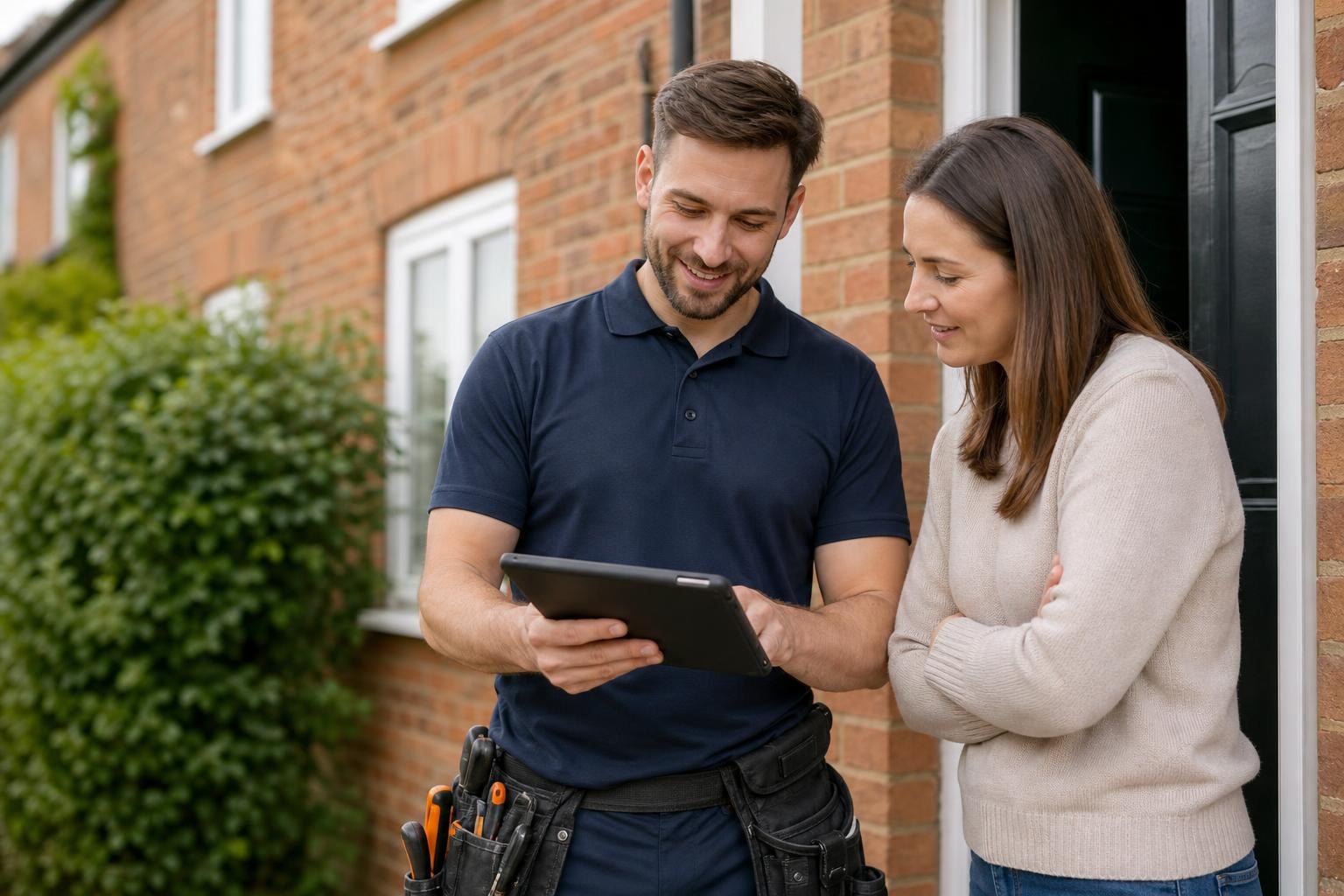
The single most effective way to collect reviews is to ask in person, at the right moment. No automation, no fancy tool. Just a genuine request from someone who's just delivered a great result.
Most tradies feel awkward about this, but it doesn't need to be a sales pitch. A simple "If you're happy with the work, I'd really appreciate a Google review - it helps other locals find us" is enough. The key is timing and delivery.
Timing the Request at the Moment of Peak Satisfaction
The best moment to ask is right after the customer has seen the finished result and expressed satisfaction. That could be when you show them the new tapware working perfectly, or when they walk into a freshly painted room and smile. Their positive emotion is at its highest, and the job is still fresh in their mind.
Waiting even a day reduces the likelihood of getting a review by roughly half. People get busy, the moment passes, and your request becomes just another thing on their to-do list. Ask while you're still standing in front of them, and you'll see a dramatically higher response rate.
Using QR Codes on Business Cards and Invoices
A QR code linked to your direct review URL is a small touch that makes a real difference. Print it on your business cards, invoices, or a small "Thank You" card you leave behind after every job. When the customer scans it with their phone, they land directly on your Google review form.
This works particularly well for customers who agree to leave a review but want to do it later. The QR code sits on their fridge or kitchen bench as a visual reminder. You can generate free QR codes through dozens of online tools, and most print shops can add them to your existing materials for minimal cost.
Automating Post-Job Follow-Ups via Email and SMS
Asking in person is ideal, but it's not always practical. Sometimes you finish a job while the homeowner is at work, or the customer is friendly but forgetful. That's where automated follow-ups come in. A well-timed email or SMS sent a few hours after the job is completed can capture reviews you'd otherwise miss.
The trick is keeping these messages personal and brief. Nobody wants to read a three-paragraph email asking for a favour. A short, warm message with a direct link does the job.
Crafting the Perfect Review Request Message
The best review request messages share three qualities: they're short, personal, and include a direct link. Here's a structure that works well for trade businesses:
Open with the customer's first name
Reference the specific job ("Hope the new hot water system is running well!")
Ask directly but politely for a Google review
Include the review link so they can tap and go
Thank them for their business
Keep the entire message under 50 words if it's an SMS. For email, you have slightly more room, but brevity still wins. Avoid corporate-sounding language. Write it like you'd text a mate, just slightly more polished.
Leveraging CRM Tools for Automated Reminders
If you're completing multiple jobs per week, manually sending review requests becomes unsustainable. A CRM with automated workflows can send a personalised review request after every completed job without you lifting a finger.
This is one area where having an integrated system pays for itself quickly. Growth Local, for example, builds automated review request sequences for trade businesses that trigger based on job completion. The system sends an initial SMS, follows up with an email if there's no response, and tracks which customers have left reviews. It's one connected workflow rather than a patchwork of separate tools. Agencies that specialise in trades understand the timing and messaging that actually gets responses, which makes a measurable difference to review volume.
Navigating Google's Terms of Service and UK Advertising Standards
Collecting reviews legally isn't complicated, but there are clear rules you need to follow. Google's review policies and Australian Consumer Law both set boundaries around what's acceptable. Crossing those lines can result in your reviews being removed, your profile being suspended, or even legal action from the ACCC.
The core principle is straightforward: reviews must be genuine, voluntary, and unbiased. Everything you do to encourage reviews should respect that principle.
The Dangers of Review Gating and Incentivisation
Review gating means filtering customers before they leave a review, typically by asking about their experience first and only directing happy customers to Google. This practice violates Google's policies. You must give every customer the same opportunity to leave a review, regardless of whether their feedback is positive or negative.
Incentivising reviews is equally problematic. Offering a discount, gift card, or entry into a prize draw in exchange for a Google review breaches both Google's terms and Australian Consumer Law. The ACCC has been increasingly active in pursuing businesses that engage in this behaviour. Even well-intentioned incentive programmes can land you in trouble if a review doesn't disclose that something was received in exchange.
The safe approach is simple: ask every customer, offer nothing in return, and accept whatever feedback comes. This builds a genuine review profile that's sustainable and legally sound.
Distinguishing Between Genuine Requests and Fake Testimonials
Fake reviews are a growing problem, and Google's detection systems have become significantly more sophisticated in 2026. Purchasing reviews from third-party services, asking friends who weren't customers to leave reviews, or writing reviews yourself are all violations that can result in permanent profile suspension.
The distinction matters because the consequences are severe. A legitimate request to a real customer is perfectly fine. Fabricating or manipulating reviews in any way is not. If Google detects suspicious patterns, such as a sudden spike of reviews from accounts with no other activity, or multiple reviews originating from the same IP address, they'll remove the reviews and may penalise your listing.
Stick to real reviews from real customers. It's slower, but it's the only approach that holds up long-term.
Managing and Responding to Customer Feedback
Getting reviews is only half the equation. How you manage and respond to them shapes public perception and influences future customers' decisions. Every review, positive or negative, is an opportunity to demonstrate professionalism.
Google also considers review responses as a ranking signal. Businesses that actively engage with their reviews tend to perform better in local search results than those that collect reviews passively and never respond.
Turning Positive Reviews into Marketing Assets
A glowing five-star review is marketing gold, but only if you use it. Beyond responding with a genuine thank-you on Google, you can repurpose positive reviews across your marketing channels.
Screenshot standout reviews and share them on your social media accounts
Feature customer quotes on your website's homepage or service pages
Include recent reviews in email newsletters or quote follow-ups
Use them in Google Ads extensions to boost click-through rates
When responding to positive reviews on Google, be specific. Instead of a generic "Thanks for the review!", reference the job: "Glad the bathroom renovation turned out exactly how you pictured it, Sarah. It was a great project to work on." This personal touch shows future readers that you genuinely care about each customer's experience.
Handling Negative Reviews Professionally and Legally
Negative reviews sting, especially when you feel they're unfair. But how you respond matters far more than the review itself. Potential customers reading your reviews will judge you by your reaction to criticism as much as by the praise.
Respond promptly, calmly, and professionally. Acknowledge the customer's frustration, offer to resolve the issue offline, and avoid getting defensive or argumentative in a public forum. A response like "I'm sorry the experience didn't meet your expectations, Dave. I'd like to discuss this further - please call me on [number] so we can sort it out" shows maturity and accountability.
Never ask a customer to remove or edit a negative review. You can flag reviews that violate Google's policies (spam, offensive content, or reviews from non-customers), but legitimate negative feedback should be addressed, not suppressed. Over time, a handful of negative reviews among many positive ones actually increases credibility. A perfect 5.0 rating with no criticism can look suspicious to savvy consumers.
If managing review responses feels like one more thing you don't have time for, automated reputation management systems can alert you to new reviews instantly and provide response templates tailored to different scenarios. Growth Local has helped trade businesses across Australia generate over 3,500 leads through integrated systems that handle everything from review collection to response management, keeping your online reputation strong without adding hours to your week.
Making Reviews a Permanent Part of Your Business
The trade businesses that consistently rank at the top of local search results aren't doing anything magical. They've simply built review collection into their standard operating procedure. Every completed job triggers a follow-up. Every happy customer gets a simple, friction-free way to share their experience. And every review, good or bad, gets a thoughtful response.
Start with the basics: create your direct review link, print a QR code, and ask your next three customers in person. Then build from there with automated follow-ups and a system that runs without constant attention. The reviews will compound over time, strengthening your local visibility and giving new customers the confidence to choose you over the competition.
If you'd rather have someone build that entire system for you, Growth Local specialises in exactly this for Australian trade businesses. Book Your Free Growth Call and they'll map out a plan to keep new reviews, leads, and booked jobs coming in without the constant chasing.


