

How to Automate Lead Generation for Australian Service Businesses
Are you effectively paying A$10,000 a month just to watch your competitors pick up the phone? For many Australian service business owners, this is the hidden cost of missed calls and manual data entry. You know the frustration of finishing a long day on-site only to find a list of tyre-kickers and unanswered enquiries. Learning how to automate lead generation isn't about chasing the latest tech gimmick; it's about building a pragmatic digital infrastructure that works as hard as you do.
You shouldn't have to choose between doing the heavy lifting and growing your company. We'll show you how to implement a high-performance system that captures, qualifies, and follows up with prospects automatically. This article outlines the exact steps to build a self-filling pipeline, improve your response times, and scale your revenue without increasing your headcount. From AI receptionists to streamlined CRM workflows, you'll discover how to turn your backend into a relentless growth engine that operates while you're busy on the tools.
Key Takeaways
- Identify and eliminate the "Missed Call Tax" that costs Australian service businesses thousands in lost revenue every month due to slow response times.
- Discover how to automate lead generation by building a digital infrastructure that captures and qualifies every enquiry around the clock.
- Learn why prioritising system architecture over "shiny object" software is the only way to reduce manual data entry and administrative bloat.
- Master the three pillars of automated lead systems-capture, qualify, and follow up-to ensure you only spend time on serious, high-value prospects.
- Move from a daily operator to a strategic business owner by implementing professional sales workflows that allow you to scale without increasing headcount.
The Hidden Cost of Manual Lead Generation in Australia
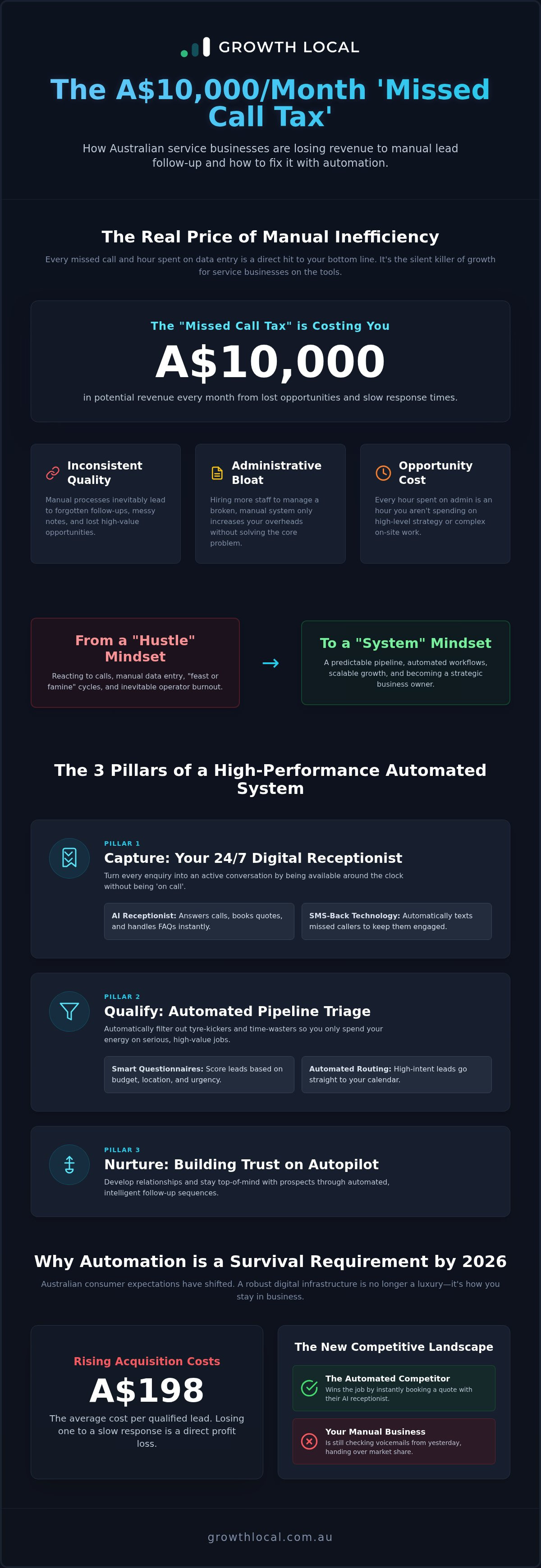
Running a service business in Australia often feels like a race against the ringer. If you're on a job site or in a meeting, every missed call is a potential A$5,000 or A$10,000 contract walking out the door. This "Missed Call Tax" is the silent killer of growth. When you rely on manual processes, your response time is tied to your physical availability. If you don't answer within minutes, the prospect has already moved to the next listing on Google. Manual follow-up isn't just slow; it's a bottleneck that prevents you from scaling. You can't hire more technicians if you're stuck in the office chasing leads that never convert.
The frustration of tyre-kickers adds another layer of inefficiency. Spending twenty minutes on the phone with someone who just wants the "cheapest price" is a drain on your energy. Moving from a "hustle" mindset to a "system" mindset means accepting that you cannot do it all yourself. You need a digital engine that filters out the noise. This shift is the difference between owning a job and owning a scalable business that operates independently of your time.
Calculating the Real Price of Manual Labour
Manual data entry into spreadsheets is a drain on your most valuable resource: time. Every hour spent typing names, cleaning up messy notes, or chasing prospects who don't pick up is an hour you aren't billing. This creates a "feast or famine" cycle. You're either too busy to handle leads or too quiet because you stopped marketing to do the work. The emotional toll of being "always on" is exhausting and leads to burnout. Understanding how to automate lead generation allows you to replace this chaos with a predictable system. It ensures that every enquiry is captured, qualified, and logged without you lifting a finger.
- Inconsistent Quality: Manual processes lead to forgotten follow-ups and lost opportunities.
- Administrative Bloat: Hiring more staff to manage a broken system only increases your overheads.
- Opportunity Cost: Every hour spent on admin is an hour lost on high-level strategy or complex on-site work.
Why 2026 is the Year of the Automated System
Australian consumer expectations have shifted dramatically. By 2026, the average cost per qualified lead across industries has hit A$198, meaning every lead you lose to a slow response is a direct hit to your profit margin. Competitors are no longer just "other tradies"; they're companies using AI receptionists to win jobs while you're still checking your voicemail. A robust digital infrastructure is no longer a luxury for big firms. It is a survival requirement. If your business doesn't have a system that qualifies leads and books appointments instantly, you're essentially handing your market share to those who do.
The Three Pillars of a High-Performance Automated Lead System
A high-performance system isn't just a collection of random apps. It's a structured workflow designed to move a stranger to a paying customer with minimal human intervention. If you want to master how to automate lead generation, you must build your infrastructure on three specific pillars: capture, qualify, and nurture. These pillars work together to ensure your business stays active even when you're off the clock. Without this foundation, you're simply throwing money at ads and hoping something sticks.
Capture: The AI Receptionist and Instant Forms
Capture is about being available 24/7 without being "on call" 24/7. An AI receptionist serves as a tireless digital employee that answers enquiries, books quotes, and handles basic FAQs at any hour. This technology eliminates the "Missed Call Tax" by ensuring every prospect gets an immediate response. When combined with SMS-back technology, your system can automatically text a caller the moment you miss their mobile call. This keeps the lead engaged and prevents them from scrolling to your competitor's listing. It turns a potential lost lead into an active conversation in seconds.
Qualify: Automated Triage for Your Sales Pipeline
Talking to every single person who fills out a form is a recipe for burnout. You need automated triage to filter out the tyre-kickers. By using smart questionnaires, you can score leads based on their budget, location, and urgency. For solar professionals, this means the system automatically asks about roof orientation or average power bills before a human ever looks at the file. High-intent leads are routed directly to your booking calendar; low-score enquiries are archived or sent to a general mailing list. This ensures you only spend your energy on the jobs that move the needle.
Nurture: Building Trust on Autopilot
The sale rarely happens on the first touchpoint. Nurturing is the process of keeping your brand top-of-mind until the prospect is ready to pull the trigger. Automated SMS and email sequences can deliver social proof, case studies, and educational content without you lifting a finger. This "long-term nurture" strategy handles the heavy lifting of building trust. It pre-sells your expertise so that when the client finally books, they're already sold on your value rather than just your price. All these pillars must be integrated into a central CRM to ensure no data is lost and every interaction is tracked across the entire customer journey.
Software vs. Systems: Why Your Tech Stack Might Be Failing You
Buying a subscription to five different apps isn't a strategy; it's an expense. Many Australian business owners fall into the "Shiny Object" trap, thinking a new tool will solve their growth problems. In reality, more tools often create more work. If your lead generation apps don't talk to each other, you're just creating digital silos. You end up as the human bridge, manually moving data between screens. This is exactly what you were trying to avoid when you looked into how to automate lead generation in the first place.
Designing the workflow first is the secret to how to automate lead generation without losing the human touch that local customers value. Your CRM must be the single source of truth for your entire operation. Every text, email, and quote needs to live in one place. When your data is fragmented, you lose the ability to see which marketing channels actually pay off. A professional system architecture ensures that the workflow is designed before a single piece of software is purchased. This prevents a "Zapier mess" where one update breaks your entire pipeline.
The Problem with Fragmented Tech
Duct-taping tools together leads to data leaks. If a lead fills out a form but doesn't sync to your dialler, that's money lost. Managing multiple subscriptions that don't integrate is expensive, confusing, and inefficient. A professional setup replaces this chaos with a streamlined engine. It's about building a foundation that doesn't crumble when you add more users or increase your ad spend. DIY automation often fails because it lacks the rigorous testing required for a high-performance business environment.
- Data Silos: Information gets trapped in individual apps, leading to missed opportunities.
- Subscription Bloat: You pay for features you don't use and tools that overlap.
- System Fragility: Small changes in one app can break your entire customer journey.
Building for Scalability and Speed
Clean data allows you to make informed decisions. You need to know your exact cost per qualified lead to scale confidently. A "tradie-proof" system is essential; if it's too complex for your team to use on a tablet in the field, they'll ignore it. Automation should feel like a local service, not a Silicon Valley bot. By using natural language and Australian-specific workflows, you maintain your brand's personality while reaping the rewards of high-tech efficiency. This ensures your digital infrastructure is logical, fast, and transparent as you grow.
A Practical Roadmap to Automating Your Lead Generation
Transitioning from a manual "hustle" to a systematic engine requires a logical, phased approach. You can't simply flip a switch and expect a perfect pipeline overnight. Building a high-performance infrastructure is about precision and sequence. If you try to deploy AI agents before you've fixed your data flow, you'll just automate your mistakes at a faster rate. Following a proven roadmap ensures that every dollar you spend on marketing is captured, tracked, and converted with maximum efficiency.
Audit and Strategy: The Foundation of Success
The first step in how to automate lead generation is identifying your "leaky buckets." This means auditing your current sales process to see exactly where prospects are dropping off. Are they calling after hours? Are they filling out forms but never getting a follow-up? Once you've identified the leaks, you must define your Ideal Customer Profile (ICP). This allows your system to automatically qualify leads based on your most profitable job types. Setting clear KPIs, such as your Lead-to-Quote ratio, gives you a benchmark to measure the success of your new digital infrastructure.
Your roadmap should follow these five critical steps:
- Step 1: Audit. Quantify your current losses and identify bottlenecks in your lead flow.
- Step 2: Map. Design the ideal customer journey from the first Google click to the final paid invoice.
- Step 3: CRM Implementation. Set up a central source of truth to manage all data and communications.
- Step 4: Automation Deployment. Integrate AI receptionists and SMS workflows to handle repetitive follow-ups.
- Step 5: Optimisation. Use real-world performance data to refine your scripts and qualification criteria.
Implementation and Refinement
Execution is where most DIY attempts fail. A "soft launch" is essential; it allows you to catch minor bugs in the workflow before you ramp up your ad spend. During this phase, you train your AI receptionist to mirror your brand's voice and handle industry-specific questions. This ensures the technology feels like a natural extension of your team rather than a robotic gatekeeper. Remember that automation is a "set and improve" process. By reviewing your data monthly, you can spot trends and adjust your qualification questions to further increase your lead quality. This continuous refinement is what separates a basic setup from a world-class sales engine.
If you're ready to stop the manual grind and start scaling with precision, you need a partner who understands the technical heavy lifting. Book a Lead Generation System Setup to begin building your automated infrastructure today.
Winning Back Your Time: Implementing Your Automated Infrastructure
The transition from operator to owner only happens when you stop being the bottleneck in your own business. If you are still the one manually answering every text or logging every enquiry into a spreadsheet, you aren't an owner; you're a high-paid receptionist. Systems facilitate the freedom to focus on high-level strategy, team management, and business growth. Understanding how to automate lead generation is the first step toward reclaiming your calendar. By building a digital infrastructure that handles the heavy lifting, you ensure that your revenue grows even when you aren't physically working.
A pragmatic approach to growth requires a shift in perspective. You must stop viewing technology as a cost and start seeing it as a relentless, 24/7 employee. This "digital engine" doesn't get tired, doesn't miss calls, and doesn't forget to follow up. It provides a level of consistency that a human team simply cannot match. Taking the first step toward a streamlined future means moving away from the "hustle" and toward a predictable, high-performance sales environment.
The ROI of Professional System Setup
Comparing the cost of professional implementation against the cost of lost leads reveals a stark reality. If you are losing A$10,000 a month to missed calls and slow responses, a properly configured CRM pays for itself in weeks. Professional setup ensures that your system is robust, logical, and transparent from day one. It improves team accountability by providing clear visibility into the sales pipeline, ensuring every technician and salesperson knows exactly which leads are hot. The peace of mind that comes from knowing every enquiry is handled perfectly is invaluable. It allows you to step away from the tools with total confidence in your backend operations.
- Accountability: Every lead is tracked, assigned, and followed up with zero exceptions.
- Efficiency: Automated workflows eliminate hours of manual data entry and admin bloat.
- Speed: Instant responses beat your competitors to the punch, increasing your win rate.
Next Steps for Your Business Growth
Moving from manual chasing to automated winning is a strategic choice. For Australian service businesses, especially those in the solar and trades sectors, specialised CRM setups are essential. These systems are built to handle industry-specific nuances like site inspections, roof orientation, and complex quoting. The Growth Local approach focuses on building bespoke systems that reflect the reality of the Australian market. We don't offer generic advice; we implement practical workhorses that drive physical business results. If you're ready to scale without increasing your headcount, it is time to Organise a strategy session with Growth Local to automate your leads and secure your company's high-growth future.
Build Your High-Performance Sales Engine
Stop paying the "Missed Call Tax" and start building a digital infrastructure that actually scales. We've explored why manual data entry is a bottleneck and how the three pillars of capture, qualify, and nurture create a pipeline that fills itself. Mastering how to automate lead generation is no longer optional for Australian service businesses; it's the fundamental shift from being a daily operator to a strategic business owner. You've already done the hard work of building your reputation; now you need a system that protects it.
Growth Local provides national expertise in digital infrastructure with a specific focus on solar CRM and tradie automation. We deliver a no-nonsense, results-oriented implementation that replaces fragmented tools with a single source of truth. You don't need more apps; you need a practical workhorse that captures every opportunity around the clock. Streamline your sales and capture more leads with Growth Local and take control of your revenue. It's time to stop chasing tyre-kickers and start winning more jobs on autopilot. Your future growth depends on the systems you build today.
Frequently Asked Questions
Is lead generation automation too expensive for a small service business?
Automation is often more affordable than the cost of a single lost contract. While there is an initial setup fee, the long-term savings on administrative labour and the elimination of the "Missed Call Tax" provide a high ROI. Small businesses can start with essential pillars like an AI receptionist and scale as revenue increases. It's about replacing an expensive, unreliable manual process with a fixed-cost digital workhorse that never takes a day off.
Will my customers know they are talking to an AI receptionist?
Modern AI receptionists use natural language processing to provide a seamless, local experience. Most customers won't notice they're talking to a bot if the script is grounded in your specific business logic and Australian vocabulary. The goal isn't to trick the customer but to provide an instant response. You can always choose to be transparent or simply focus on the efficiency of booking their quote without delay; customers value speed above all else.
How long does it take to set up an automated lead generation system?
A professional implementation typically takes between two to four weeks depending on the complexity of your sales journey. This timeframe includes auditing your current lead flow, building the system architecture, and training your AI agents. We don't believe in "quick fixes" that break under pressure. A methodical setup ensures your digital infrastructure is stable, tested, and ready to handle high-volume traffic before you ramp up your marketing spend or increase your headcount.
Do I need to be a tech expert to manage these automated workflows?
You don't need to be a tech expert because the system is designed to be "tradie-proof." A professional setup ensures the backend complexity is hidden, leaving you with a simple, user-friendly interface. Your team can manage leads from a mobile app or tablet while on-site without needing to understand the underlying code. The focus remains on your core trade while the technology handles the heavy lifting of data management, lead qualification, and follow-ups.
Can I automate lead generation for a solar installation business specifically?
Yes, we specialise in how to automate lead generation for solar businesses through custom CRM configurations. Automated workflows can qualify prospects based on roof orientation, current electricity bills, and shading issues before you even visit the site. This ensures your sales team only spends time on high-intent leads that meet your specific installation criteria. It's a proven way to increase your lead-to-quote ratio and improve your margins in a highly competitive national market.
What happens if the automation makes a mistake with a prospect?
Mistakes are rare in a professionally configured system, but human oversight remains a critical component. We implement a "set and improve" strategy where you can review AI transcripts and automated logs to refine the logic. If an edge case occurs, the system can be programmed to route the enquiry directly to a human team member for immediate resolution. This ensures your brand reputation stays intact while the automation handles the vast majority of standard enquiries effortlessly.
Which CRM is best for an Australian tradie business looking to automate?
The best CRM for an Australian tradie is one that acts as a "Single Source of Truth" and integrates seamlessly with local communication tools. It needs to handle SMS, email, and call logging in one place. While many generic tools exist, a specialised setup tailored to service workflows is more effective than a DIY solution. The right choice depends on your headcount and specific job types, but it must be scalable, transparent, and easy to use in the field.
How do I ensure my automated emails don’t end up in the spam folder?
Ensuring deliverability requires following Australian regulations and technical best practices. As of July 1, 2026, ACMA requires sender ID verification for SMS, and similar rigor applies to email. We configure your system with proper SPF, DKIM, and DMARC records to prove you're a legitimate sender. Using clean, qualified data rather than "cold lists" also keeps your engagement rates high and prevents your sequences from being flagged as spam by local providers. High-quality data is the best defence against spam filters.


