

Facebook Ads for Tradies: The Complete 2026 Australian Guide
Facebook ads don't fail for trade businesses because local homeowners aren't on social media; they fail because most operators treat them like passive digital billboards instead of automated intake engines. If you've ever burned good cash testing Facebook ads for tradies only to cop tyre-kickers, or missed enquiries while flat out on the tools, you're not alone. Wrestling with confusing technical settings inside Meta Ads Manager shouldn't eat up your evenings after a hard day on-site, especially when seasonal lulls make your schedule unpredictable.
You're about to discover how Australian trade businesses run profitable Meta ad campaigns that capture qualified local jobs without burning budget. We break down the practical steps to filter out price-shoppers before you quote, attract consistent high-margin residential and commercial work, and automate your lead response so no enquiry goes cold while you're working.
Key Takeaways
- Ditch boosted posts for structured campaign architecture inside Meta Ads Manager to capture qualified local jobs instead of wasted clicks.
- Discover how to build high-converting Facebook ads for tradies using authentic on-site photos, real job footage, and straightforward copy.
- Choose the right conversion pathway between pre-filled Instant Forms for fast volume and dedicated landing pages for high-ticket projects.
- Lock in the five-minute response window with automated intake tools so hot enquiries never slip through to your competitors while you're on the tools.
- Connect front-end ads directly to a dedicated CRM system to turn raw ad clicks into booked quotes and consistent revenue.
Why Most Tradies Burn Cash on Facebook Ads (And the Fix)
Most trade businesses that try social media advertising get burnt. You throw fifty bucks at a post, wait for the phone to ring, and end up with three likes from overseas accounts and zero booked quotes. Running successful Facebook ads for tradies isn't about collecting empty social praise; it requires a structured commercial pipeline built to capture paying jobs.
When you rely on passive website traffic or unvetted web forms, mobile users bounce before taking action. Even worse, generic forms flood your phone with invalid numbers and price-shoppers looking for the cheapest quote in town. To stop the bleed, your business needs deliberate campaign architecture that qualifies homeowners upfront.
The 'Boost Post' Trap vs Meta Ads Manager
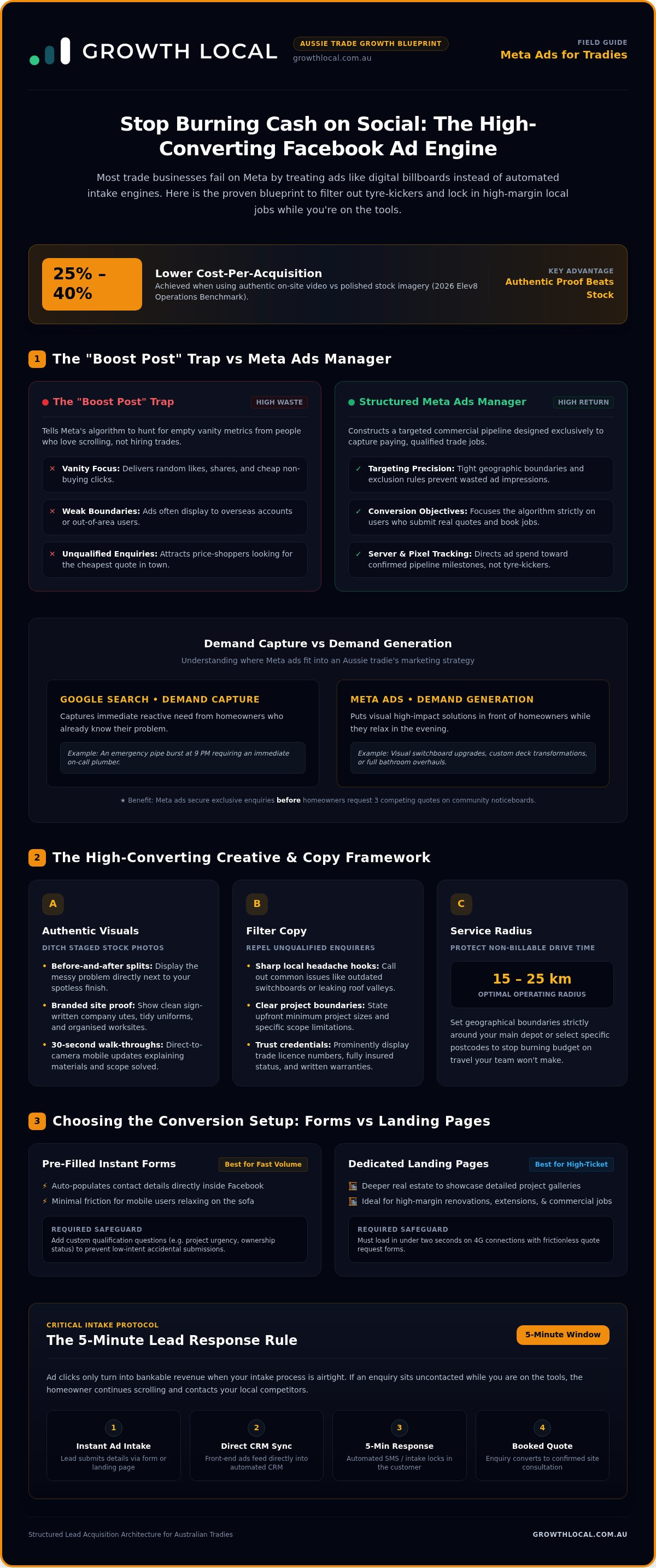
Hitting that blue "Boost Post" button is the quickest way to waste ad spend. Boosting tells Meta's algorithm to hunt for vanity engagement: comments, shares, and cheap clicks from people who love scrolling, not hiring trades. Meta Ads Manager, by contrast, lets you build targeted campaigns aimed squarely at business outcomes.
- Targeting precision: Ads Manager allows tight geographical boundaries and exclusion rules, preventing ads from showing outside your actual operational zone.
- Conversion objective control: Choosing Lead Generation or Sales objectives trains the platform to display your offer only to users who actively submit quotes and book consultations.
- Pixel and server tracking: Tracking tools measure real pipeline milestones, ensuring your daily budget focuses on confirmed enquiries rather than aimless browsing.
Demand Generation vs Demand Capture: Social vs Search
Google search captures existing demand from users who already know they have a problem, like an emergency pipe burst. Facebook does the opposite; it generates demand by putting high-impact solutions directly in front of homeowners while they relax in the evening.
Visual projects trigger immediate action. A crisp video of a custom deck, a modern switchboard upgrade, or a completed bathroom overhaul stops thumbs mid-scroll. When executed properly, Facebook ads for tradies give you exclusive enquiries before homeowners ever post to community noticeboards or ask three other local contractors for competing quotes.
The High-Converting Facebook Ad Framework for Trade Businesses
Nailing your campaign setup in Ads Manager is only step one. To turn feed impressions into signed contracts, you need a repeatable structure: hook, problem, proof, and clear action. When running Facebook ads for tradies, winning campaigns don't rely on luck. They follow a tight formula designed to attract serious property owners while turning away casual window-shoppers.
Every element of your ad creative must pull its weight. If your visuals look fake or your message lacks clear boundaries, you will waste valuable workshop hours answering pointless enquiries. Here is how to structure your assets to capture high-margin jobs.
Capturing Authentic Job Site Visuals That Stop the Scroll
Ditch sterile stock photos. Homeowners spot staged models instantly and scroll right past. Raw smartphone footage captured straight from the job site builds immediate credibility. A 2026 Elev8 Operations contractor benchmark revealed that ads featuring authentic on-site video deliver 25% to 40% lower cost-per-acquisition compared to polished stock imagery.
- Before-and-after splits: Showcase the messy initial problem right alongside your spotless finished installation.
- Branded site proof: Snap high-resolution photos showing clean company vehicles, tidy uniforms, and organised work areas.
- Direct-to-camera updates: Record a quick 30-second walk-through on your phone explaining the scope, materials used, and specific homeowner challenges you solved.
Writing Direct-Response Copy That Filters Out Tyre-Kickers
Good ad copy repels the wrong crowd as effectively as it attracts the right one. Open with a sharp hook addressing a specific domestic headache, such as outdated wiring or leaking roof valleys. Clearly state who your service is for, detailing upfront requirements like minimum project sizes or specific scope limits.
Back up your claims by highlighting your trade licence numbers, fully insured status, and written workmanship warranties. This sets you apart from unlicensed operators and immediately filters out bargain hunters who only care about the absolute lowest price.
Audience Targeting and Service Radius Best Practices
Don't burn budget targeting entire regions if your team won't travel there. Keep your targeting pragmatic by setting a 15 to 25-kilometre radius around your main depot or selecting specific local postcodes to minimise non-billable driving time. Meta's modern algorithm works best with these broader geographic boundaries paired with hyper-relevant local copy, rather than layering dozens of narrow interest tags.
Layer in custom audiences built from your existing client lists and past website visitors to re-engage warm prospects. If you want a complete client acquisition engine set up without the guesswork, you can reach out to Growth Local to get your ads and intake workflows running smoothly.
Meta Lead Forms vs Dedicated Landing Pages: Choosing Your Setup
Capturing the lead is where most marketing campaigns either generate profit or burn cash. Once a homeowner taps your ad, you have two primary conversion mechanisms: native Meta Instant Forms or external dedicated landing pages. Both pathways work, but choosing the right one depends entirely on your trade service scope, job margins, and administrative bandwidth.
Running successful Facebook ads for tradies requires matching the intake path to customer intent. High-volume, urgent maintenance calls demand zero friction. In contrast, complex domestic projects require deliberate qualification steps to keep your quoting pipeline uncluttered.
Meta Instant Lead Forms: Fast Mobile Capture
Instant Forms keep users inside the Facebook app, pre-populating fields using profile data. Data from Involve Digital shows native Instant Forms produce 2x to 3x higher initial submission volumes than external landing pages. However, raw volume is useless if prospects submit outdated phone numbers by accident.
To secure genuine enquiries, always select Meta's Higher Intent form type, which adds an explicit confirmation step. Combine this with custom conditional questions:
- "Do you own the property where work is required?"
- "When are you looking to start this project?"
- "What is your street address or postal code?"
Forcing manual inputs eliminates accidental clicks and filters out tenants who lack authority to approve domestic trade contracts.
Custom Landing Pages for High-Ticket Trade Work
Major investments like whole-home rewiring, solar installations, or extensive structural renovations require deeper homeowner trust. Sending prospects directly to a dedicated landing page introduces intentional friction that weeds out bargain hunters before they reach your schedule.
According to Involve Digital's Lead Generation Benchmark Report, while unqualified instant form submissions convert to booked sales appointments at roughly 2%, qualified dedicated landing page enquiries convert at approximately 17%. Homeowners investing thousands need reassurance.
A high-converting trade landing page strips out distracting website menus, focusing strictly on proof:
- Licence numbers and trade association accreditations clearly displayed above the fold.
- Unedited customer review embeds and verified warranty commitments.
- Lightweight, mobile-optimised project galleries that load in under two seconds on cellular data.
If your team has the administrative systems to respond instantly, Instant Forms deliver great volume for day-to-day repairs. For high-ticket contracting where quoting requires on-site assessments and significant estimating time, dedicated landing pages protect your operating margins.
The 5-Minute Follow-Up Rule: Converting Ad Leads into Paying Jobs
Generating clicks is only half the battle. The real reason most campaigns fall over comes down to sluggish response times. According to research from the MIT Lead Response Management Study, contacting an inbound lead within five minutes makes a business 21 times more likely to qualify that prospect compared to waiting just thirty minutes. Wait longer, and your odds drop off a cliff.
Aussie trade owners run into a physical wall here. You're halfway up a scaffold, crawling under a subfloor, or running a drop saw when an ad submission hits your phone. You can't drop your tools to answer. That delay turns profitable Facebook ads for tradies into lost revenue, because 78% of customers simply hire the contractor who responds first.
Automating Instant SMS and Email Confirmations
Stop playing phone tag while driving between work sites. Connecting your ads to automated text sequences engages prospects in under sixty seconds, locking down the lead before they start browsing rival businesses.
An effective automated intake message does three things immediately:
- Confirms receipt of their enquiry with a friendly, personal greeting.
- Prompts them to reply with site photos or specific measurements so you can assess the job faster.
- Provides a direct booking link so they can lock in an on-site consultation without waiting for a manual callback.
Using Smart Voice and AI Systems on the Job Site
When homeowners choose to dial your business number directly from your ad, voicemail is where deals go to die. Industry data from Harvard Business Review highlights that the average small business takes over 40 hours to return web leads, while half never reply at all. Property owners simply won't wait around.
Deploying dedicated voice automation bridges this gap completely. Discover how an AI receptionist Australia setup captures incoming calls instantly, asks project screening questions, collects site addresses, and logs qualified bookings straight into your dispatch pipeline while you keep working.
Building a Predictable Lead Generation Pipeline with Growth Local
Standalone ads can never fix a leaky bucket. When you treat social advertising as an isolated experiment, you end up with messy spreadsheets, forgotten callbacks, and no clear idea of which campaigns actually produced profit. Growth Local treats Facebook ads for tradies as the front-end intake mechanism of a complete commercial engine. Targeted campaigns, instant qualification, and custom CRM systems connect seamlessly to turn cold clicks into bankable revenue.
Review our comprehensive lead generation system setup Australia to see how unified digital intake protects your billable hours and keeps your job schedule steady.
Connecting Meta Campaigns to Custom Trade CRMs
Enquiries shouldn't sit trapped inside Meta Business Suite for days. Every new enquiry belongs in a dedicated pipeline that tracks the job from first contact to site assessment, signed proposal, and final invoice. Read our guide on CRM implementation for small business Australia for practical setup steps.
Automated lead tagging immediately categorises incoming jobs by service discipline, location radius, and project scale. Your team can see at a glance which specific creatives attract high-margin rewiring or renovation contracts versus small repair callouts.
Measuring Real Return on Ad Spend (ROAS) Instead of Clicks
A cheap lead means nothing if the caller never books a site visit. Vanity metrics like impressions or clicks look impressive on paper, but real performance comes down to actual revenue collected. Trade operators must track concrete numbers: cost per qualified quote, booked appointment rates, and overall customer acquisition cost.
Feeding CRM pipeline stages like "Quote Booked" and "Job Won" back into Meta using the Conversions API tells the delivery algorithm exactly who your best customers are. Accounts syncing CRM conversion data back to Meta regularly achieve a 30% to 50% improvement in downstream lead quality. The platform stops hunting for cheap clicks and actively prioritises paying homeowners.
Check our transparent pricing packages to find the right growth model for your business, or get in touch via our contact page to discuss your trade business goals.
Turn Your Trade Marketing Into a Predictable Growth Engine
Winning on social media doesn't require endless hours glued to a screen or throwing hard-earned cash at boosted posts. Successful Facebook ads for tradies work when you pair authentic on-site proof with pre-qualifying intake questions and rapid follow-up workflows. By building a unified pipeline, you stop wasting evenings quoting for tyre-kickers and focus entirely on profitable domestic and commercial contracts.
With nationwide service capability focused on scalable digital marketing infrastructure, Growth Local delivers custom-built CRM and lead automation setups for Australian trade contractors. Pairing targeted ad campaigns with smart call answering and AI receptionist technology ensures every serious enquiry gets captured and qualified instantly, even when you're flat out on the tools.
Take back your evenings, protect your operational margins, and build a predictable pipeline of booked quotes that keeps your trade business thriving all year round.
Frequently Asked Questions
Do Facebook ads work for domestic trade businesses in Australia?
Yes, Facebook ads work exceptionally well for domestic trades across Australia, particularly for visual services like roofing, landscaping, decking, and renovations. While search engines capture emergency repairs, social campaigns showcase quality craftsmanship directly to homeowners browsing in the evening. When paired with instant pre-qualification questions, Facebook ads for tradies generate steady, exclusive job enquiries before prospective clients start ringing around for competing quotes.
How much should an Australian tradie spend on Facebook ads each month?
A practical starting ad budget for an Australian trade business is around $30 to $50 per day to test creatives and gather enough conversion data. Industry benchmarks show trade lead costs typically sit between $35 and $65 per qualified lead. Allocating roughly $1,000 to $1,500 monthly directly to Meta ad spend gives the algorithm sufficient volume to optimise without stretching your working capital thin.
What is the difference between boosting a post and running Meta Ads Manager campaigns?
Boosting a post pays Meta to find social engagement, such as cheap likes, shares, and casual comments. Meta Ads Manager, however, allows you to build targeted conversion campaigns with dedicated sales objectives. Ads Manager lets you set tight service radiuses, use custom intake forms with qualification questions, and track downstream quote appointments, ensuring every dollar spent works toward booking actual jobs.
How do I stop getting low-quality tyre-kickers from my Facebook ads?
You eliminate tyre-kickers by adding intentional friction to your intake process. Switch from low-friction volume forms to Meta's Higher Intent lead forms or a dedicated landing page. Add mandatory qualifying fields asking if they own the home, their suburb or postcode, and their anticipated project start date. Stating minimum job sizes upfront in your ad copy also filters out people chasing cheap patch jobs.
Can Facebook ads work if I do not have a company website?
Yes, trade businesses can run profitable campaigns without a traditional website by using Meta Instant Forms. These native forms open directly within the Facebook mobile app, loading instantly and pre-populating verified contact details. For contractors without an established web presence, Instant Forms provide a fast, dependable capture mechanism that delivers phone numbers and project scopes straight into your CRM or email inbox.
How quickly do I need to follow up leads from social media ads?
You should contact inbound ad leads within five minutes of submission. Research proves that reaching out within this initial window makes you 21 times more likely to qualify a prospect compared to waiting thirty minutes. Because most homeowners award their project to the first contractor who replies, setting up automated SMS responses ensures you lock in leads even when you're working on the tools.
Should my trade business run Google Ads or Facebook ads first?
It depends on your primary trade service. If you focus on urgent, reactive callouts like emergency plumbing or breakdown repairs, Google Ads captures immediate high-intent searches. For planned residential upgrades, visual renovations, or large installations where before-and-after imagery drives interest, Facebook ads for tradies provide cheaper reach and generate exclusive quote opportunities well before homeowners start searching Google for alternatives.


