

Digital Infrastructure for Service Businesses: 2026 Guide
Real digital infrastructure has nothing to do with dusty server rooms, bloated enterprise IT contracts, or confusing technical jargon. For hardworking operators, practical digital infrastructure for service businesses simply means putting a reliable, connected engine in place to handle the heavy lifting behind the scenes.
You already know the frustration of losing high-value jobs because your mobile rings while you are flat out on the tools. Juggling paper notes, messy spreadsheets, and disconnected software apps while chasing quotes late into the evening is exhausting. To make matters worse, most modern tech advice feels completely out of touch with how everyday Australian service operations actually run.
This 2026 guide cuts through the noise. You will discover what digital infrastructure actually means for Australian service businesses and how connected systems can capture every lead, automate quote follow-ups, and eliminate administrative burnout without the tech headache. Here is your roadmap to building a reliable workflow that protects your billable hours and gives you your evenings back.
Key Takeaways
- Understand the core pillars of modern digital infrastructure for service businesses, moving past tech jargon to build a connected operating engine.
- Uncover where disconnected tools and manual processes quietly drain your weekly revenue and rob you of billable job hours.
- Learn how automated lead intake and smart AI receptionists capture every inquiry instantly, even when you are busy on site.
- Follow a practical four-step audit framework to modernise your customer pipeline without costly downtime or complex coding.
- Discover how to scale your business turnover smoothly by linking marketing directly to sales without having to hire extra admin staff.
What Is Digital Infrastructure for Service Businesses?
Search online for digital infrastructure and tech giants will instantly bombard you with talk about enterprise server racks, fibre optic lines, and multi-million dollar data facilities. That makes zero practical sense when you run an Australian trade, maintenance, or professional trade firm.
For everyday operators, digital infrastructure for service businesses is the connected software stack that powers your customer intake, job scheduling, and operational delivery. Academic research defines this operational structure as a service system, linking people, tools, and processes together. In practical terms, digital infrastructure functions as an automated operational engine that captures inquiries, coordinates field schedules, and drives client communication from the first phone call through to paid invoice.
Physical machinery like utes, excavators, and trade tools get the physical work done on site. Your digital infrastructure is the digital workhorse that ensures your marketing campaigns, booking calendars, and customer records work together seamlessly behind the scenes.
Cutting Through the Tech Hype: Why Physical Servers Do Not Matter
You don't need a noisy server cupboard or a massive IT consulting team to build a high-performing business. Old-school enterprise setups relied on costly hardware and bespoke code that took months to build and cost a fortune to maintain.
Modern service businesses rely entirely on reliable cloud-hosted applications. These platforms keep your operational overhead low, protect your client records, and let your team access job details anywhere from a mobile phone. What matters isn't where data physically lives; it's how reliably your cloud tools communicate and trigger daily actions automatically.
The Core Difference Between Isolated Tools and Unified Infrastructure
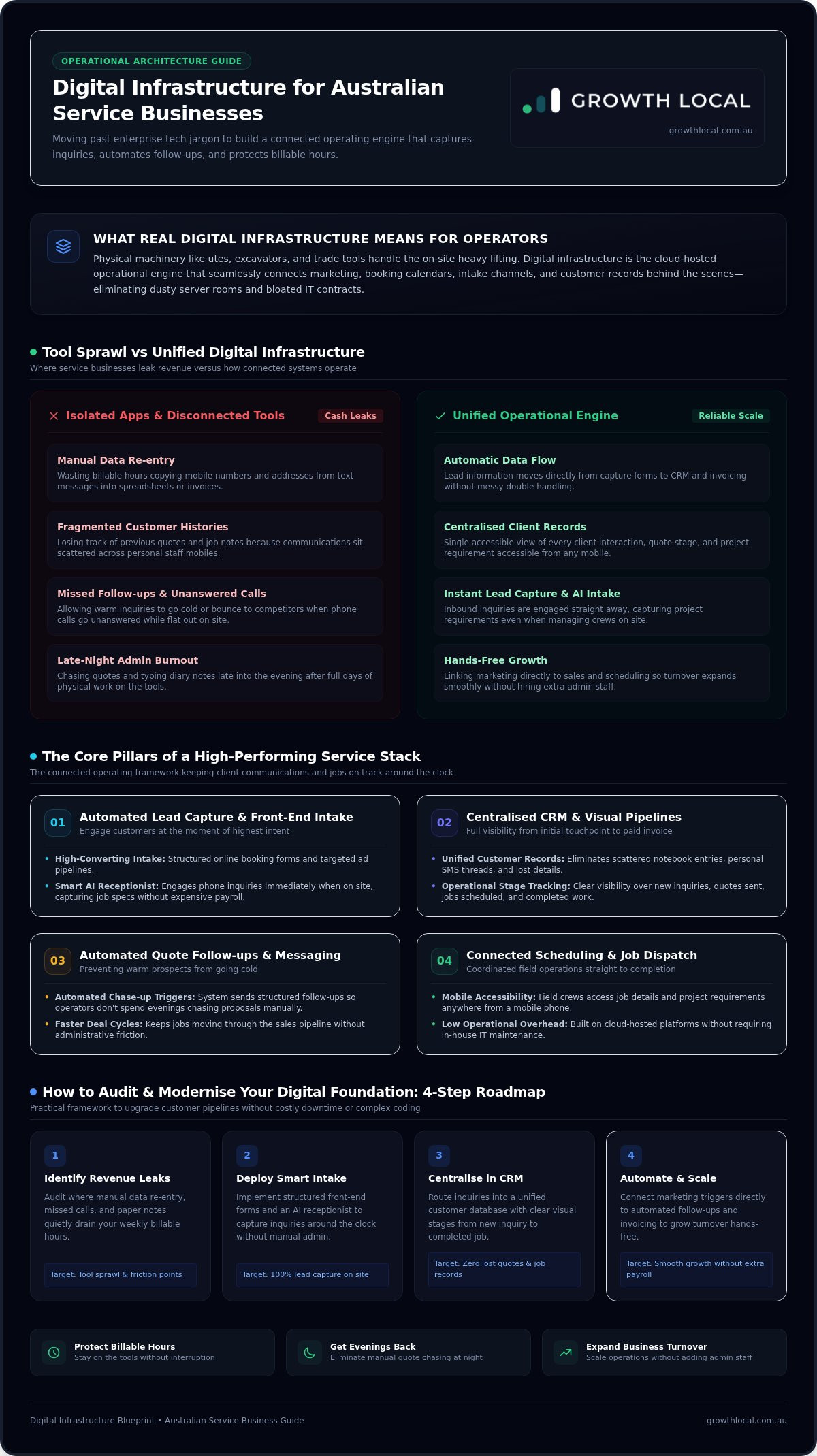
Most business owners don't suffer from a lack of technology. They suffer from tool sprawl. They run one app for invoicing, a separate diary for bookings, paper notes in the vehicle, and customer calls on personal mobiles.
Isolated apps create immediate friction across your working week:
- Manual data re-entry: Wasting billable hours copying phone numbers from text messages into spreadsheets or invoices.
- Fragmented customer histories: Losing track of customer quotes and job notes because communications sit scattered across personal phones.
- Missed follow-ups: Allowing warm prospects to go cold simply because nobody had time to send a manual chase-up text.
Unified digital infrastructure removes these operational bottlenecks. When you integrate your marketing forms, customer records, and messaging tools into a single connected setup, data flows straight from lead capture to final completion without messy double handling.
The 4 Core Pillars of a High-Performing Service Stack
A resilient operating setup doesn't happen by accident. To build truly dependable digital infrastructure for service businesses, you must align four operational pillars that work together around the clock. When these systems talk to one another, your business stops leaking money through administrative cracks and starts operating like a finely tuned machine.
Pillar 1: Automated Lead Capture and Smart Front-End Intake
Winning new work starts at the very first touchpoint. High-converting landing pages, structured online intake forms, and targeted ad campaigns capture customer demand right when intent is highest. But if an inquiry hits an unanswered mobile while you are managing a crew on site, that customer simply dials the next contractor on Google.
Implementing an AI receptionist Australia operators rely on solves this immediate leak. It engages callers straight away, captures project requirements, and logs inquiries without adding expensive administrative payroll.
Pillar 2: Centralised Customer Relationship Management (CRM)
Scribbled notebook pages and messy desktop spreadsheets guarantee lost revenue as your job volume increases. A purpose-built CRM implementation for small business Australia provides a clear, unified view of every prospect and existing client.
Visual pipelines track deals across clear operational stages:
- New Inquiries: Immediate capture from web forms, phone calls, or digital ads.
- Quotes Sent: Total clarity on outstanding proposals awaiting decision.
- Work Scheduled: Live job bookings ready for dispatch without double booking.
- Completed Jobs: Structured records ready for invoicing and review requests.
Pillar 3: Workflow Automation and Rapid Follow-Up Communications
Speed to lead wins jobs. Deploying sales workflow automation Australia businesses use triggers instant SMS confirmations the second an inquiry lands. Automated workflows send timely reminders before quotes expire, follow up with past clients for maintenance checks, and secure higher conversion rates without demanding your evening downtime.
Pillar 4: Unified Analytics and Performance Dashboards
Operating without real-time numbers means guessing your profit margins. A unified dashboard tracks critical health metrics across your operation, including customer acquisition cost, quote conversion rates, and average response times. Seeing your pipeline figures clearly lets you invest marketing dollars into channels that actually deliver paying work.
If you want to see how these integrated components connect in real time, you can schedule a live walkthrough of the system to explore a practical setup built for local trade and service operations.
The Hidden Cost of Disconnected Tools: Where Service Businesses Bleed Cash
Running a company on a patchwork of disconnected software creates an invisible operational tax on your turnover every single day. When tools don't communicate, your business bleeds profit through missed inquiries, slow quote turnarounds, and endless manual admin. Without a coordinated digital infrastructure for service businesses, you end up paying for technology that creates more work instead of eliminating it.
These software cracks trigger expensive day-to-day headaches:
- Missed inbound revenue: Every unanswered call is a high-value customer searching for another provider.
- Late-night administrative burnout: Wasting two to three hours every evening re-entering job details and customer numbers.
- Tanked quote conversion: Taking days to deliver pricing while faster competitors lock in the booking on the spot.
- Scheduling blunders: Mixing up addresses, booking double shifts, or arriving without the right job history, leaving clients furious.
The 5-Minute Window: Why Slow Lead Response Kills Conversion Rates
Speed dictates sales success. Industry sales data consistently shows that responding to an online inquiry or missed call within five minutes dramatically increases your chance of closing the deal. Wait an hour, and your chances plummet.
Australian trade and service contractors face a physical barrier here. You cannot safely stop halfway through installing switchboards, pouring slabs, or fixing pipework just to type out a quote. An automated response workflow bridges that exact gap. It instantly texts the customer, acknowledges their project request, and collects basic job details before the lead ever thinks about looking up a competitor.
Software Bloat and the Subscription Trap: Paying for Redundant Apps
Many business owners get lured into subscribing to half a dozen standalone tools. You end up paying for a form builder, a basic booking calendar, a mass email platform, an SMS blast tool, and a standalone accounting suite. None of them talk to each other without brittle third-party connectors that constantly break.
Every broken sync means lost data, duplicate records, and wasted hours trying to diagnose tech faults yourself. Consolidating these separate subscriptions into a unified digital infrastructure eliminates software bloat, trims monthly operational expenses, and gives your business a rock-solid operational spine that actually works.
How to Audit and Modernise Your Digital Foundation: A 4-Step Roadmap
Modernising your operational setup does not demand months of business disruption, high developer fees, or custom coding. By auditing your current setup methodically, you can build a resilient foundation that runs smoothly whether you are managing six staff on site or taking a well-earned break. Upgrading your digital infrastructure for service businesses boils down to four actionable steps.
Step 1: Map the Entire Journey from Initial Lead to Final Payment
Grab a notepad and trace every physical step a new project takes through your business. Pinpoint the exact moments where someone manually copies customer details, forwards an email, or writes down an address on a scrap of paper. These touchpoints are your biggest operational leaks, showing you precisely where uncontacted prospects drop off and quotes get forgotten.
Step 2: Consolidate Your Channels into a Unified Inbox and CRM
Stop forcing your team to monitor five different messaging apps while juggling calls. Funnel phone inquiries, website contact forms, direct messages, and portal leads into a single platform. Integrating these entry points into a cohesive lead generation system setup Australia operators use gives your team a clear, shared customer record so nobody ever has to guess what was previously quoted.
Step 3: Implement Automated Intake and Instant Follow-Up Triggers
Automate your front door to capture demand the moment it hits. Set up your systems to deliver an immediate SMS confirmation whenever a web form lands, reassuring the prospect that their job request is in hand. Combine this with an intelligent phone assistant to qualify callers and collect basic job specifications while you work. Linking this directly to an online calendar lets qualified clients pick a site inspection slot straight away without endless back-and-forth phone tag.
Step 4: Establish Automated Review and Retention Loops
Your client workflow should not terminate when the final invoice gets paid. Modern digital infrastructure triggers automated review requests via SMS the moment a job status changes to complete. Consistent review collection directly builds your visibility for local SEO for tradies, driving more organic inquiries over time. Concurrently, schedule automated reminders for annual maintenance or seasonal inspections to secure high-margin repeat work without manual chasing.
Building for Scale: How Automated Systems Unlock Hands-Free Growth
Growing a service firm shouldn't force you into an administrative hiring spree. Far too many operators assume that doubling their monthly turnover requires hiring two or three extra office workers to field calls, type out quotes, and send routine updates. Investing in connected digital infrastructure for service businesses changes that equation entirely, turning daily operational chaos into a predictable, scalable system.
Scaling Operations Without Skyrocketing Your Office Headcount
Automated workflows let you take on double or triple your current inquiry volume without increasing office overhead. Instead of funding an additional administrative wage just to keep up with phone messages and schedule site visits, your connected system absorbs the extra workload effortlessly.
Your field technicians receive clean, pre-qualified job details, site instructions, and customer histories straight to their mobiles before leaving the depot. Standardised communication sequences guarantee that every prospect receives immediate confirmations and professional check-ins, eliminating human error. Instead of spending your days putting out administrative fires, you gain the freedom to manage your crew, oversee gross margins, and steer the company forward.
Why Professional Implementation Beats DIY Setup Every Time
Trying to stitch together modern software on your own is an easy trap to fall into. What starts as a quick weekend project often spirals into late nights wrestling with buggy third-party connectors, broken webhooks, and dropped customer inquiries. As a business owner, your hours are far too valuable to spend acting as an unpaid software developer.
Working with experienced specialists ensures your operational engine is built right from day one. You skip the trial-and-error cycle and immediately deploy a dependable digital infrastructure for service businesses tailored specifically to trade and field operations. Review the options on our Growth Local pricing page, or contact Growth Local today to build a system that powers long-term growth.
Take Control of Your Operations and Scale with Confidence
You didn't get into business to spend your evenings untangling messy spreadsheets, chasing overdue quotes, or stressing over missed customer calls. Modernising your operating setup with purpose-built digital infrastructure for service businesses solves those bottlenecks for good. Connecting specialised CRM systems, round-the-clock AI receptionist workflows, and targeted marketing campaigns gives your operation an engine that captures every opportunity automatically.
When routine intake and follow-up communications run reliably in the background, your crew stays focused on delivering quality work on site. You protect your profit margins, deliver a seamless experience to every customer, and scale turnover without adding hefty administrative overhead.
Step off the administrative treadmill and give your company the reliable operating foundation it deserves.
Frequently Asked Questions
What does digital infrastructure mean for an Australian service business?
For Australian trade and service companies, digital infrastructure for service businesses is the connected cloud engine running your daily operations behind the scenes. Instead of physical computer servers or IT racks, it consists of integrated software tools that connect your marketing campaigns, lead capture forms, CRM pipelines, and messaging workflows. It ensures customer inquiries move cleanly into active job schedules without manual paperwork or dropped calls.
Can a small tradie business really benefit from digital infrastructure?
Yes, smaller trade businesses often see the greatest relief. Sole operators and small crews waste hours every week juggling text messages, missed calls, and late-night quotes. Setting up a streamlined operational engine automates intake and customer follow-ups right from the start. That means you capture high-margin jobs while working on site, reduce unpaid admin hours, and present a sharp, professional image that rivals much larger competitors.
How does an AI receptionist fit into our daily digital setup?
An AI receptionist acts as an automated front-of-house intake manager. When your crew is busy on a job or driving between sites, the system answers incoming calls instantly, gathers essential project details, and qualifies the caller. It then syncs this data directly into your CRM and schedules site appointments automatically. You capture every opportunity without the massive payroll overhead of an in-house receptionist.
Do I need to replace all my existing accounting or invoicing software?
Not at all. Modern digital workflows are designed to connect with your core business platforms rather than replace them. Established accounting and invoicing tools like Xero or QuickBooks integrate straight into your CRM and job management pipeline. Won quotes automatically push into your accounting system to generate invoices, eliminating duplicate entries while keeping your financial records and bookkeeping processes completely intact.
How long does it take to implement a complete digital infrastructure system?
Deploying complete digital infrastructure for service businesses usually takes just a few weeks, not months. Because the architecture relies on configured cloud systems and proven automation pipelines rather than bespoke coding from scratch, onboarding moves swiftly. The implementation focuses on mapping your customer journey, connecting communication channels, testing triggers, and training your team without disrupting your daily billable trade operations.
Will my team need extensive technical training to use these new systems?
No, your field technicians won't need to learn complex tech skills. The complex automation runs on the backend, leaving the frontend user experience straightforward. Field teams simply view daily schedules, customer notes, and site addresses directly on their mobile phones through an intuitive app. Most staff become fully comfortable with the daily workflow after a single briefing session.
How does modern digital infrastructure improve our overall customer conversion rate?
It increases conversions by eliminating response delays and keeping communication consistent. Leads receive instant SMS replies and calls get answered immediately, locking in prospects before they contact competitors. Automated quote check-ins prompt clients to approve proposals without requiring you to manually chase them. By standardising rapid communication across every pipeline stage, you turn more inbound inquiries into booked, paying work.


