

CRM for HVAC Business Australia: The 2026 Efficiency Checklist
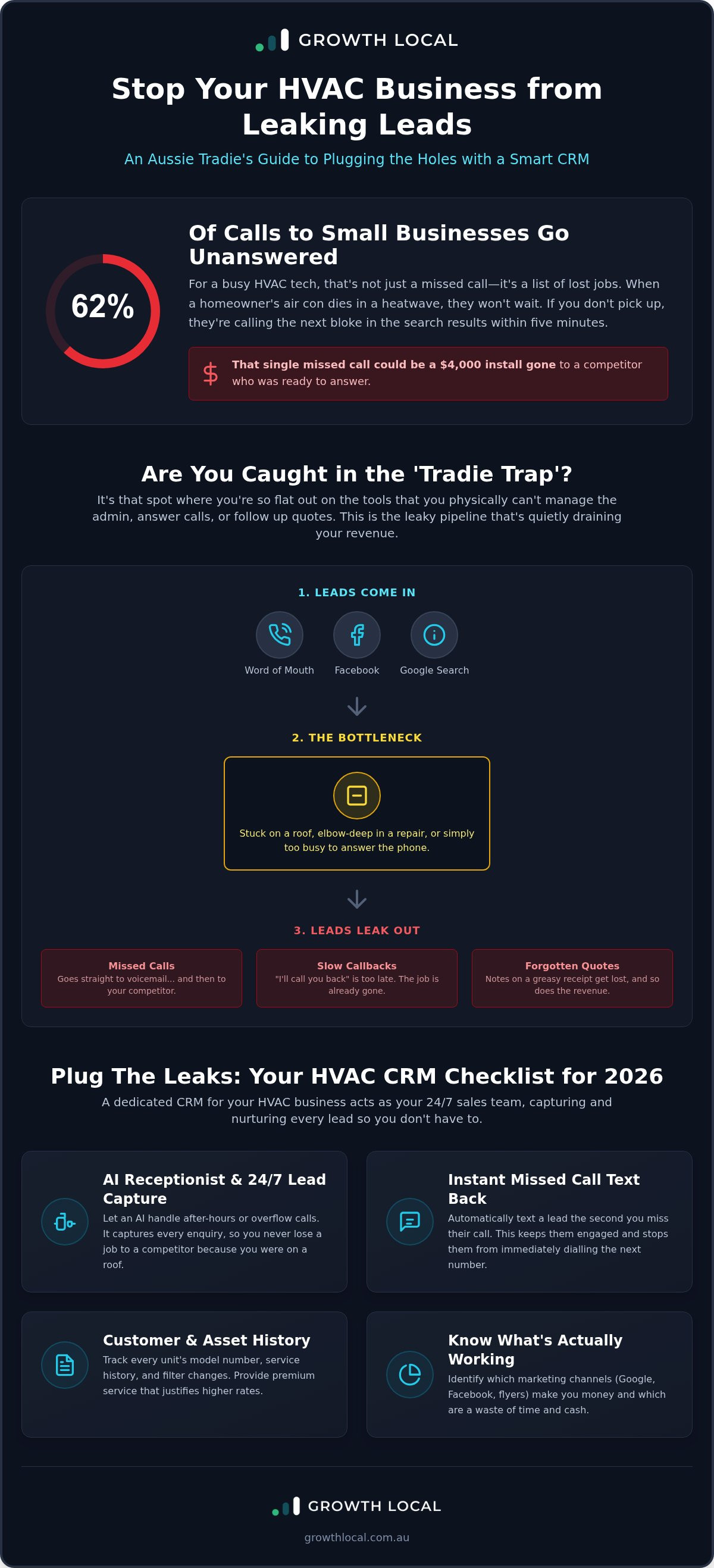
Did you know that 62% of calls to small businesses go unanswered? For a busy HVAC technician stuck on a roof or halfway through a compressor swap, that statistic isn't just a number; it's a list of lost jobs and wasted marketing dollars. You shouldn't have to choose between finishing a repair and winning your next contract. We know the frustration of seeing a missed call notification and knowing that lead has already moved on to the next fridgey in the search results before you've even climbed down the ladder.
Finding the right CRM for hvac business Australia is about more than just storing phone numbers. It's about building a digital infrastructure that captures, nurtures, and closes leads while you're actually doing the work. In this guide, we'll show you how to stop the manual data entry, automate your follow-ups, and finally get some time off the tools without your revenue taking a hit. We're breaking down the 2026 efficiency checklist to help you customise a system that organises your schedule, secures your pipeline, and scales your business.
Key Takeaways
- Identify the hidden costs of missed calls and learn why your current setup might be leaking thousands in potential revenue every month.
- Understand the critical difference between job management and a dedicated CRM for hvac business Australia to ensure your sales pipeline stays full.
- Discover how automated SMS follow-ups and instant lead capture can win you more work while you're busy on-site or off the tools.
- Follow a practical 2026 implementation checklist to audit your lead sources and move your data from old shoeboxes into a streamlined digital system.
- Learn how an AI receptionist can act as your digital apprentice to capture every enquiry 24/7, so you never lose a job to a competitor again.
Why Your HVAC Business is Leaking Leads (and How to Plug the Holes)
Being flat out isn't always the same as being profitable. Many Aussie HVAC owners fall into what we call the "Tradie Trap." It's that stage where you're so busy on the tools that you physically can't answer the phone or reply to emails. Research from 411 Locals shows that 62% of calls to small businesses go unanswered, and in the high-stakes HVAC world, that's a disaster. If you're elbow-deep in a ducted system repair and ignore a call, that's a potential $4,000 install gone to the bloke down the road who actually picked up.
To scale, you have to move past the messy whiteboard and the "I'll remember that later" mindset. Using a professional system for Customer Relationship Management (CRM) allows you to capture data systematically rather than relying on your memory or a pile of greasy receipts. A dedicated CRM for hvac business Australia transforms your operation from a manual hustle into a streamlined machine that captures leads while you're busy on a roof. It stops the "system rot" that happens when leads are forgotten or quotes are sent days too late.
The Problem with "I’ll Call You Back"
When a homeowner's air con dies in the middle of a January heatwave, they aren't going to wait two hours for a callback. They want a solution immediately. If you don't answer, they click the next link on Google within five minutes. This slow response doesn't just lose you one job; it damages your brand reputation. People talk, and if you're known as the fridgey who never calls back, you're capping your growth. Manual follow-up creates a massive bottleneck that keeps you chained to the tools forever.
Visualising a Leaky Pipeline
You might have plenty of work today, but do you know exactly where your leads are coming from? Most tradies can't tell you if their best jobs come from Google, Facebook, or word of mouth. Without tracking, you're just guessing. Implementing a CRM for hvac business Australia helps you identify which marketing channels are actually making you money and which are a waste of time. A leaky pipeline is like trying to fill a bucket with a massive hole in the bottom; no matter how much water you pour in, you'll never keep it full.
The Non-Negotiable CRM Features for Aussie HVAC Pros
Choosing a CRM for hvac business Australia shouldn't be about picking the one with the flashiest dashboard. It's about utility. You need a system that works as hard as your lead tech does. For most Aussie tradies, the biggest bottleneck isn't the work itself; it's the administrative heavy lifting required to actually win that work. Using digital tools to run your business effectively means moving beyond basic spreadsheets and into active automation that handles the grunt work while you're on-site.
A generic CRM won't cut it when you're managing refrigerant handling permits and emergency call-outs. You need specific tools designed for the speed of the Australian trade market. A proper CRM for hvac business Australia acts as your 24/7 sales team, ensuring every enquiry is captured, logged, and followed up without you lifting a finger. This creates a professional image that separates the serious operators from the blokes who are still scribbling notes on the back of a lunch wrapper.
Automated Lead Capture and AI Receptionists
Missed calls are the silent killer of growth in the service industry. If you're busy on-site and can't pick up, an AI receptionist can step in to handle after-hours enquiries or overflow calls. This isn't a robotic voice from the 90s; it's an intelligent system that understands the context of the call. Combined with an "Instant Missed Call Text Back" feature, you can automatically text a lead the second you miss their call. This keeps them engaged and stops them from calling your competitor while you're finishing a compressor swap.
Integrating your phone system directly with your CRM creates a single source of truth for every customer interaction. When a client calls, their entire service history and previous quotes should pop up immediately. This level of technical mastery allows you to provide a premium service that justifies higher rates. It ensures you never walk into a job blind, giving you the upper hand before you even step through the front door.
Service Agreements and Recurring Revenue
Tracking assets and equipment is vital for long-term profitability and business value. Your CRM should maintain a detailed history of every unit you service, from the model number to the last filter change. This data allows you to automate seasonal maintenance reminders for the summer and winter rushes. You can fill your "shoulder months" with pre-booked service jobs, ensuring your technicians aren't sitting idle when the weather is mild. This creates a predictable income stream and builds a database with real value if you ever decide to sell the business.
Don't let your quotes die in a customer's inbox. Most people need a nudge before they say "yes", but manually chasing every quote is a massive time sink. Automated quote reminders take the awkwardness out of chasing money and ensure you aren't leaving thousands on the table simply because you forgot to follow up. If you want to see how this looks in practice, you can book a quick walkthrough to see the automation in action.
CRM vs. Field Service Management: What Do You Actually Need?
One of the biggest mistakes we see in the Aussie trade market is blokes trying to use their job management software to do their marketing. It's a bit like trying to fix a split system with a hammer; it’s the wrong tool for the job. While Field Service Management (FSM) tools are brilliant for the operational side of things, they often fall short at winning new business. A dedicated CRM implementation for small business Australia focuses on the top of your funnel, ensuring you actually have jobs to put into your FSM in the first place.
The Australian Government recognises this digital gap through initiatives like the Digital Solutions program, which helps small businesses adopt the right software. For an HVAC business, the 'Best of Breed' approach is usually the winner. This means using a powerhouse CRM for hvac business Australia to capture leads and automate follow-ups, then pushing those won jobs into your FSM for scheduling and invoicing. This integration creates a seamless data flow that stops information from falling through the cracks between the office and the van.
When a CRM is the Priority
If your phone isn't ringing or your technicians are sitting idle, you don't have an operations problem; you have a lead generation problem. A CRM is your priority when you need to focus on lead conversion and customer reactivation. It allows you to run targeted email or SMS campaigns to your existing database, reminding them to book a service before the summer heatwave hits. This proactive marketing is something a standard FSM simply isn't built to handle. You need a system that actively hunts for work rather than just recording it.
When an FSM is the Priority
Once your pipeline is overflowing, you need a way to manage the chaos. An FSM becomes the priority when you're juggling multiple technicians, complex multi-day installs, and wholesale supplier integrations. It’s built for detailed job costing, tracking technician timesheets, and generating on-site invoices. While the CRM wins the work, the FSM ensures the work is done efficiently and you actually get paid for it. Both tools are essential, but they serve completely different purposes in a growing HVAC business.
The Ultimate HVAC CRM Implementation Checklist for 2026
Setting up a CRM for hvac business Australia isn't a weekend hobby; it's a strategic overhaul of your digital infrastructure. You can't just buy a subscription and hope for the best. To actually see a return on your investment, you need a systematic approach to moving your data from the dashboard shoebox into a structured digital format. This process requires you to audit your lead sources, map your sales journey, and ensure your tech stack actually talks to each other.
Success depends on the "boys on the tools" actually using the system. If your technicians find the software clunky or too technical, they'll revert to paper notes and the whole system will collapse. Clean your data before you start. This means merging duplicate contacts, updating old phone numbers, and categorising customers by the equipment they have installed. Once your data is organised, you can focus on the specific steps that turn a database into a revenue engine.
Step 1: The Lead Capture Audit
Identify every single point where a customer can contact you. This includes your website forms, Facebook Messenger, Google Business Profile, and even the phone number on your van. Test your current response time by having a mate send an enquiry and see how long it takes for someone to reply. Be honest with yourself about the results. Response time is the single most important factor in conversion because modern customers value immediate solutions over brand loyalty.
Step 2: Automating the "Grunt Work"
Most HVAC leads die because of poor follow-up. Implement the "3-7-14" rule for your quotes: an automated SMS or email nudge sent three days after the quote, seven days after, and a final check-in at fourteen days. This persistence wins jobs without you having to manually chase every homeowner. Using an AI receptionist allows you to qualify these leads instantly, filtering out the tyre-kickers from the high-value emergency repairs.
Create templates for common HVAC enquiries like regassing, winter servicing, or ducted system installs. Having these ready to go means your office staff or the AI can provide professional, consistent information every time. This level of automation frees you from the laptop and lets you focus on the technical work that actually pays the bills. It ensures your business keeps moving even when you're off the tools or taking a well-earned break.
Scaling Your HVAC Business with Growth Local’s Automation Systems
Building a million-dollar HVAC operation requires more than just technical skill on the tools; it requires a robust digital infrastructure. You can't scale a business if you're still the one manually texting every lead or chasing every overdue invoice. At Growth Local, we specialise in building the engine that runs behind the scenes. We customise every CRM for hvac business Australia to match the specific workflows of the local trade market, ensuring your software supports your growth rather than slowing you down.
Our "Done-For-You" approach means you don't have to spend your weekends playing IT support. We handle the heavy lifting of the setup, migration, and integration. By implementing GoHighLevel for tradies, we provide you with a high-performance sales engine that captures leads, automates follow-ups, and manages your reputation on autopilot. This allows you to focus on high-level strategy and technician management while the system handles the grunt work of lead nurturing.
Our Result-Oriented Framework
We don't care about vanity metrics like "clicks" or "impressions" if they don't lead to booked jobs. Our framework focuses on tangible outcomes like technician utilisation and actual ROI. If your team isn't consistently booked out, we look at the data to see where the bottleneck is. We handle the technical complexity of CRM migration, ensuring your historical data is moved safely into your new system. As your business grows, we provide ongoing support to customise your automation, making sure the system evolves alongside your team and your revenue targets.
Ready to Stop Chasing Your Tail?
The transition from a small team to a dominant local player starts with a decision to stop doing everything manually. In 2026, the gap between the top HVAC firms and the rest is defined by their level of automation. If you're tired of missed opportunities and late nights in front of a laptop, it's time to build a system that works as hard as you do. Reclaiming your time is the first step toward maximising your profit and finally getting off the tools for good.
Book a free strategy session with Growth Local
Stop Leaking Profits and Start Scaling Your HVAC Empire
Running a successful trade business shouldn't mean being tethered to your phone 24/7. We've explored how the right CRM for hvac business Australia acts as a digital apprentice; capturing leads while you're on a roof and chasing quotes while you're asleep. By plugging the holes in your lead pipeline and automating the grunt work, you move from just having a job to owning a scalable asset that doesn't rely on your constant manual input.
Growth Local specialise in no-nonsense Aussie tradie systems that actually deliver physical results. We are AI receptionist experts who understand the heavy lifting involved in running a service business. Our team handles the implementation from start to finish, so you won't spend your weekends frustrated with software settings. It's about building a professional image that wins premium jobs and finally gives you back your freedom from the admin desk.
It's time to stop chasing your tail and start building the digital infrastructure your business deserves. Take the first step toward a more profitable and organised future today. You've done the hard work on the tools; now let's make the technology work for you. Your future self will thank you for the extra time off.
Frequently Asked Questions
What is the best CRM for an HVAC business in Australia?
Finding the right CRM for hvac business Australia means looking for a platform that specifically addresses the conversion gap by capturing leads instantly. Growth Local specialises in GoHighLevel implementations for tradies because it combines marketing automation with lead management. You need a system that organises your pipeline and integrates with an AI receptionist to ensure no call goes unanswered. It's about finding a platform that handles the sales heavy lifting.
How much does it cost to set up a CRM for a small HVAC company?
Costs vary depending on the complexity of your automation and the level of customisation required for your specific workflows. Rather than looking for the cheapest option, focus on the return on investment through recovered missed calls and automated quote follow-ups. A professional CRM for hvac business Australia is an investment in your digital infrastructure. We recommend booking a strategy session to get a clear picture of the specific setup required.
Will a CRM help me get more air conditioning service jobs?
Yes, by capturing every enquiry automatically and reacting instantly to new leads. A CRM allows you to reactivate your existing database with seasonal maintenance reminders, turning one-off repairs into recurring service agreements. Instead of waiting for the phone to ring during a heatwave, you can use automated SMS and email campaigns to fill your schedule during the shoulder months. It ensures you're proactive rather than reactive with your marketing.
Can I integrate my CRM with Xero or MYOB?
Most modern CRM systems integrate seamlessly with major Australian accounting platforms like Xero and MYOB. This connection ensures that once a job is won and completed, the data flows directly into your invoicing system without manual entry. It reduces administrative errors and saves hours of office work every week. We focus on building a tech stack where your tools actually talk to each other to maintain efficiency and data accuracy.
Do my technicians need to be tech-savvy to use a CRM?
No, the system should be designed to be as simple as possible for the boys on the tools. A well-implemented CRM handles the complex backend automation so the frontend remains user-friendly. Technicians only need to interact with basic features like status updates or photo uploads. If the system is too complicated, it won't be used; which is why we prioritise no-nonsense interfaces that don't require an IT degree to navigate.
What is the difference between a CRM and Job Management software?
A CRM is built for sales, marketing, and lead conversion, while Job Management software focuses on operations, scheduling, and invoicing. Most HVAC pros try to make their job management tool do a CRM's job and end up losing leads. You need a CRM to win the work and a job management tool to execute it. Combining both creates a complete business engine that handles the entire customer journey from first contact.
How long does a CRM implementation actually take?
A professional setup typically takes a few weeks to fully customise and test before your team goes live. This timeframe allows us to map your sales process, clean your existing data, and integrate tools like an AI receptionist. We handle the heavy lifting of the migration to ensure a smooth transition. Rushing the process often leads to system rot, so we take the time to build a robust foundation for your growth.
Can a CRM help with my HVAC seasonal marketing?
Absolutely, seasonal marketing is where a CRM truly pays for itself. You can segment your database to send automated service reminders before the summer and winter rushes hit. This keeps your technicians busy during the quieter months and ensures your customers aren't left in the lurch when the weather turns. It's the most efficient way to build recurring revenue and maintain a consistent presence in your market without manual effort.


