

Automated Customer Intake Systems: The 2026 Guide and Implementation Template
Your intake process shouldn't just be a digital filing cabinet; it is an active qualification engine that either wins jobs or sends good clients straight to your competitors. If you've spent half your week playing phone tag while out on the tools, or watched hot leads go cold because an enquiry sat in your inbox, you already know the grind. Modern automated customer intake systems eliminate this friction by turning clunky web forms and missed calls into structured, immediate job bookings.
No business owner wants to waste hours chasing missing site photos, incomplete addresses, or double-handling data between emails and messy spreadsheets. You need a reliable setup that captures, qualifies, and logs customer details within seconds. In this 2026 guide, you'll discover how automated customer intake systems eliminate phone tag, qualify service leads instantly, and streamline client onboarding. We'll break down the core mechanics and hand you an implementation template to get your operations running like clockwork.
Key Takeaways
- Learn how modern automated customer intake systems capture qualified job data instantly, ending the frustrating cycle of phone tag and lost prospects.
- Discover how deploying smart intake channels, from dynamic forms to conversational AI receptionists, ensures you capture every enquiry even while you are out on the tools.
- Master a battle-tested five-stage framework that guides new clients from initial contact straight into a structured quote or booking.
- Identify and fix friction points, such as clunky multi-step forms and isolated inboxes, that cause potential clients to bail out to competitors.
- See how connecting your front-end intake directly to a tailored CRM setup eliminates double-handling and boosts job conversion rates across the business.
What Are Automated Customer Intake Systems and Why Manual Onboarding Fails
An intake process is the bridge between a prospect showing interest and paying for your services. At its core, an automated customer intake system captures, validates, and routes incoming enquiries without human intervention. Instead of forcing prospects to wait around for a manual callback, these platforms collect essential project details, filter out poor-fit enquiries, and plug structured records straight into your operational pipeline. In modern service businesses, applying the principles of Business Process Automation (BPA) to front-end intake transforms lead capture from a bottleneck into a dependable growth driver.
Manual onboarding fails because human bandwidth has hard limits. When you rely on scribbled notes, static paper forms, or messy email threads, balls get dropped. Teams spend five or more hours per client chasing down basic job specifications, site photos, or billing information. That wasted admin time stalls your pipeline and creates immediate friction for clients who just want their problems solved quickly.
The True Business Cost of Slow Lead Response
Speed wins jobs. Most Australian prospects hire the first business that delivers a coherent, professional response. Playing phone tag drains productive daytime hours from actual billable trade operations, leaving you exhausted by dinner time.
- Diverted revenue: Unanswered calls during peak hours push high-value enquiries straight to competing businesses down the road.
- Slower pipeline velocity: When basic intake drags over three days, quote acceptance rates plummet because buyer momentum evaporates.
- Wasted marketing spend: Pouring money into ads only to funnel prospects into an unattended voicemail is burning cash.
Core Pillars of an Automated Intake Workflow
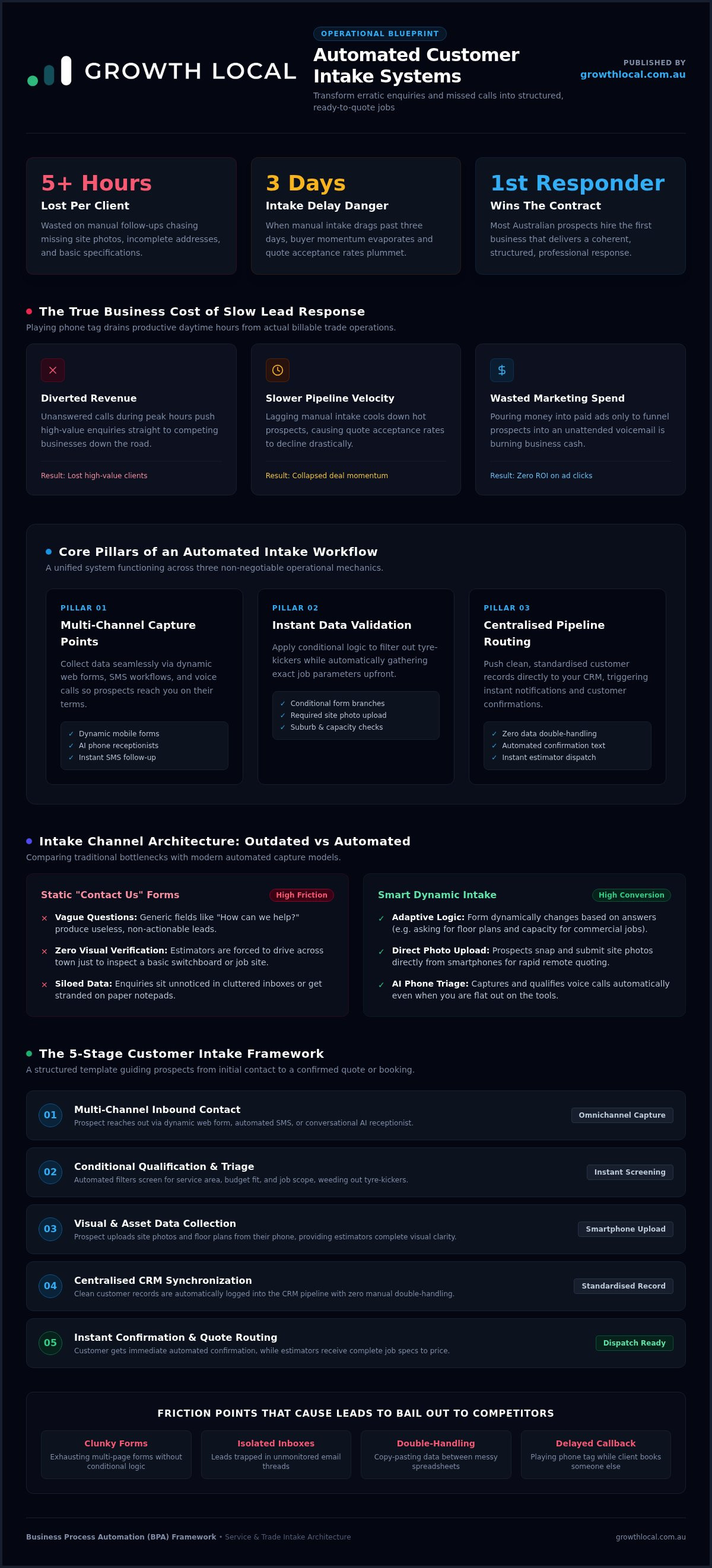
Well-engineered automated customer intake systems do not rely on a single, isolated contact widget. They function as an integrated machine across three fundamental pillars:
- Multi-channel capture points: Collect data seamlessly via dynamic web forms, SMS workflows, and voice calls so prospects can reach you on their terms.
- Instant validation: Apply conditional logic to filter out tyre-kickers while gathering exact job parameters upfront.
- Centralised routing: Push clean, standardised customer data straight into your operational CRM, triggering instant notifications and immediate confirmation messages to the customer.
Setting up this underlying digital infrastructure turns erratic enquiries into orderly jobs ready for quoting or dispatch.
Evaluating Modern Intake Channels: Forms, Portals, and AI Receptionists
Every customer prefers a different front door. One homeowner wants to type their problem into a contact page during lunch, while another wants to pick up the phone right now because water is leaking through their ceiling. Evaluating modern intake architecture requires balancing capture speed with operational convenience, ensuring no profitable job slips through the cracks. Unifying these separate touchpoints into a coherent pipeline requires robust digital architecture across your entire business.
Competitors often treat intake as nothing more than a static website widget. That is a massive blind spot. Public sector case studies on automating customer service with AI show that real efficiency gains come from multi-channel triage, not isolated tools. High-converting automated customer intake systems blend conversational phone triage, dynamic web forms, and self-service scheduling into one connected pipeline.
Dynamic Web Forms vs Static Online Contact Pages
Old-school contact pages ask vague questions like "How can we help?" and deliver useless leads. Dynamic forms, by contrast, use smart conditional logic to adapt in real time based on what the prospect selects. If a customer clicks "Commercial Air Conditioning", the form immediately asks for floor plans, system capacity, and site access constraints.
Mobile-responsive forms also let clients snap and upload site photos directly from their smartphones. This simple step gives your estimators the exact visual data they need to price jobs accurately without driving across town just to look at an electrical board.
AI Phone Receptionists for Immediate Voice Intake
Most trade and service providers miss their best calls while operating noisy machinery or driving between jobs. Human call centres are often expensive and lack the trade knowledge needed to screen complex work. Integrating a dedicated AI receptionist provides an immediate, conversational answer to incoming callers.
Advanced speech-to-text models parse conversational voice enquiries, extract caller details, determine urgency, and log structured data straight into your job pipeline. It captures the lead on the spot, reassuring the caller that their job is logged while you stay focused on the tools.
Self-Service Booking and Triage Portals
Giving prospective clients direct access to your availability cuts out three rounds of back-and-forth emails. Modern triage portals allow pre-qualified leads to lock in site visits or quotes against your live diary.
- Card-on-file capture: Securing upfront call-out fees or deposits significantly slashes costly no-shows and last-minute cancellations.
- Instant SMS confirmations: Automated confirmations and calendar invites reassure the client that their booking is confirmed.
If you want to see how these intake channels plug directly into your daily operations, you can explore Growth Local's complete solutions at Growth Local to streamline your pipeline today.
The 5-Stage Customer Intake Framework: A Practical Template
A bulletproof intake system moves enquiries systematically from initial greeting to booked job without dropping critical details along the way. While tech theorists often push complex enterprise governance models, real-world service operations need a reliable, step-by-step workflow that works under daily operational pressure. Research from enterprise technology leaders highlights that streamlining the onboarding journey through systematic automation cuts operational drag while sharply lifting client satisfaction. Applying a structured five-stage framework guarantees predictable, repeatable client onboarding across every job you take on.
Well-built automated customer intake systems use each sequential phase to validate, filter, and enrich prospect information before your staff ever lifts a finger. Standardising this exact pipeline gives your team clear operational visibility while removing friction for prospective customers.
Stages 1 and 2: Multi-Channel Capture and Instant Triage
Stage 1 activates the moment an enquiry lands. Whether the lead comes from a dynamic web form, a direct SMS, or an inbound voice call handled by an AI receptionist, the system instantly triggers an automated acknowledgement via text and email within seconds. This rapid response assures the prospect that their request is safely in hand.
Stage 2 conducts instant automated triage. The workflow evaluates postcodes, job categories, timeline urgency, and project scope against your operational criteria. Unqualified leads or jobs outside your service radius are politely redirected or tagged immediately, preventing your estimators from wasting valuable quoting hours on tyre-kickers.
Stages 3 and 4: Smart Data Gathering and Pipeline Assignment
Stage 3 handles data enrichment. Instead of forcing prospects through a clunky 20-field questionnaire upfront, the system sends an automated mobile prompt requesting essential supporting files, site photos, or switchboard pictures only after the enquiry passes Stage 2 qualification.
Stage 4 automatically maps the enriched job card directly into your pipeline. The system assigns the deal to the appropriate technician or project manager based on skill set, job type, and team availability, ensuring seamless operational handoffs.
Stage 5: Booking Confirmation and Automated Pre-Job Briefing
The final stage locks in the booking and preps both sides for execution. It syncs the appointment directly with your live calendar, issues an itemised confirmation, and triggers automated SMS reminders to virtually wipe out last-minute customer no-shows.
At the same time, the system dispatches automated preparation instructions to the customer, telling them exactly how to prepare access, secure pets, or clear work areas before the crew arrives on site. Your field team receives a complete, standardised job card packed with photos and scope notes, ready to quote or start work immediately.
Overcoming Common Implementation Mistakes and Friction Points
Automating your intake can transform your cash flow, but over-engineering the workflow will kill your conversion rates overnight. When businesses treat onboarding like an interrogation, prospects simply close the browser tab. Industry research reveals that 63% of customers evaluate a company's onboarding experience when deciding whether to buy, and 74% will head straight to a competitor if that process feels too difficult. Designing successful automated customer intake systems requires stripping away unnecessary steps so prospects can book work effortlessly.
Another silent killer is operational fragmentation. A brilliant front-end questionnaire does nothing for your bottom line if the submitted information sits isolated in a web app, completely detached from your dispatch diary and quoting software. Reviewing your conversion drop-off points each month shows you exactly where potential clients get stuck, allowing you to fine-tune each touchpoint for maximum throughput.
Preventing Customer Drop-Off from Form Fatigue
Asking twenty detailed questions right off the bat guarantees high abandonment. Restrict your initial capture strictly to what is essential for initial contact: name, phone number, general location, and the core issue. Once the lead is secured in your pipeline, you can use progressive profiling to collect secondary project specifications.
- Fewer fields upfront: Keep stage-one digital forms down to four or five core fields to maximise completion rates.
- Mobile performance: Ensure intake portals load in under two seconds on 4G networks and let users upload photos straight from their phone camera.
- Conversational tone: Ditch dry, bureaucratic jargon. Use friendly, direct prompts that reassure prospects their job will be sorted promptly.
Bridging the Gap Between Front-End Intake and Field Operations
The biggest technical breakdown happens between what the customer types and what your technicians see on site. When forms do not map directly into your backend CRM, office staff get bogged down copying and pasting details across multiple open tabs. This manual handling creates errors, delays job starts, and frustrates tradespeople in the field who turn up without gate codes or scope notes.
Solving this requires real-time two-way synchronisation. Intake responses must automatically populate client profiles, dispatch boards, and accounting records without human intervention. Establishing these robust workflows keeps your office staff and field technicians completely aligned from day one.
Speak with Growth Local about streamlining your intake workflows
Deploying High-Performing Intake Systems with Growth Local
Setting up a modern qualification pipeline shouldn't require hiring an army of software developers or juggling six different software subscriptions. Growth Local builds tailored digital infrastructure and marketing workflows designed specifically for Australian service operators. We eliminate technical headaches by setting up seamless CRM pipelines and conversational AI receptionists that handle customer enquiries reliably from day one.
Our solutions capture, qualify, and route leads around the clock without manual intervention. Instead of wasting your evenings chasing missing customer details or typing notes into disconnected apps, our setups manage the heavy administrative lifting automatically. That leaves you free to focus on quoting, completing jobs, and growing your bottom line.
Tailored Automation Built for Australian Service Providers
Generic, off-the-shelf software templates often fail because they don't match how your business actually runs out in the real world. We configure workflows that reflect the operational reality of your specific trade, connecting inbound marketing campaigns directly to your quoting pipelines. Whether prospects find you through paid advertising or organic search, every enquiry enters a unified capture engine.
By synchronising high-converting web forms with intelligent voice intake, our automated customer intake systems ensure you never miss a genuine opportunity while on the tools. Clean job records land straight into your operational pipeline, ready for rapid dispatch without any messy double-handling.
Reclaim Your Time and Scale Your Operations
Switching from scattered manual messages to systematic automation brings immediate operational relief. Instead of dealing with constant phone tag and half-filled enquiries, you wake up to fully qualified, scheduled appointments booked cleanly into your calendar. The friction disappears, quote response times accelerate, and lead-to-job conversion rates climb across the entire business.
- Consistent data capture: Gather site photos, project dimensions, and job scopes before you even pick up the phone.
- Better customer experience: Impress clients with immediate confirmations, automated SMS updates, and effortless digital booking.
- Reliable scaling: Handle sudden spikes in lead volume without adding administrative headcount or dropping customer service standards.
Take a look at our transparent pricing packages to find the right operational fit for your business. When you are ready to remove the administrative bottleneck and build a reliable intake engine, contact Growth Local to get your system up and running.
Transform Your Customer Onboarding Into a High-Converting Engine
Relying on manual callbacks, scribbled phone notes, and chaotic email threads is a surefire way to cap your business growth. Modern service operators gain an unbeatable edge by deploying automated customer intake systems that capture, qualify, and book jobs within seconds. When your intake pipeline operates seamlessly, you cut out phone tag, capture every inbound opportunity, and deliver an effortless experience that keeps clients coming back.
Growth Local builds proven digital infrastructure tailored specifically for Australian trade and service operations. From bespoke CRM pipelines to turnkey AI receptionist technology, we build systems that handle the heavy administrative lifting so you can focus on running your jobs.
Taking control of your intake today gives you back hours of personal time every week while driving higher job conversion across your business.
Frequently Asked Questions
What is an automated customer intake system?
An automated customer intake system is a digital workflow that captures, qualifies, and routes new enquiries without requiring manual data entry. Instead of relying on paper forms or scribbled notes, it collects customer contact info, project specifications, and job urgency automatically. The data gets validated instantly and funnelled into your operational CRM pipeline, triggering instant confirmations and scheduling tasks for your team without administrative delays.
Will automated intake systems make my business feel impersonal to customers?
No, automated intake actually improves personal customer connection by removing frustrating delays and forgotten callbacks. Australian homeowners and business owners appreciate prompt, clear communication when they reach out for help. By delivering immediate acknowledgements, conversational text messages, and easy calendar bookings, your business looks attentive and organised. Your team can then focus entirely on delivering exceptional hands-on service once you arrive on site.
How quickly does an automated intake system respond to new customer enquiries?
A properly configured system responds within seconds of an enquiry being submitted across web forms, text messages, or phone calls. Immediate automated SMS or email confirmations reassure prospects that their request has been logged and is under review. This instant engagement prevents prospective clients from continuing their search and hiring a competing local provider while waiting for someone in your office to call back.
Can an automated customer intake workflow handle phone calls as well as online forms?
Yes, modern automated customer intake systems handle inbound voice calls seamlessly using AI receptionist technology. When you cannot pick up because you are working on site or driving, the conversational AI answers naturally, captures caller details, assesses job urgency, and logs the audio transcript directly into your CRM pipeline. This means you never lose high-value inbound calls to unattended voicemails again.
Do I need to replace my existing CRM to use automated customer intake?
Not necessarily, because modern automation workflows can integrate directly into most established CRM and field management platforms. The goal is to bridge front-end lead generation channels with your existing operational software. Growth Local evaluates your current tech stack to build custom connections, ensuring clean intake data synchronises straight into your dispatch diaries, customer records, and quoting pipelines without requiring a costly overhaul.
How does automated intake help filter out unqualified leads and tyre-kickers?
Automated intake uses conditional logic and smart qualification rules to screen incoming enquiries before they reach your calendar. The workflow checks postcodes against your service area, asks budget or scope questions, and identifies job timelines. Enquiries that fall outside your target criteria receive polite automated redirections, saving your estimators hours of wasted travel time and unpaid site visits each week.
What happens if a customer enquiry contains incomplete or incorrect details?
The system detects missing information automatically and triggers automated follow-up prompts to collect what is needed. If a prospect submits an enquiry without uploading site photos or specifying a site address, an immediate SMS requests those details before booking confirmation. This progressive data collection ensures your field team receives complete, actionable job cards before quoting or setting foot on the property.


